Coercion does not necessarily arrive with soldiers and weapons in the grammar of interstate conflicts. More frequently, and with growing complexity, it comes through the more subdued machinery of sideways-bending institutions, infrastructure hastened during diplomatically delicate times, and legal manoeuvres intended to convey intent while maintaining the illusion of restraint. In South Asia, where two nuclear-armed states have spent seven decades managing the same rivers they spent the same period refusing to trust each other, water has become precisely this kind of instrument; a domain of pressure that is plausibly deniable, structurally consequential, and tuned to the frequencies of crisis. What had long been an analytical suspicion among South Asian security scholars became an empirical fact after India declared on April 23, 2025, that the Indus Waters Treaty of 1960 was to be held “in abeyance” in the wake of the Pahalgam attack: water had officially entered the coercive toolkit of sub-conventional conflict between India and Pakistan. This article makes the case that what we are seeing is a pattern rather than an exception, one that has critical ramifications for Pakistan’s long-term national resilience, water diplomacy, and strategic planning, and necessitates a new conceptual vocabulary to adequately define it.
To understand what is new about the current moment, one must first understand what Cold Start was designed to do, and why Water Start, as a parallel concept, is analytically necessary. India’s Cold Start doctrine, developed in the early 2000s following the Kargil conflict and the 2001 Parliament attack crisis, was a response to a specific strategic problem: how to conduct a punishing conventional military operation against Pakistan quickly enough to achieve meaningful objectives before the international community intervened to impose a ceasefire, while remaining calibrated enough not to cross Pakistan’s nuclear red lines. As Walter Ladwig’s foundational analysis in International Security established, Cold Start envisions Integrated Battle Groups conducting rapid, shallow thrusts into Pakistani territory, offensive enough to inflict costs, limited enough to deny Pakistan the justification for nuclear escalation. Its logic is the logic of calibrated pressure: impose real pain below the threshold of catastrophic response.
Water Start operates on identical logic but in a different domain. It refers to the intentional use of water-related instruments: treaty suspension or reinterpretation, acceleration of upstream infrastructure construction during crises, selective flow restriction or manipulation, denial of hydrological data, legal contestation through international mechanisms, and strategic narrative construction, as tools of coercive pressure and crisis signalling during sub-conventional conflicts. Like Cold Start, Water Start is designed to impose real costs on Pakistan while remaining below the threshold that would trigger a catastrophic or nuclear response. Like Cold Start, it exploits a structural asymmetry: just as India’s conventional military superiority creates the space for limited offensive action, India’s upstream riparian position on the western rivers creates the space for water coercion. And like Cold Start, it functions most powerfully not through its actual implementation but through the credible threat of implementation, the knowledge, on Pakistan’s side, that the instrument exists and has been used before.
Water Start is not possible without a prior structural condition: hydrohegemony. Zeitoun and Warner’s foundational framework in Water Policy defined hydro-hegemony as the capacity of an upstream riparian state to control transboundary water resources through a combination of geographic advantage, superior infrastructure capacity, greater international diplomatic standing, and narrative authority over how the river and its management are framed. All four requirements are met by India’s location in the Indus basin. The sources of the two rivers most significant to Pakistan’s western Punjab and Sindh, the Jhelum and Chenab, originate in or travel through Indian-administered territory before they cross the Line of Control. India has spent decades constructing hydropower infrastructure on these rivers, such as the Kishanganga project on the Jhelum tributary, the Ratle project on the Chenab, and several smaller run-of-river plants that collectively make up a sizable infrastructure with the potential to manipulate flow. The non-consumptive use clauses of the treaty provide for the individual defence of each of these initiatives. India is in charge of the hydrological data for these upper reaches, which Pakistan requires to manage its reservoirs, plan its agricultural calendar, and predict seasonal droughts and floods. And India has, since the Uri episode in 2016, successfully introduced into public discourse the frame that water is a legitimate instrument of counter-terrorism pressure; a narrative that, repeated through enough official channels, begins to normalise what international water law explicitly prohibits.
The pattern of Water Start is most clearly visible when three crisis episodes are examined in sequence. After the Uri attack of September 2016, in which militants killed eighteen Indian soldiers at an army base in Kashmir, Prime Minister Modi convened a meeting of the Indus Waters Commission and publicly declared that “blood and water cannot flow together.” India announced it would expedite construction of projects on the western rivers and explore whether existing treaty provisions on storage and pondage could be reinterpreted to increase India’s water use. No immediate physical diversion occurred, but the political signal was unmistakable: water had been explicitly linked to the terrorism dossier, and the treaty’s sanctity had been publicly questioned at the highest level of Indian government for the first time in its fifty-six-year existence. The water instrument had been brandished, even if not deployed.
In the weeks that followed the Pulwama bombing and the Indian Air Force’s strike on Balakot in February 2019, India announced that it would expedite the release of water from the Ranjit Sagar Dam on the Ravi River into the Arabian Sea. This water was described by India as “going to waste,” but under different political circumstances, it could have been redirected toward India’s own agricultural use, reducing downstream flow to Pakistan. India’s Water Minister simultaneously announced plans to divert the remaining flow of the Beas, Ravi, and Sutlej, the three eastern rivers allocated to India under the treaty, entirely away from Pakistan. Legally, this was within India’s treaty rights. Temporally, its announcement within days of the Balakot strike was not a coincidence. The water instrument had been calibrated to the crisis timeline.
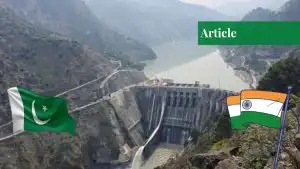
The 2025 episode represents the most significant escalation to date. Following the Pahalgam attack on April 22, the Indian Cabinet Committee on Security announced on April 23 that the Indus Waters Treaty would be held “in abeyance.” — This term is absent from the treaty text and has no standing in international water law. The American Review of International Arbitration at Columbia Law School examined in February 2026 that the word “abeyance” was carefully chosen because it sounds less absolute than “suspension” or “termination,” creating intentional legal ambiguity while accomplishing the practical effect of declaring the treaty inoperative. India’s Ministry of Jal Shakti notified Pakistan formally, citing cross-border terrorism as a fundamental change in circumstances under the Vienna Convention — an argument the Washington International Law Journal found legally tenuous, given that neither the VCLT nor the IWT provides for unilateral abeyance. The Permanent Court of Arbitration subsequently affirmed that the treaty remained in force and that there was no legal basis for India’s declaration. India rejected the PCA’s jurisdiction as “illegal and void.” As of April 2026, Chatham House reported that no agreement to restore the treaty had been reached, despite the May 2025 ceasefire. The treaty’s operational status remains in a condition of deliberate, legally contested uncertainty, which is, from a coercive standpoint, precisely the point.
Each of these three episodes reflects a process that securitisation theory, developed by Buzan, Wæver, and de Wilde at the Copenhagen School, describes as a “speech act” that elevates an issue from the domain of ordinary politics into the register of existential security threat. Modi’s “blood and water” declaration in 2016, Jal Shakti’s formal notification in 2025, the accelerated construction announcements timed to crisis moments, all of these are discursive performances that do something beyond merely describing a policy position. They constitute water as a security issue, simultaneously legitimising coercive water action and establishing that Pakistan’s water survival is contingent on its counter-terrorism behaviour. This framing is not incidental. It transforms the IWT from a technical bilateral water management agreement into a conditional offer that India can withdraw on political grounds, a transformation that, if accepted by the international community’s silence, sets a precedent of profound danger for every downstream riparian state in Asia.
Pakistan securitises water in the opposing direction: as an existential vulnerability rather than a sovereign asset. This opposing securitisation is analytically accurate but strategically incomplete. The Pakistani state has been slow to translate its genuine water crisis, ranked fourteenth among the world’s seventeen most water-stressed nations, with only thirty days of storage against an international benchmark of one hundred and twenty, and approximately ninety-five percent of freshwater consumption concentrated in agriculture, into a sustained and coherent diplomatic campaign at the international forums where the rules of transboundary water governance are written and contested. The vulnerability is real; the political mobilisation of that vulnerability at the global level has been insufficient.
The Water Start dynamic does not operate in a stable physical environment. It is being executed against a backdrop of accelerating climate stress that makes Pakistan’s hydro-strategic vulnerability structurally worse with each passing year. Pakistan is home to more than 7,000 glaciers in the Karakoram, Hindu Kush, and Himalayan ranges. These glaciers are receding under temperatures that the Germanwatch Climate Risk Index consistently ranks among the most dangerous experienced by any country on earth. The DKI Asia-Pacific Center for Security Studies’ May 2025 analysis noted that climate-driven hydrological variability creates compounding risks in the India-Pakistan water nexus: the same glacial retreat that will eventually reduce Indus flows also creates near-term unpredictability; flood years and drought years arriving in rapid, destabilising succession, which makes Pakistan’s already inadequate storage infrastructure even more strategically exposed. For the upstream hydro-hegemon, this variability is an asset: the coercive value of controlling the timing of water release or restriction increases precisely when the downstream state can least absorb uncertainty. Climate change is not a background variable in this picture. It is a structural force multiplier for Water Start.
The concept of hybrid warfare, developed primarily through analysis of Russian grey-zone operations and the broader post-2014 literature on below-threshold conflict, offers the operational vocabulary that Water Start requires. Hybrid warfare is defined not by the use of any single instrument but by the coordinated use of multiple instruments: military, political, economic, informational, and legal, each individually deniable, collectively devastating. Water Start is a hybrid in exactly this sense. The individual components are defensible: treaty notification is a legal act; dam construction is infrastructure development; data withholding has no explicit prohibition; political statements are free expression. Taken together, timed to crisis moments, coordinated across legal, physical, and discursive registers, they constitute a coercive campaign whose overall effect on Pakistan’s strategic calculations is not deniable, even when each element is.
This is what makes Water Start theoretically distinct from older accounts of water conflict, which tend to focus on physical scarcity or allocation disputes as the drivers of interstate tension. Water Start does not require the actual diversion of rivers to impose costs on Pakistan. It requires only the credible capacity for such diversion, combined with the willingness to signal that capacity at moments of crisis. The cost is primarily psychological and economic: agricultural planning disrupted by hydrological uncertainty, investment deterred by treaty instability, diplomatic bandwidth consumed by legal proceedings, and the constant background anxiety of a country that knows its most fundamental resource is held, in some measure, at the discretion of a state with which it has been in a condition of managed hostility for seventy-eight years.
Pakistan’s response to Water Start must be as multi-dimensional as the instrument itself. On the legal front, the June 2025 PCA ruling affirming the IWT’s continued validity is a foundation, not a conclusion. Pakistan should invest in sustained legal engagement: building the evidentiary record of every treaty deviation, funding the technical and legal expertise required for continuous arbitration, and internationalising the case through the UN General Assembly, the International Court of Justice, and every multilateral forum where treaty stability and the peaceful management of transboundary water resources can be framed as global governance issues rather than bilateral disputes. The World Bank, as the treaty’s guarantor, must be pressed to exercise that guarantee with the seriousness the moment demands.
Physically speaking, accelerating the construction of the Mohmand and Diamer-Bhasha dams is both a strategic need and an infrastructure priority. The coercive power of India’s upstream leverage directly decreases with each megalitre of more storage capacity that Pakistan constructs. Pakistan has 59,000 megawatts of hydropower potential that is still largely unrealised. By utilising CPEC financing when it is available and mobilising international climate finance through the Loss and Damage Fund when it is feasible, the development of that potential would simultaneously reduce energy insecurity, increase storage, and produce the kind of tangible economic benefit that makes water diplomacy credible to the population it is intended to serve.
On the diplomatic front, Pakistan must reframe its water crisis not as a bilateral grievance but as a climate justice argument with global resonance. It is, by objective measurement, among the world’s greatest victims of climate change and among its smallest contributors. Its glaciers are retreating, its delta is dying, its aquifers are depleting, and its treaty framework is under unilateral assault. This story has not been told at global forums with the sustained, coordinated force it deserves. A Pakistani diplomatic campaign that links Water Start to the global conversation about upstream leverage, transboundary water rights, and the consequences of using environmental stress as a coercive instrument would internationalise a bilateral dispute in ways that raise the reputational and diplomatic cost of India’s water adventurism and deprive it of the international silence that currently sustains it.
The concept of Water Start offers something that the existing literature on South Asian security has conspicuously lacked: a theoretically coherent account of how water functions as an instrument of limited war in a nuclearised environment, why it has become more potent over time, and what its deployment in three successive crisis episodes tells us about the direction of Indian strategic doctrine. It situates water not as a development concern that has unfortunately become politicised but as a deliberate strategic asset that an upstream hydro-hegemon has learned to deploy with increasing precision below the threshold of conventional conflict. The doctrine does not announce itself. It proceeds through legal notices, construction contracts, political speeches, and data withholding. It imposes real costs in agricultural disruption, investment deterrence, and strategic anxiety. And it works, in the most important sense: it changes Pakistan’s behaviour and constrains its options without triggering the escalation that overt military pressure would invite.
For Pakistan, the implication is that water security and national security are no longer separable categories. The country that once produced the world’s most durable bilateral water agreement must now confront the possibility that its successor, if there is one, will be negotiated not in the spirit of the 1960 Karachi signing, two states agreeing, however reluctantly, that the basin’s management transcended their political differences, but in the shadow of a coercive calculus in which every river crossing is a potential leverage point. The rivers that made this civilisation are now contested instruments in a strategic competition whose resolution requires not just better treaties but better statecraft: legal, diplomatic, hydrological, and strategic. Pakistan possesses all the tools it needs. What the moment requires is the will to use them with the same systemic coherence that Water Start has demonstrated; they can be turned against it.
If you want to submit your articles and/or research papers, please visit the Submissions page.
To stay updated with the latest jobs, CSS news, internships, scholarships, and current affairs articles, join our Community Forum!
The views and opinions expressed in this article/paper are the author’s own and do not necessarily reflect the editorial position of Paradigm Shift.

Abdul Basit | MS International Relations | Researching soft power, cultural diplomacy and global politics | Writing on geopolitics, foreign policy and defence affairs.