
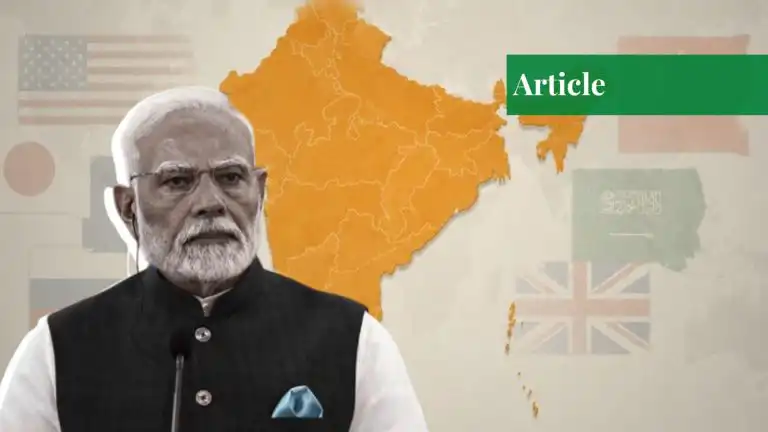
Indian leaders often claim that their foreign policy is based on ancient wisdom. However, India’s strategic culture today is a blend of mythical history, strict hierarchy, and cinematic politics, shaped by geography, sectarianism, and self-interest. The idea of India as an enduring civilization-state hides deep contradictions, which are a structural dilemma. India is both a subcontinent that is too big for its own good, a society divided by caste and creed, and a government where Hindu nationalist ideas and myths of expansion have crept into an autocratic administration. This mix makes Indian policy less of a stable grand strategy and more of a reflection of current domestic crusades, with Pakistan always being seen as the enemy in a made-up civilisational struggle.
India’s current regime is based on an ideology that apparently asserts a proud civilisational heritage. Nevertheless, the predominant Hindu nation narrative is largely a contemporary construction rather than an enduring reality. Colonial and nationalist thinkers changed history in certain ways to bring people together. In fact, even the most important Hindutva texts are from the 20th century, such as Vinayak Savarkar’s Hindutva (1923), which explicitly envisioned India as a unified Hindu Rashtra, generally known as Akhand Bharat, and explicitly anticipated the realisation of the Zionist dream, envisioning India, akin to Palestine, as exclusively Hindu. M. S. Golwalkar, an ideologue for the RSS and the author of We, or Our Nationhood Defined (1939), told India that to learn from Nazi Germany and said that any foreign race meant Indian Muslims should either adopt Hindu culture or be completely subordinated to the Hindu nation. The radical intellectuals who established the ideological foundations of today adopted foreign supremacist models rather than an uninterrupted indigenous heritage.
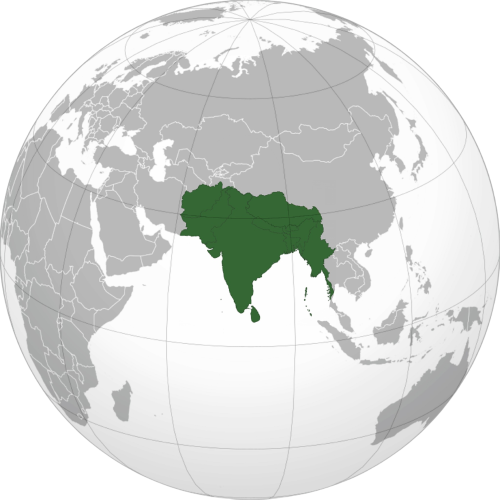
India’s land and coastlines affect its strategy, but not always in the same way, since it is both a continental and maritime nation. It is aware of continental pressures due to its long borders with China, Pakistan, and Myanmar. Its Indian Ocean coastline and maritime heritage connect it to naval issues. This makes it hard to find a balance between being too open and being too vulnerable, especially since almost 95% of India’s trade goes through open waters. The Indo-Gangetic plains and northwest have also made India vulnerable to repeated threats throughout history, making it an invader’s paradise and forcing it to defend long borders at a high cost. Because of this, India’s goals are often bigger than what it can afford.
Indian nationalism today is based on extremist ideas from the past. The ruling BJP and its mentor, the RSS, have long admired the Jewish supremacist policy of Israel, where majoritarianism is enshrined in the constitution. Savarkar and other RSS leaders openly talked about making a Hindu Rashtra, which meant a Hindu state and living out their own Zionist dream on the subcontinent. Israel’s exclusionary policies toward Palestinian Muslims, which we see as supporting Hindutva’s anti-Muslim bias. The Citizenship Amendment Act (2019) was even based on Israel’s Law of Return, which gives citizenship to non-Muslim immigrants in the same way that Israel gives it to Jews living abroad.
Saffron supremacists want a government that puts Hindus first. In Golwalkar’s famous 1939 book, he said that all foreign races in Hindustan should either adopt the Hindu culture or live under the Hindu nation, claiming nothing, deserving no privileges, not even citizens’ rights. This isn’t a secret message that Hindutva has always held that Muslims and other groups should be subordinated to the Hindu nation, which is similar to fascist ideas about racial hierarchy.
Hindutva thinkers glorified Adolf Hitler long before the BJP came to power, and many people saw National Socialism as a good example of disciplined nationalism. Golwalkar himself liked the Nazi race policies. He said that Hitler’s annexation of Austria and the Sudetenland showed what a true national community was, and that India should learn from those events. India’s right-wing fantasy is based on ideas of Nazi and Aryan purity at its core.
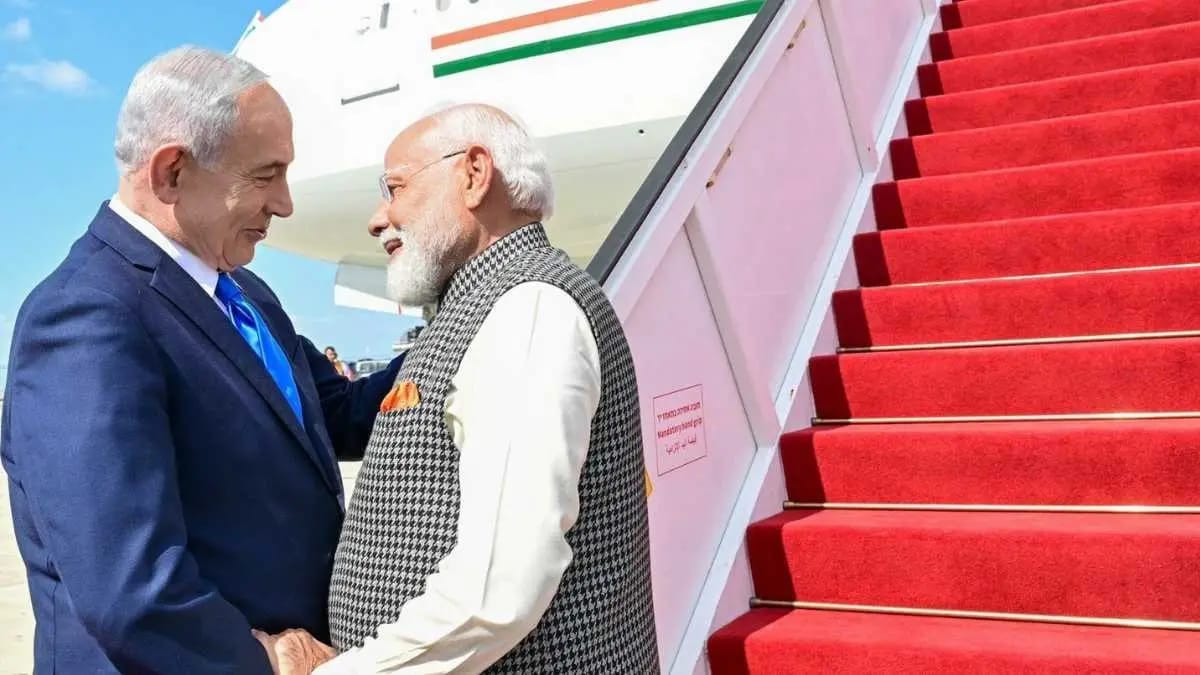
The Modi government openly copies Israel’s words and partnerships today. People have called Prime Minister Modi and Israel’s Benjamin Netanyahu’s relationship the Bibi-Modi bromance because they are so close. Both share a similar worldview and see their country as a religious refuge “Bibi’s Israel. . . a haven for all Jews, Modi’s India. . . to keep Hindus safe”. The ideological link goes even deeper when the RSS leaders have praised Israel’s military strength and democratic appearance, saying it should be a model for India.
Hindu nationalists now openly use ideas from Zionist and even Nazi playbooks to make decisions. These relations aren’t on the edge. Senior BJP ministers and ideologues freely spread hate speech at home and support Israel’s actions abroad. In 2021, BJP leader Kapil Mishra yelled at a rally that India should ‘‘goli maaro saalon ko’’ which means shoot the traitors [Muslims]. This phrase was widely seen as genocidal. Amit Shah, the Home Minister, has even said that the riots in Gujarat in 2002 taught a lesson to Muslims. BJP politicians have gotten used to making public calls for violence like this. These facts, along with a love for foreign supremacist models, lead to a majoritarian, militarised way of thinking in Indian strategy.
India’s own internal hierarchy supports this ideological bent. Even after 70 years of independence, the country’s upper-caste elites still run its institutions. The upper tiers of the bureaucracy are still dominated by caste elites, just like they were during the colonial era. As a matter of fact, this means that most of India’s generals, diplomats, and policymakers are Brahmins, Rajputs, or members of other privileged castes. The same goes for the legal system and academia, as they are both top-heavy. The modern-day maharajas of the bureaucracy still run India’s modern state, and they are not very accountable to the public.
This Brahmanical bias affects how they deal with other countries. A governing class made up of people from the same caste tends to project hierarchy outward. It naturally sees other societies as insiders and outsiders, favouring those it sees as culturally similar and suspicious of those it sees as foreign. Unwritten rules still apply, even though there is official equality; few lower-caste officers have ever held high-ranking civil or police jobs. Caste loyalties can also affect the make-up of units and the officer corps in the security establishment. The Indian strategic thought is still very conservative and inward-looking. It doesn’t take into account the full range of Indian experiences, but only the narrow view of its ruling classes.
India’s strategic culture has changed since 2014. This is called saffronisation of diplomacy, which means that India is seen as a Hindu nation and institutions are changed to reflect the beliefs of the majority. This also means that the foreign service’s old internationalist status is no longer valid. Because of this, Hindu symbols, loyalty to an ideology, and diplomacy that is more openly linked to identity politics than to secular neutrality have become more important. Because of this, Hindutva has more of an effect on foreign policy than a simple calculation of national interest. For Pakistan and South Asia, the result is greater mistrust. India is more often seen through a communal and civilisational lens, which means that Kashmir, terrorism, and regional competition are seen as contests over identity and historical grievances rather than as normal interstate disputes. This makes it harder to reach a compromise and makes the region less stable.
In short, India’s current strategic culture is more of a political project for Hindus than a set of timeless civilisational wisdom. Leaders only use history and famous thinkers when it works for them, and they simply don’t care about the pluralism and the structural dilemma of contradictions that come with those legacies. Since 2014, Hindu identity has become a bigger and increasingly bigger imperative of foreign policy. Strategic discourse has been influenced by a limited cadre of influential elites, caste dynamics, and the constraints of geography and economics, rather than a coherent grand strategy. People often overstate their strength and downplay the economic gap, weak borders, and internal divisions as structural problems. This highlights the complex dynamic in Pakistan and South Asian societies, characterised by both confidence and concern. India’s rise is linked to rigid ideologies, the concept of Akhand Bharat, and a trend of perceiving neighbours as part of a mythical society rather than as sovereign nations. India’s strategic culture is based on a genuine paradox as it intends to be a great power through civilisational and ideological assertion, but it is limited by material and geographic factors that have been around for a long time. This creates a structural dilemma between ambition and capacity that still affects how India acts at home and in the region.
If you want to submit your articles and/or research papers, please visit the Submissions page.
To stay updated with the latest jobs, CSS news, internships, scholarships, and current affairs articles, join our Community Forum!
The views and opinions expressed in this article/paper are the author’s own and do not necessarily reflect the editorial position of Paradigm Shift.

Abdul Haq holds an MS degree in International Relations from the School of International and Public Affairs (SIPA), Jilin University, the People’s Republic of China. He currently works as a Research Officer at the Pakistan Strategic Stability Institute (PSSI), Islamabad, Pakistan. Prior to this role, he served as a Research Assistant for the CCTVES at the Institute of Regional Studies (IRS), Islamabad, Pakistan. He is an expert on China, SCO, CARs, and South Asian affairs. He writes on global issues, international politics, international law, peace, conflict, and security studies.