In the era of social media, the contest for territory has increasingly evolved into a contest for perception. Public diplomacy involves the state’s efforts to communicate with the foreign public to increase its influence, support, and legitimacy. Unlike propaganda, which influences public opinion through the dissemination of information in the media. However, strategic communication dominates by systematically using information and narratives to achieve military and political goals. These approaches often blur the lines between influence and deception in the modern age. The war has evolved from traditional on-ground battles to high-speed information ecosystems increasingly exploited for strategic manipulation. The Russia-Ukraine war served as the first testament of this new reality, succeeded by the recent Iran-Israel conflict in the Middle East. States now compete to control what the public believes and finds more convincing.
Public Diplomacy in Today’s World
Public diplomacy has taken a turn from traditionally shaping international narratives to now controlling perception in real-time. It transitioned from press releases and embassy events to emotional storytelling and deepfakes during conflicts. Modern public diplomacy, in an aggressive manner, controls what billions consume on their smartphones and influences global opinion.
Russia-Ukraine War: Turning Point in Information Warfare
Since 2022, the Russo-Ukrainian war has been fought on two fronts: the physical and the social front. While Ukraine was highly integrated by the brutal clashes on the ground, the cyberspace information war was no less brutal. The maneuver of digital conflict, like bot networks, deepfakes, and cognitive warfare, was perfected in this war to undermine Ukraine, weaken their will to fight, and influence the global perspective. Kyiv, in response, used appealing storytelling to gain political and moral support from the Western audience and leaders.
Perceptions are formulated through fear, nationalism, and victimhood to create immediate psychological responses. Fear is used by exaggerating the events and portraying the rival as a dangerous threat to create urgency and justify severe acts. Nationalism revolves around guarding national pride and sovereignty by making political decisions morally imperative. Yet, victimhood is the most powerful tool for molding global opinion by presenting themselves as victims of injustice or being forced to seek public empathy and legitimacy. In Ukraine’s case, the strategic use of social media platforms like X (formerly Twitter), Instagram, TikTok, and Telegram made their diplomacy successful.
Russia portrays Ukraine as an illegitimate state, falsely labeling it a “neo-Nazi state.” Kremlin-funded media like RT (Russia Today) and Sputnik, later acknowledged by Western media as instruments of Moscow’s propaganda but still popular in other regions, used deepfake content to spread disinformation. As in March 2022, a fake video of Ukrainian President Volodymyr Zelenskyy addressing his soldiers to lay down their weapons and surrender to Russia circulated. Noted that this video was first broadcast on a pro-Kremlin channel, and afterwards, a Ukrainian television channel, Ukraine 24, was hacked by them to telecast this message.
President Zelenskyy immediately retorted by posting a video on Instagram debunking the messages and declaring this function as “childish provocation.” He also remarked that Ukraine defends its people and its land and won’t lay down till its victory. The TV channel also validated that it was hacked, while the Atlantic Council’s Digital Forensic Research Lab (DFRLab) analyzed that the video was a misleading adaptation of the Ukrainian leader. To protect the online environment, social media platforms like Meta, YouTube, and X quickly removed the video following their policies against the faked media, but millions had seen it by that point in time.
The Russian agenda was clear: to expand the perplexity and to erode the Ukrainian western support and its international standing. But Kyiv’s impressive resistance made it effective through regular video conferences and selfies in military uniforms to show their suffering. Moreover, appealing to the foreign figures by portraying Ukraine as a smaller state protecting its sovereignty and by using the Russian language while addressing Russians to attain sympathy. He presented in a manner that the world could feel. Throughout this period, he reached over 17 million followers on Instagram. This astute approach induced economic aid of about €380 billion for Ukraine, foiling Moscow’s attempt to discredit Kyiv globally.
Global Spread of Tactics
The world is experiencing a period of technological disruption in conflicts. Information warfare merges technology and psychology, using disinformation, propaganda, and cyberwar to obliterate the opponent’s information. It also secures its own information against rivals to gain a propitious status. In the twenty-first century, the war in Ukraine became the critical lab for this phenomenon, leaving imprints far beyond Europe. In 2025, approximately 20% of data on social media surfaces was proven to be part of disinformation campaigns, including around 40,000 tweets in a dataset.
Iran-Israel Conflict: Modifying the Digital Playbook
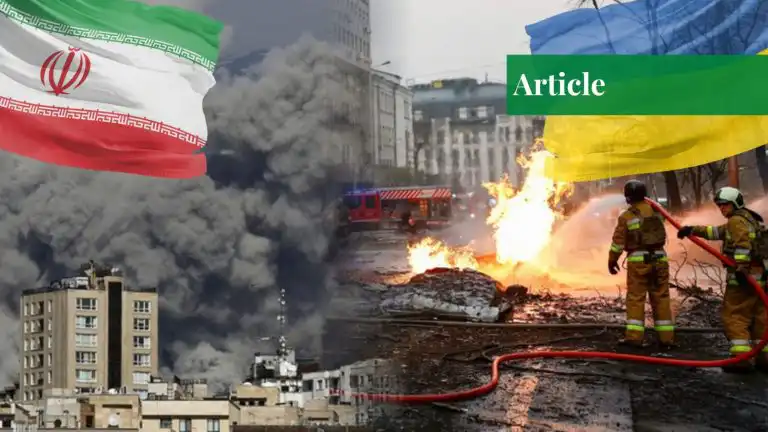
A similar exemplar has been seen in the recent Middle East conflict. Iran and Israel had not only fought with armed forces, ballistic missiles, and drones, but also with codes, gadgets, and the inventiveness of people. Modern warfare is ingrained with artificial intelligence, disinformation, and hacking. During the Iran-Israel war, social media platforms witnessed an unprecedented surge of manipulated and misleading content. Deceptive content by creators showed Dubai’s Burj Khalifa in flames, missiles striking parts of Tel Aviv, and an explosion on a US base in Iraq.
Moreover, multiple clips showing the death of the new Iranian supreme leader, Mojtaba Khamenei, were found to be false by the fact-checkers. This effort was shaped to exploit Iran’s spirit, but this move never changed Iran’s trajectory. This fallacious data collectively appeared in more than thousands of posts, reaching millions of media users. As a consequence, the manipulated war footage shaped public perception and created uncertainty. The framework is identical, while only the names have been tweaked.
It is not a coincidence. The spread of narrative warfare is more rapid than weapons. For the social media companies, there is no single solution for this problem, but they are endeavoring to ameliorate their policies for a safer and more truthful online space. The model evaluated in the Ukrainian conflict did not stay there; it is widely used in smaller contexts in the Iranian war. The wars in Europe and the Middle East exhibit the consolidated force of kinetic and cyber power.
Evolution of Public Diplomacy
Public diplomacy is no longer cogent; it is prudent and weaponized. It has emerged with new realms through weaponized narratives and cognitive operations, along with soft power and diplomacy. It crafts a psychological impact on the millions of users who seek knowledge and updates from the internet and rely on its information without verifying its credibility. Modern diplomacy aims at influencing foreign audiences to counter hostile propaganda, combining soft power with digital tools. The contemporary world is immersed in real-time perception management in a global consumer’s contention.
The peril just does not lie in the fabricated data but in its spread. Once a strategy is used in a war, it becomes a model for the forthcoming combats. The world is living in a stage where information wars are replicated and enhanced across the theaters of war.
On today’s battlefields, physical success comes from control of the field itself, whereas ultimate success comes from the narrative. In the ever-changing landscape of information warfare, not only must countries vie for control of their land, but they must also strive for control of how they are perceived.
If you want to submit your articles and/or research papers, please visit the Submissions page.
To stay updated with the latest jobs, CSS news, internships, scholarships, and current affairs articles, join our Community Forum!
The views and opinions expressed in this article/paper are the author’s own and do not necessarily reflect the editorial position of Paradigm Shift.

Khadija Sikandar is an undergraduate student of international relations at Fatima Jinnah Women's University. Her areas of interest are diplomacy, global affairs, and security. She focuses on analyzing contemporary issues and international politics through research and aims to contribute to policy discussions.