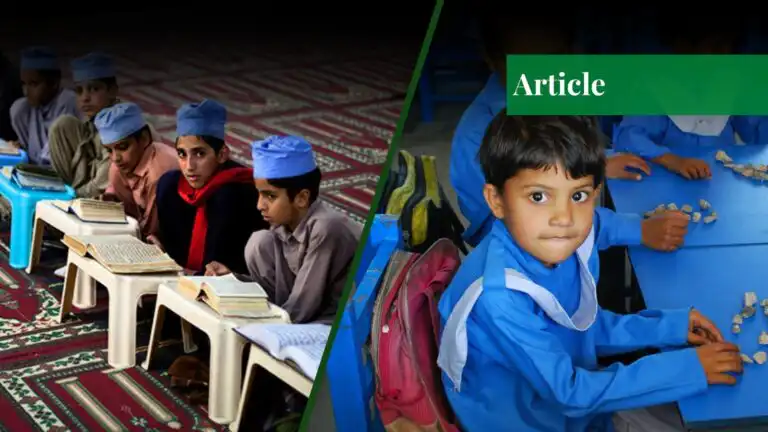
In a country that is as divided and complicated as Pakistan, the split between its two educational systems, specifically madrassas (or madrassahs) alongside mainstream education, has become a hot topic. This split moves beyond educational curriculum; it represents a significant social, economic, and political divide with potential future implications for society. As Pakistan’s educational system is influenced and constructed both historically and contemporarily, one must ask oneself: What does having madrassas and formal institutions mean for today’s youth? Does this divide perpetuate social inequity, or resolve it? These questions are not just philosophical matters of inquiry; they define the future of Pakistan’s political, economic, and social systems. Within this broader context, the role and impact of madrassa education in Pakistan become central to understanding the country’s future trajectory.
A Comparative Educational Divide: An Overview
The dual education system of Pakistan consists of madrassas, where education is focused on religious edification, and secular schools, which have a broader and less religious curriculum. Historically, madrassas have been places where students memorize the Quran and learn about Islamic jurisprudence and religious teaching. Secular schools, ranging from public schools to privately run institutions, have curricula that focus on secular subjects, often mathematics, science, and social studies, with Islamic studies included.
The madrassa system has existed in Pakistan for several decades, with increased attention received under the Zia-ul-Haq regime (1977-1988), where the Islamization of the schooling system and law of the country became prominent. During the Zia period, madrassas emerged as political and ideological spaces, alongside being centers of Islamic education, just in time for fighters mobilizing to combat the Soviet invasion of Afghanistan. The state reduced its support for public education, and madrassas became prevalent as people sought alternative options for education in places where mainstream schools were unreachable or not an option, particularly in rural areas.
The gap between the two systems of education is as stark as ever today. UNESCO estimates that 2 million students are currently enrolled in madrassas within Pakistan, which is a large percentage of our population. What that number does not include is any estimation of the informal or unregistered madrassas, so it’s hard to know what impact they even have in terms of influence. Public education is underfunded, overcrowded, and generally has little room for any young Pakistani to grow beyond either of those systems. This societal divide shows great inequalities in social policy and educational access, where students of wealthier families or students experiencing other types of social privilege can access a quality secular education, while students in poverty have a much greater chance of being pushed into a madrassa system that does not provide them with a way out economically or socially.
Madrassas in Pakistan: Beyond Religious Education
In order to understand the significance of madrassas in Pakistan, it is important to bear in mind that they are not only educational institutions, but also social institutions that are situated in the heart of local communities. For many families, madrassas provide free education, as well as boarding and food. They offer features that public schools do not always provide in areas with high poverty levels. Madrassas play the role of community institutions and fill a void in the public sphere.
Nonetheless, this benevolent view of madrassas is a misunderstanding and a reduction of what is a more nuanced picture of the educational divide. The madrassa curriculum usually centers around religious studies with little to no focus on practical skills or subjects like math, science, or technology. Students graduating from madrassas are not typically oriented to the modern job market of the globalized economy. While madrassas may give students a great deal of information about Islamic texts, this knowledge may not specifically help them deal with the real-life challenges they will face in an economy that changes rapidly. As some critics have observed, students who have received a madrassa education are not typically receiving an education that has practical applicability and responsibility for them as citizens in a pluralistic society.
In addition, the impact of extremist ideologies emanating from madrassas, though not representative of all madrassas, has become a subject of debate. A few madrassas have been accused of encouraging radical, religious views that fundamentally oppose those of Pakistan’s national interest and the international community’s desire for peace, tolerance, etc. While these worries are certainly justified in a few cases, they obscure the fact that the vast majority of madrassas do not espouse such views, yet are embroiled in the larger question of Pakistan’s educational future.
On top of the ideological and educational concerns, these religious schools have faced increasing scrutiny over issues of abuse, especially sexual abuse. In recent years, reports have emerged highlighting a shocking number of instances of sexual violence in specific madrassas that were taking advantage of vulnerable children who would often end up in madrassas because of their families’ financial struggles. Abusers have often taken advantage of their power and the trust parents placed in them, as many parents view madrassas as a haven for their children. Again, occurrences of egregious abuse do not represent the majority of madrassas, but the volume of certain incidents raises important questions of safeguarding students in religious organizations, reasons to create new policies and reforms in Pakistan.
The Public Education Crisis
While madrassas are sometimes viewed as the answer to the failing mainstream system, it is necessary to recognize and highlight the chronic problems that the public education arena of Pakistan exhibits. These issues include lack of funding, poor infrastructure, untrained and unqualified teachers, and, taken altogether, high rates of dropout. Though the constitution stipulates free and compulsory education, this remains a challenge. Pakistan is rated 146 out of 188 countries when it comes to education quality. As of 2024, over 25 million children were out of school, meaning that 46% of the child population was not attending school. For those children who are in school, there are questions of quality; schools often lack access to water, electricity, etc.
The gap between the madrassas and the public schools is even more pronounced because of disparities in location. Urban centers like Karachi, Lahore, and Islamabad have some, though sometimes poorly funded, good private schools. However, students in rural areas have limited availability of options. As a result of this lack of educational choice, many students opt for madrassas. Therefore, in many ways, madrassas have become the default, or perhaps only, educational opportunity for marginalized communities, at least providing shelter, food, and education, albeit education that often lacks utility. According to a UNDP report, nearly 73% of Pakistan’s rural population lives in areas where they cannot receive a quality education. Because of these conditions, madrassas become the only viable option and exacerbate the inequalities found within Pakistan’s educational system.
Madrassas and Social Mobility
In Pakistan, the dual education design raises questions concerning social mobility and the future of youth. In theory, the madrassa system should provide all students with an equal opportunity for learning and growth, regardless of their social status. The reality is much different than theory. The students enrolled in madrassas often do not receive the benefits from a multi-faceted education that would open a multitude of opportunities in their lives. Also, while madrassa students have mastered religious scripture, they lack the tools to be a relevant competitor in today’s labor market since they cannot keep up with secular subjects.
Conversely, students enrolled in integrated schooling, particularly in urban cities, have a greater variety of subjects and activities available to pursue. These students also have a better chance of attending a better university, better earning potential, and a greater chance of entering the globalized economy of Pakistan. This educational disparity further entrenches the issues of classism, as wealthier families can afford to have their children pursue a broader education, which continues to perpetuate inequity.
Apart from this, the urban and rural divide exacerbates the issue since students in rural areas rely heavily on madrassas for education and are left behind in terms of skills and credentials. In the long term, this increases the class divide and takes away the opportunity for social mobility from Pakistani youth, and limits the possibility of Pakistan utilizing the maximum talent and innovative power of its citizens.
Can Institutes Address the Inequality?
There is no easy answer to whether or not madrassas can help address the educational divide in Pakistan. Although madrassas are vital to achieving basic education for a large number of children who would otherwise remain out of school, they are not able to provide the well-rounded, more diverse education available in public or private schools. If the dual education approach in Pakistan is going to address educational inequalities, then there needs to be comprehensive reforms of both systems and teaching methods.
There needs to be curriculum reform on the madrassa side. Providing vocational training, critical reasoning, and modern language education would help madrassa students transition to the modern economy in a better way. Integrating interfaith dialogue, gender inclusivity, and political literacy could build on this to create social cohesion and alleviate sectarian issues.
In the public education sector, adequate funding for infrastructure, teacher training, and up-to-date teaching resources is needed. The government also needs to commit to providing free education for all children. It is necessary to reduce the urban-rural educational divide so that a better future can be secured for the youth of Pakistan.
Conclusion: A Path Forward
Pakistan’s two-tier education system, consisting of madrassas on one end and public schools on the other, is an enormous problem for Pakistan’s future. While madrassas offer schooling to millions, they also reinforce social and economic inequality through a limited means of education (more narrow intellectual opportunities) and limited social mobility. The answer is not to overthrow the madrassa system, but to reform it and offer the students a broader and more plural education that makes them ready for all the complexities of the modern world.
In order to tackle the larger issues affecting Pakistan’s education system, the government, civil society, and religious institutions need to work together to create a fairer, more accessible, and innovative education system. Only when this reform has taken place will Pakistan unleash the potential of its youth and facilitate a more unified and prosperous journey moving forward.
If you want to submit your articles and/or research papers, please visit the Submissions page.
To stay updated with the latest jobs, CSS news, internships, scholarships, and current affairs articles, join our Community Forum!
The views and opinions expressed in this article/paper are the author’s own and do not necessarily reflect the editorial position of Paradigm Shift.

Momina Areej is currently pursuing an MPhil in Clinical Pharmacy Practice. With a passion for writing, she covers diverse topics including world issues, literature reviews, and poetry, bringing insightful perspectives to each subject. Her writing blends critical analysis with creative expression, reflecting her broad interests and academic background.