I have never been very optimistic about the decentralization of the security framework. Currently, the Middle East, and particularly the Gulf region, is transforming from its long-time reliance on the U.S for its security to regional powers. It means that in a multi-polar world, the petrodollar framework under which Gulf states had to deal in dollars, and the U.S. would provide them security, is not enough to ensure the security of Gulf States, and owing to that, the Gulf is diversifying its security umbrella.
September 2025, the Saudi-Pakistan Mutual Defense Agreement came amid heightened regional concerns following the Doha strike; on Sept 9th, Israel’s airstrike on Doha, Qatar, targeted a residential complex hosting Hamas leadership. While under a formal U.S. security guarantee and host of the largest American military facility in the Middle East, the Al-Udeid Air Base, the U.S. was unable to protect Qatar from Israel, a U.S. long-standing ally in the Middle East. This event exposed the security arrangements in the Middle East and the vulnerabilities of Gulf States.
On May 15th, 2026, India and the UAE signed a defense pact. Although it does not carry any mutual obligations and does not constitute a framework for collective security, it is solely focused on advancing their maritime security, technology, training, and industrial collaboration. This development highlights the transforming nature of the security shell of the Middle East. It also hints that fragmentation in South Asia is affecting arrangements in the Middle East; the India-UAE pact came after the Saudi-Pakistan mutual defense agreement. Although of a different nature, its purpose is the same: enhancing and ensuring security.
Additionally, the very recent Mecca joint defense agreement was signed on Friday, August 7, 2026, among the Kingdom of Saudi Arabia, Pakistan, and Turkey. This pact includes parties that have prominent standing in their respective sphere such as Saudi Arabia, a leading economic power in the Middle East; Pakistan, the sole nuclear-armed Muslim state; and Turkey, the second-largest military power in NATO. This pact carries a framework of collective security, which means that an attack on one will be considered an attack on all, and it seems like an extension of the Saudi-Pakistan mutual defense agreement in September 2025.
Although these pacts enhance deterrence and security of the parties involved, if we look at the military statistics of Saudi Arabia, Pakistan, and Turkey, collectively they hold 1,100 air combat and fighter aircraft. Additionally, the collective naval power and ballistic missile arsenals of the Mecca Joint Defense Agreement members present a formidable combination of surface dominance, indigenous missile technology, and strategic deterrence. But on the other hand, it compels other states to go for arrangements of the same nature to protect their interests and balance the leverage of their adversaries. Maybe in the near future we will witness a defense agreement among Israel, India, and the UAE to balance the Mecca Joint Defense Agreement.
So, why be skeptical and not too optimistic about this decentralization of the security framework?
Once the region is under one security umbrella, until and unless the security provider is fulfilling its commitments as the U.S. did for a long time, there is no need for regional arrangements; but once the provider fails to fulfill its commitment, as the U.S. failed to protect Qatar from Israel. Moreover, Iran’s successful strikes on U.S. installations in the Middle East exposed U.S. regional deterrence; that’s why Gulf states are diversifying their security partners. This diversification of security partners can easily transform a bilateral crisis into a regional one, owing to a collective obligation on states involved in an agreement to protect their allies.
India and Pakistan are historical rivals and share a history of animosity, from multiple major wars to temporary escalations. These two countries are locked into this pattern when we look back at their history. And one thing is very visible: nuclear deterrence from 1998 onwards is playing a vital role in preventing both states from engaging in major war, as the cost of major war will outweigh its benefits. Let’s suppose India and Pakistan are in crisis, as they have a historical pattern of bilateral crises. India attacked Pakistan and violated its sovereignty, as they did in Feb 2019 and May 2025, while being part of the Mecca joint defense agreement; this could bring its allies to fulfill their commitment to secure Pakistan. And if India is in a similar agreement, this could bring its allies into this crisis too. The same is true for the Middle East, looking at Saudi Arabia and Iran. So, in this way, a local crisis can easily be transformed into a regional crisis. This will have far-flung effects.
Historical events have proved that decentralization of the security framework has yielded devastation. The Congress of Vienna in 1815 was convened for the post-Napoleonic war settlement. The Vienna settlement established the balance of power in Europe, and under this arrangement there was no major war for the next 100 years, except for the Crimean War in 1854 and Franko-Prussian war 1870. During this whole time period, Great Britain supported weak states against strong ones in order to preserve the balance of power. But with the unification of Germany in 1871, Germany became a powerful and unmatched country on the European continent. Even several powerful countries together cannot match the power of Germany, and with this, the framework of the balance of power gradually started losing its function. Eventually, the balance of power led to decentralization and ended up with two blocks: The Triple Entente and the Central Powers. The Balkan crisis, which started between Austria and Serbia with the assassination of Archduke Franz Ferdinand, brought their allies, Germany and Russia, into it. In this way, the obligation to protect allies transformed a local crisis into World War I, which was unprecedented in its devastation. Additionally, the League of Nations, which was based on collective security owing to multiple reasons such as the U.S. wasn’t its member, had framework enforcement issues. This declined states’ confidence in the institution, and ended up with two blocs, the Allies and the Axis, and resulted in WW2, which was again a devastation of unprecedented nature.
After WW2, the establishment of the United Nations in 1945 established a comprehensive structure of global institutions, slowly and gradually reviving states’ faith in it. And till now, the UN is governing global affairs, whether it is mediation, reconciliation, dispute settlement, peacekeeping, discussions over traditional or non-traditional threats, or supporting the most affected country by war or natural calamities. But over time, the UN has failed to fulfill its commitment, whether it’s the Rwanda genocide, the Gaza genocide, or, on multiple occasions, not stopping powerful states from violating the sovereignty of middle powers or weak countries. It’s surrendering in front of powerful states. War criminals are heads of state, and by having substantive power, they are enjoying full privileges. With this course of events, once again states are losing faith in global institutions as different models have been adopted for those who are in the core, semi-periphery, and periphery. Owing to this, states are turning to their own devices by joining regional blocs, as is visible in the Middle East.
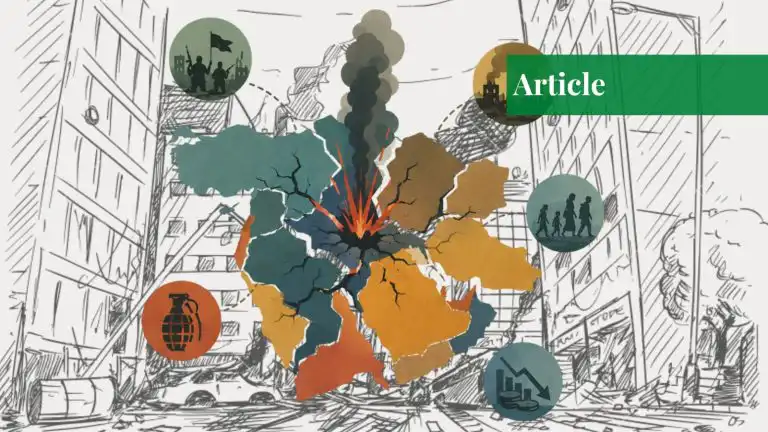
Hence, again, history is repeating itself; states are losing faith in global institutions and prioritizing regional blocs to ensure their security. If this trend of decentralization continues, it could significantly increase the likelihood of a large-scale war, as history has witnessed. Given the changing strategic dynamics, diversification may be rational. The danger lies in the emergence of interconnected and competing security commitments without mechanisms for crisis management and de-escalation.
If you want to submit your articles and/or research papers, please visit the Submissions page.
To stay updated with the latest jobs, CSS news, internships, scholarships, and current affairs articles, join our Community Forum!
The views and opinions expressed in this article/paper are the author’s own and do not necessarily reflect the editorial position of Paradigm Shift.

Umair Khan is a student of International Relations at the University of Peshawar. His academic interests include international security, geopolitics, conflict studies, Pakistan’s foreign relations, and regional security dynamics in South and Central Asia. He is also involved in academic research, debating, and student-led initiatives related to international affairs and peace and security.