Pakistan has long been grappling with the menace of terrorism, religious extremism, and countless other vices that are byproducts of Pakistan’s decades-long flawed Afghan policy. Let’s decipher how Pakistan’s unconditional support for the US and its disastrous Afghan policies and overinvolvement in Afghan affairs has cost Pakistan dearly. How has the US and its “cost-effective strategy” of using the jihadists and mujahideen in Afghanistan to counter the Soviet Union made Pakistan pay through the nose? How did Zia and Musharraf’s power-hungry attitude push Pakistan into a never-ending loop of chaos and instability?
Soviet Invasion of Afghanistan
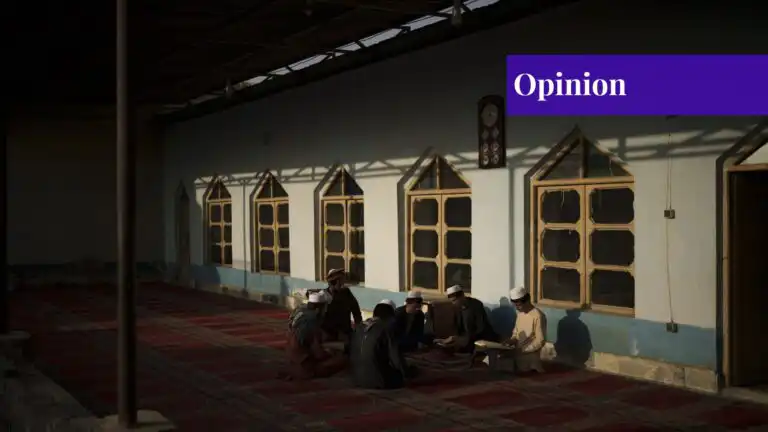
It was the year 1979 when the Soviet Union invaded Afghanistan. Dictator General Zia-ul-Haq, who was at the helm of affairs, in concert with Saudis and Americans, decided to fight the Soviets. The Saudis and Americans started pouring billions of dollars into establishing madrassas and producing mujahideen. Saudi charities were used by the Zia regime to establish madrassas—especially in the tribal belt along the Pakistan-Afghanistan border. As a result of Zia’s madrassa-mujahid-jihad policy, the number of madrassas surged to 12,000-15,000 by the mid-1980s; a number which was just 150 in 1947 and only a few hundred till 1970. Madrassas or, if rightly said, mujahideen-producing factories, were booming and so were the Taliban.
How the US Created the Mujahideen
The United States spent millions of dollars to provide Afghan children with books filled with violent images and militant Islamic teachings, part of a covert attempt to spur resistance against the Soviets. A separate syllabus was designed for these madrassas and students there were indoctrinated to be jihadists. Ishtiaq Ahmed, a renowned author, wrote in his book, “The Pakistan Garrison State,” that according to an article published by Joe Stephens and David B. Ottaway, school textbooks designed by the Center for Afghan Studies at the University of Nebraska-Omaha, under a USAID grant worth $50 million were published to promote the idea of jihad among mujahideen.
Students were supposed to understand mathematics puzzles by solving questions such as whether the speed of a Kalashnikov bullet is 800 meters per second. If a Russian is at a distance of 3200 meters from a mujahid, and that mujahid aims at the Russian’s head, calculate the number of seconds it would take for the bullet to strike the Russian’s forehead. About 1.5 to 2 million Taliban, who were products of such madrassas, were being equipped with something way more dangerous than guns and bombs, which was ideological training.
For Americans, it was nothing but a cost-effective strategy to counter the Soviets, as mentioned by CIA operatives. But by blindly following Washington’s policies, Zia shot himself in the foot. God knows whether Zia couldn’t foresee the ramifications of his Afghan policies, or if he just deliberately ignored them to elongate his unconstitutional rule through Washington’s support. The Soviets left defeated, but worse was yet to come.
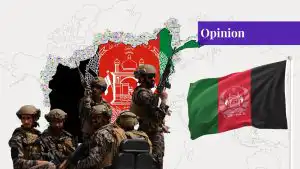
Things took a turn for the worse when the US invaded Afghanistan after the September 11 attacks. The once-known freedom fighters, well-trained and equipped with modern weapons, turned against their own masters. Musharraf’s decision to join hands with Bush on the so-called “Global War on Terror” came as a blow to the Taliban, who considered it a huge betrayal on Pakistan’s part. That was when terrorism and religious fanaticism started showing its ugly face.
From extremely well-guarded sites such as the GHQ (general headquarters), and ISI (inter-services intelligence) offices in Peshawar, to schools, hotels, and checkposts—everything was under attack. From far-flung ex-Federally Administered Tribal Areas (FATA) to the capital city, Islamabad, religious fanaticism and terrorism were at their peak. From Mullah Fazlullah’s full-fledged operation in Swat to establish Sharia Law to Mufti Aziz’s moral police patrolling and attacking music shops and massage centers in Islamabad. Unregistered madrassas in every nook and cranny considered themselves the flag bearers of Shariah and the global caliphate—that’s what they were indoctrinated with.
General Musharraf went all out to oppose freedom-fighters-turned-terrorists. Long story short, every step General Musharraf took pushed Pakistan into a blind alley. The emergence of Tehreek-e-Taliban Pakistan (TTP) and scores of other terrorist outfits, Lal-Masjid Saga, drug trafficking, gun culture, economic chaos, political instability, and insecurity, ramifications of the US’ cost-effective strategy, and Pakistan’s unconditional support for US’ apocalyptic policies were obvious.
America’s Departure from Afghan Territory
Today, the US has left the Islamic Emirate of Afghanistan. Whether they left victorious or defeated is another debate, but Pakistan is still grappling with the aftershocks of the US-Afghan policies. The role of the US in promoting militancy in Pakistan by spending billions of dollars can never be ignored. The dictators’ “Yes Sir!” attitude towards Washington has ruined Pakistan to such an extent that even decades later, it seems hellishly difficult to pull Pakistan out of the whirlpool of terrorism and religious fanaticism. Pakistan’s tumultuous relations with its Western neighbor are also a reflection of its flawed Afghan policies. What’s more alarming is that there is no sense of urgency and seriousness in ruling circles to curb the menace of religious extremism and terrorism. Stakeholders are exploiting such sensitive issues for their own gains, and Pakistan is bleeding every day.
There is a Chinese strategic thought that external causes become operative mainly through internal causes. So, before dubbing everything as a foreign conspiracy, the government should take stringent measures immediately to curb homegrown terrorism and extremism.
One step that could be beneficial and put a full stop to terrorism and religious extremism in the longer run is to expedite actions against unregistered madrassas and regulate the registered ones. The minds of a madrassa student needs to be purged of sectarianism, fanaticism, and jihadist tendencies. In this regard, the policy of a single national curriculum could work wonders.
If you want to submit your articles and/or research papers, please check the Submissions page.
The views and opinions expressed in this article/paper are the author’s own and do not necessarily reflect the editorial position of Paradigm Shift.

The writer is an undergraduate at International Islamic University Islamabad in the department of
Politics and International relations.