There is a saying by an Egyptian democracy activist, Wael Ghonim:
“The power of the people is much stronger than the people in power.”
It seems that this saying resonates perfectly with the recent situation in Azad Jammu and Kashmir. It recently witnessed unprecedented protests and political upheaval—perhaps the biggest ever movement led by the common people in the 76-year history of Azad Jammu and Kashmir. Before diving further, let’s understand, what this movement was all about. What was so unprecedented in that movement?
The Recent Protests in Azad Kashmir
On May 11, 2024, Kashmiris took to the streets to demand subsidized electricity and flour, along with other demands, including the end of unnecessary perks and privileges enjoyed by politicians and bureaucrats. A ten-point charter of demands was put forward by the Awami Joint Action Committee (AJAC). Although this movement gathered momentum on May 11, 2024, it’s been in place since March 2023. Negotiations were held between the government of Kashmir and the Awami Joint Action Committee many times, and the government assured them to fulfill their demands. But the government’s assurances were not more than hollow rhetoric.
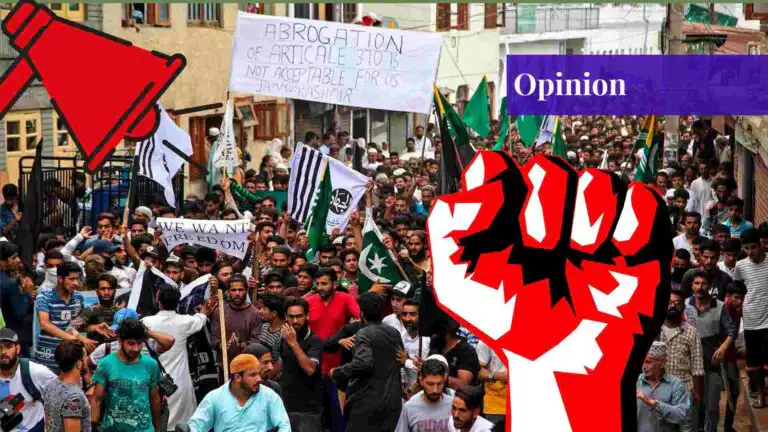
So, on May 11, upon the call of the Awami Joint Action Committee, millions came out on the streets chanting for the accountability of elites and subsidized electricity and flour. Despite being dealt with heavily by the law-enforcement agencies, people remained steadfast and continued marching towards the capital city, Muzaffarabad. But what made this protest/long march unusual? The aspect that made these demonstrations unique was that these protests were not driven by any political agenda or a particular political party. No political leader was leading them.
People came out in millions on their own, demanding their rights, and removing obstacles put up by the police. There was a wheel jam strike; mobile phone services and the Internet were shut down. People used mosques to disseminate their messages and went out on their feet. There was an absolute sense of unity displayed by the people, with no divisions along ideological or party lines. People came out in millions across the party lines and made the march successful.
Given the pressure and chants of accountability, the federal government was forced to bow down before the legitimate demands of demonstrators. The prime minister of Pakistan, Shahbaz Sharif, approved the substantial aid package of Rs23 billion for Kashmir. The price of flour dropped from Rs3,100 per mound to Rs2,000 per mound. The rates for electricity were set at Rs3 per unit for domestic consumers, up to Rs5 per unit for consumption between 100 and 300 units, and Rs6 per unit for usage exceeding 300 units.
A Movement Without a Leader
On the one hand, this protest was unprecedented because it was a purely poor people’s movement; on the other hand, it was also unique in the way that all local leadership of Kashmir, including current and former prime ministers, presidents, ministers, members of legislative assemblies (MLAs) and aides, disappeared into thin air. They were nowhere to be seen with the people of their constituencies; almost all of them ran away to Islamabad to their luxury apartments. This added further fuel to the already outraged people, who called for boycotting those who claimed to be their representatives but ran away when they were needed the most.
The rising political awareness has certainly made it difficult for political leaders to go in public and ask for votes. One thing that’s clear as day is that people have rejected the drawing-room politicians and politics. They are politically aware to the extent that they don’t need any political stalwart anymore to lead them, and they cannot be fooled anymore by “shadi politics” or “qabrustan politics.” The influx of millions of people without any political leader and the display of complete unity over public interests show that blind following by the public of their political leaders and division along party lines are a thing of the past. People are fed up with an elite-centered political system.
A display of people’s frustration was seen when an opposition leader from Pakistan Tehreek-e-Insaf (PTI) went to attend the funeral prayer of a boy killed by paramilitary forces during protests. Khawaja Farooq was barred by the angry public from attending the funeral prayer. There is no second thought that this “People’s Rights Movement” was a turning point in the political history of Kashmir. And the people of Kashmir have made it crystal clear that leaders are chosen, not installed.
Those who are installed are puppets, not leaders. Moreover, this movement is a testament to the changing political dynamics and the power of people. It clearly shows that, if there is any headstream of power, it’s only the people. Additionally, it shows how people’s movements can shake power corridors. Changing political dynamics show that if any politician doesn’t do politics at the grassroots level, he/she can’t survive in the long term. Those who can’t lead people in hard times should have no right to rule over people in good times.
If you want to submit your articles and/or research papers, please check the Submissions page.
The views and opinions expressed in this article/paper are the author’s own and do not necessarily reflect the editorial position of Paradigm Shift.

The writer is an undergraduate at International Islamic University Islamabad in the department of
Politics and International relations.