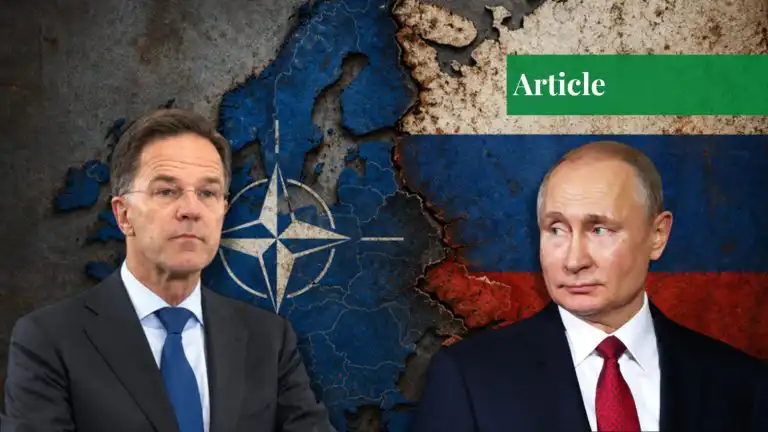
Since the end of the Cold War, NATO has been working on a simple strategic bargain, where the United States provides the military backbone, and Europe gives the political strength and supplementary capabilities. Today, that bargain is being rewritten. Though the alliance’s reorientation is logical and necessary, the unofficial banner of NATO 3.0 isn’t merely another phase of NATO’s evolution; it represents the most consequential shift in transatlantic security.
The debate is no longer whether Europe should spend more on defence or not; that argument has already been settled. The real question is whether Europe is in a position to assume a greater responsibility for its own defence, without losing its deterrence against Russia.
European Defence Capabilities And Division:
One of the biggest circumstantial achievements is that NATO members are spending more on defence. On 25th June, when Mark Rutte met Trump, he showed him charts showing over one trillion USD in cumulative extra core defence expenditure by European Allies and Canada since 2016. Rutte suggested that this increase was largely driven by Trump’s repeated pressure on the European allies. However, we see that several countries had already begun spending much more on defence before NATO adopted the new 5% GDP budget. For instance, Poland and the Baltic states were already spending 4% of their GDP, not under Trump’s pressure, but due to the Russian threat.
One of the important divisions among European states concerns perceptions of the Russian threat, which hinders equal defence contributions. Northern Europe – due to its closeness to Russian territory – perceives Russia as a major security threat, whereas southern European countries see it as a less direct threat. Historically, Southern European nations have viewed Russia as a reliable trade partner and supplier of energy, which has led them to feel less urgency about increasing defence spending.
The public opinion here matters a lot, making it difficult for the governments of Southern Europe to convince the people that they should prepare for the war.
Hybrid Warfare: NATO’s Greatest Blind Spot
While the debates over conventional military prevailed at the summit, the major European security issue lies elsewhere – the grey zone warfare. Historically, Russia has heavily relied on hybrid warfare through cyber-attacks, sabotage, espionage, and drone incursions, etc., to destabilize NATO without the invocation of Article 5. This strategy exposes a fundamental weakness in NATO’s posture, as it exploits ambiguity and makes it difficult for the debates over the defence budget and conventional military capabilities in Ankara to decide whether collective action is required.
In today’s era, deterrence cannot be measured through conventional means alone but through resilience via technological, economic, and societal advancement. Thus, even if Europe builds its defence without US backing, military modernization alone cannot protect it if Europe remains vulnerable to hybrid threats.
Strategic Paradox of NATO 3.0
NATO 3.0 emphasizes the reduction of Washington’s conventional military support in Europe, while relying mainly on America’s nuclear guarantees. However, such a trade-off rests on a flawed assumption. Conventional and nuclear security aren’t interchangeable but complementary to each other and two faces of the escalation ladder. A strong nuclear deterrence depends upon the strength of the conventional responses to aggression, which lie below the nuclear threshold.
This creates a strategic paradox, where the United States, on one hand, encourages the European allies to strengthen their conventional military input, and simultaneously remains cautious about Europe’s nuclear role. This creates a dangerous gap between the escalation framework, which Russia can exploit at any time in the future, by applying limited conventional pressure while calculating that the United States would be unwilling to escalate directly to the nuclear level.
Therefore, the objective of NATO 3.0 shouldn’t be the rapid transfer of responsibilities but to strengthen the European pillar of deterrence across both the conventional and nuclear domains. Otherwise, a hasty transition would leave Europe with fewer credible options to counter Russian aggression in the future.

Intra-EU and Intra-NATO Rivalries:
The disagreement among European countries caused by instability in the neighborhood must be addressed promptly for a successful transition towards NATO 3.0. For instance, France and Italy support opposite political factions in Libya and have competing strategic and economic interests. Consequently, this makes it difficult for the EU to have a unified Libya policy. Whereas, Turkey backed the UN-recognized government in Libya, while France was perceived as favouring rival forces. They also disagree over security issues in the Sahel region of Africa.
While these political divisions hinder collective action, they also provide an opening for Russia and China to exploit them and strengthen their positions in Europe’s Southern neighborhood. Russia expands its military and political presence through arms sales and diplomatic engagement, while China prevails through economic integration via infrastructure development and the BRI.
For decades, Europe thought of exporting its economic and political model to neighboring regions through the Brussels effect. However, we see that the reality is the reverse of it. Instead of Europe shaping the regions, the eastern side – involving the Russia-Ukraine war – and the southern side – conflicts in Libya, Syria, and the Sahel – are directly affecting Europe’s strategy.
Thus, Europe must do two things simultaneously under NATO 3.0: strengthen the European pillar of the existing NATO structure and begin preparing for a new European security architecture, where the American role is downsized and redefined.
Conclusion:
NATO 3.0 shouldn’t be a transition towards an independent Europe but a more balanced and resilient alliance. It can be done efficiently, because the stakes are on Washington’s side as well: American military bases in Europe are the backbone of Washington’s world power projection framework; moreover, the European defence industry supports over 83.000 jobs in the US. Thus, rather than weakening the relationships, NATO 3.0 should modernize them. The real test is not whether Europe can smoothly replace Washington’s role, but whether both sides can redefine burden-sharing without risking deterrence capabilities.
If you want to submit your articles and/or research papers, please visit the Submissions page.
To stay updated with the latest jobs, CSS news, internships, scholarships, and current affairs articles, join our Community Forum!
The views and opinions expressed in this article/paper are the author’s own and do not necessarily reflect the editorial position of Paradigm Shift.

Syeda Mishal Zahra is an independent researcher, pursuing her BS in international relations from the National Defence University, Islamabad. She has published her work with various national think tanks. Her interests include geopolitics, security, and world order.