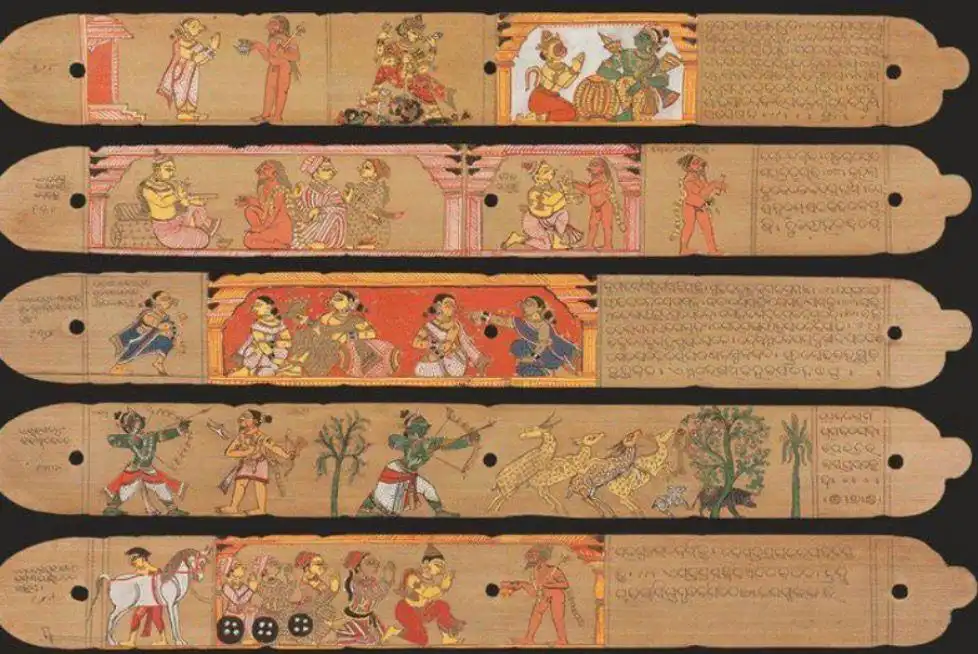
The origins of Miniature Art can be traced back to the 9th-10th century, where it began as a means for illustrating religious texts, animal studies, medical discourses, royal tales, and travelogues. It was primarily found on palm leaf manuscripts in the Buddhist Pala period.
However, it wasn’t until the Mughal conquest of India in the 16th century that miniature painting became widely recognized as a beloved art form. Humayun, the second Mughal Emperor, inherited his late father’s appreciation of art and literature. He invited the renowned Persian artists Mir Sayyid Ali and Abdus Samad into his court to encourage cross-cultural dialogue. This ultimately led to the emergence of an art form that fused Persian and Islamic art styles, while borrowing influences from the Renaissance era.
By the 18th century, Miniature Painting had developed a distinct identity. It made a gradual shift from the flat effect of Persian Miniature to a more three-dimensional style, showcasing everyday court life, nature, royal histories, exotic renditions of flora and fauna, and Indian mythology in the form of small-scale artworks. These paintings utilized a special kind of paper called wasli, paired with vibrant, long-lasting paints and delicate brushes, all of which were meticulously handcrafted to achieve the desired depth and texture.
During the Mughal rule, the practice was locally known as musawwari, but after the British colonial period, the term coined for them changed to “Company Paintings”. The arrival of the British changed the course of Miniature Paintings as they brought forth a wave of colonial rupture that introduced a hierarchy that framed “Fine Arts” (Western tools and techniques) as superior. This reduced miniature paintings to a decorative craft, treating them as exotic and stereotypical representations of the primitive and decadent East. Miniature lost its cultural significance and became a symbol of a pre-colonial past.
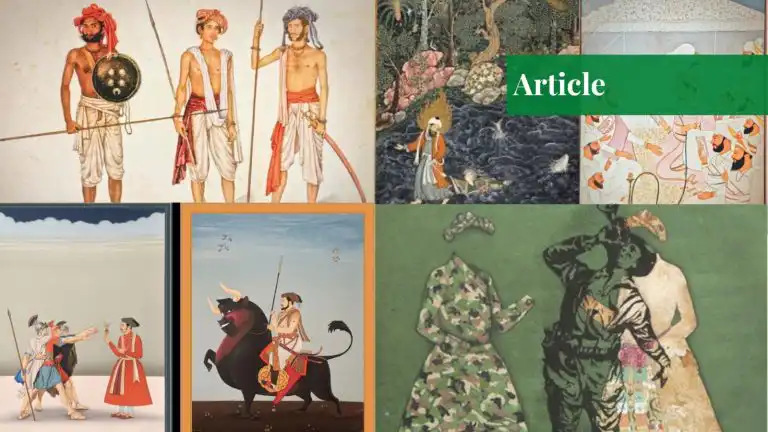
However, in 1982, Bashir Ahmed and Zahoor ul Akhlaq succeeded in establishing the Department of Miniature at NCA, Pakistan. This department set the stage for a new art movement called ‘Neo-Miniature’, which redefined the previously centralized and elitist traditional miniature art. Neo-Miniature used the techniques of traditional miniature, including pardakht, to paint narratives that explored contemporary issues like cultural identity, diaspora experience, gender roles, imperialism, sexuality, and religious authority.
Shahzia Sikander’s thesis, The Scroll (1989-90), widely considered the artwork that initiated this movement, introduced satirical reflections of reality that challenged patriarchal and colonial oppression. It unfolds a complex narrative from left to right, discussing the social limitations of existing as a woman. “This work marked the beginning of my depicting women as proactive, intelligent, witty protagonists connected to the past in imaginative and abundant ways,” Sikander said.
This marked a critical shift in how miniature art could exist in a contemporary context; it broke free from its historical constraints, morphing into a medium to explore nuanced, socio-political, personal narratives.
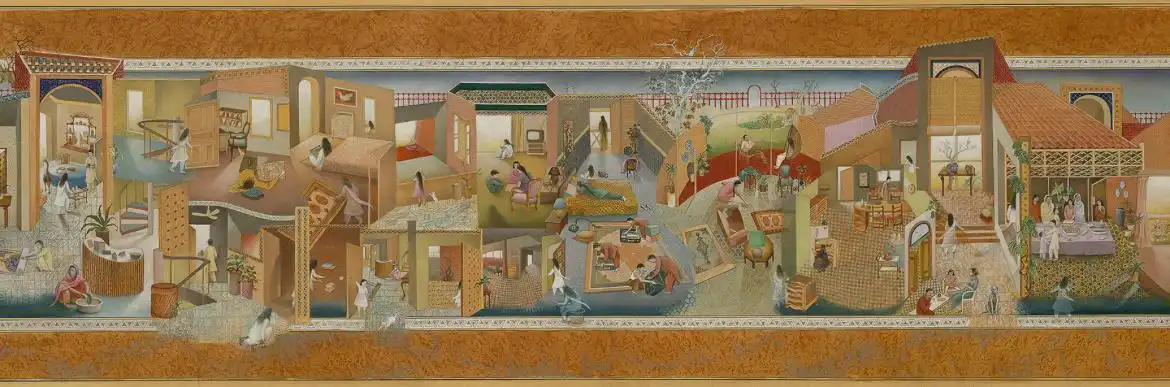
Neo-Miniature remains a movement dominated by women as it serves as a way of forcing visibility to gain control over their representation and dismantling orientalist narratives. In traditional miniature paintings, women were only ever represented as passive figures or decorative objects to appeal to a male-dominated empire. Neo Miniature positions women as active agents in the artworks, exploring their lived experiences. It is an act of defiance to use a medium that once erased their very existence to finally tell their stories. Moreover, there is comfort and relatability in resurrecting an art form that mirrors one’s own experience of the systematic erasure and dismissal by self-proclaimed progressive institutions.
Other famous artists include Aisha Khalid, Imran Qureshi, Hamra Abbas, Saira Wasim, and Nusra Latif Qureshi.
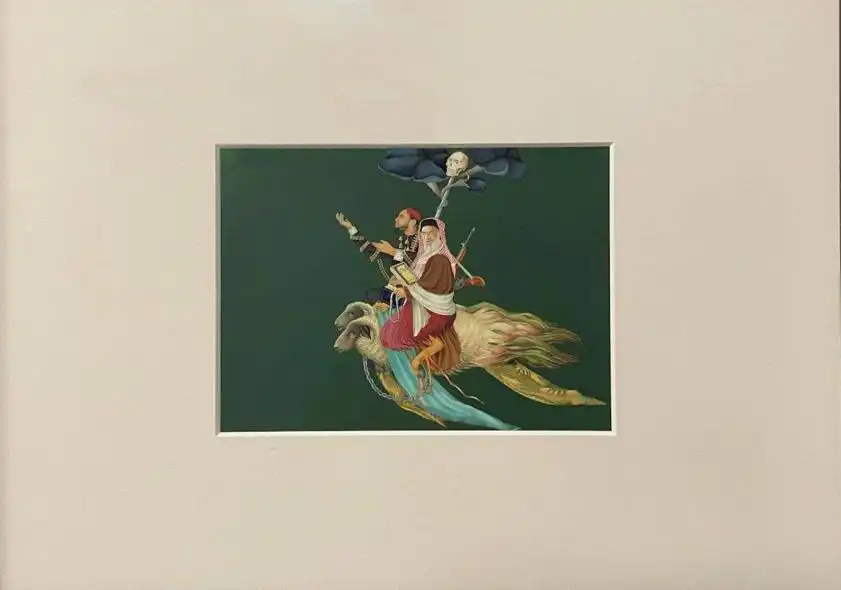
Saira Wasim’s painting represents the corruption that results from the intersection of political and religious power. A common theme in her paintings is a social commentary on Western Imperialism and Eastern Fundamentalism.
Hamra Abbas captures members of Lahore’s transgender community and removes their bodies and backgrounds to bring attention to their subjects’ faces.
The title references the 1963 poem by Adrienne Rich and explores the diaspora immigrant experience.
After three decades of experimentation and going global, Neo-Miniature art has found a place in the global art market, especially following 9/11, which resulted in an increased Western interest in Pakistan. While the global expansion has allowed artists to engage with sensitive political issues that may have proved difficult locally and served as a link between local realities and global audiences, critics like Nafisa Rizvi argue that miniature has started feeding into oriental fantasies rather than subverting them. Critics also argue that this increased exposure and ultimate acceptance have decreased the shock value of the art form and led to the commodification of miniature art, which puts its authenticity in question. It is no longer radical by default.
As Neo Miniature Art continues to evolve, artists like Imran Qureshi and Shahzia Sikander further experiment with the art form, breaking traditional boundaries by translating the art into digital formats and collages. A recent example includes 3 to 12 Nautical Miles (2026) by Shahzia Sikander, a 9-minute animated cinematic tableau that both honors and subverts miniature paintings. It explores cycles of exploitation to reinforce British dominance, focusing specifically on the Chinese Qing Empire and the Indian Mughal Empire, represented by an entwined dragon and lion, respectively; Opium was cultivated on the colonized lands of India so it could be pumped into China for the Opium Wars.
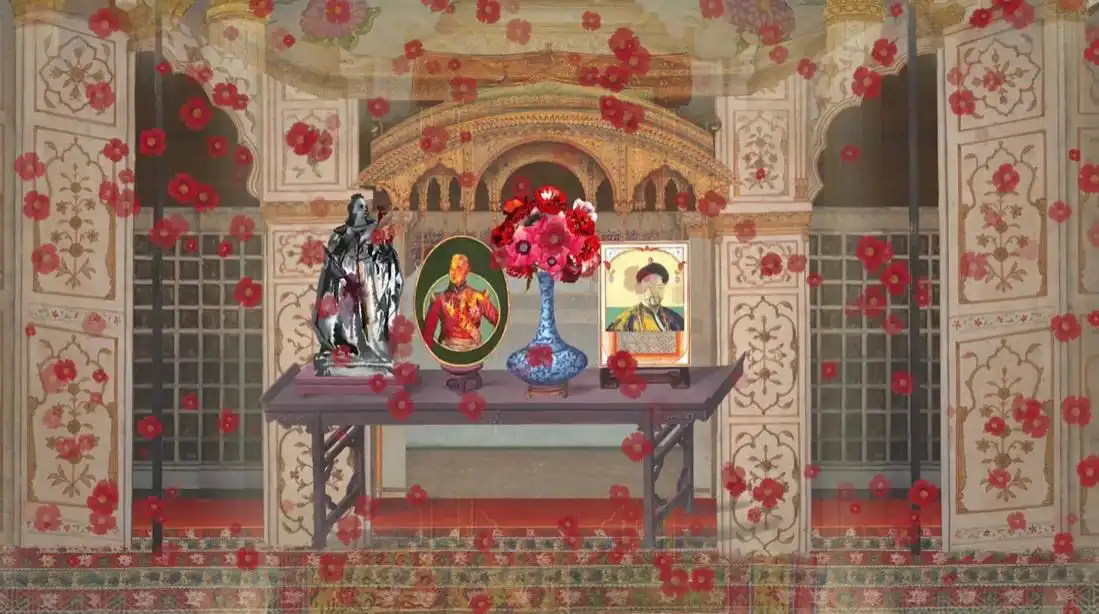
Moreover, despite the fact that condensing miniature training into a four-year course at NCA has enabled the practice to survive and evolve, critics argue that students only receive a superficial understanding. The traditional master-student practice has been dissolved along with the act of crafting the wasli, paints, and brushes by hand. However, this has allowed students to keep innovating and breaking traditional molds.
Neo-Miniature remains one of the most politically charged movements that have emerged from South Asia. Its ability to reclaim a marginalized art form that disrupts colonial structures while simultaneously forcing these structures to recognize it is a testimony to its undeniable influence and legacy. Moreover, art movements throughout history have faced commodification but are hardly ever discounted. Reducing the movement to how market-driven an art becomes takes away from its political and historical significance.
If you want to submit your articles and/or research papers, please visit the Submissions page.
To stay updated with the latest jobs, CSS news, internships, scholarships, and current affairs articles, join our Community Forum!
The views and opinions expressed in this article/paper are the author’s own and do not necessarily reflect the editorial position of Paradigm Shift.

Rida Omer is a second-year Mass Communication student with a love for creativity, storytelling, and all things artistic. She enjoys expressing ideas through graphic design, photography, and digital content creation while exploring different forms of media and visual art.

Asna Nabil is a Mass Communication major at NUST. She enjoys consuming, creating, and hyper-fixating on all forms of art, including reading, writing, knitting, photography, films, mixed media, graphic design, music etc.

Dua Uzair is a Mass Communications undergraduate at the National University of Sciences and Technology with experience in digital media, social media management, and visual storytelling. She is skilled in content creation, graphic design, photography, and video editing using Adobe Creative Suite and Canva. Dua is currently working with S3H Studios, Bunyaad Pakistan, and NIMUN’26 to create engaging and impactful digital content.