

“Some days I’d leave the office at five, get on the tube after a full day of work, and think about how I was doing it all for free.”
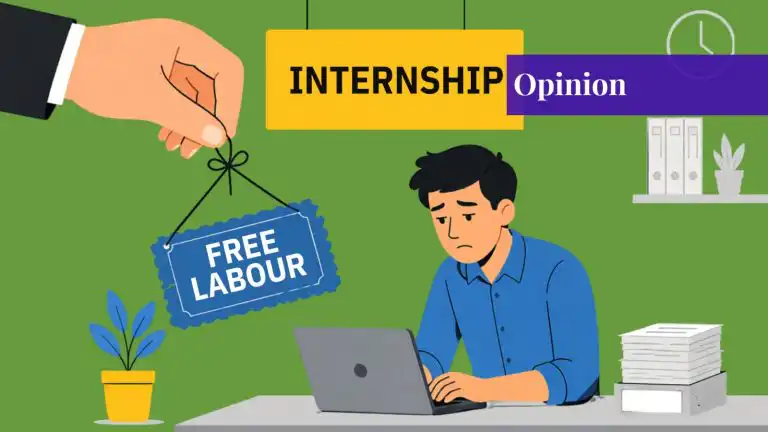
For six whole months, Ahmed* worked without pay.
For even a physics graduate of one of the world’s top UK universities, finding placements proved no easy task.
He had already spent two years applying to more than 50 internships, and after much effort, last year’s cycle bore fruit. He secured a full-time, unpaid internship at an AI startup in England.
“I took it because there weren’t enough open positions in the job market,” he said. “Unpaid roles often have a higher chance of selection. You need to take unpaid opportunities to create more internships for yourself.”
Ahmed’s experience may have taken place in London, but it reflects a broader, global reality. In fact, it is one that Pakistani graduates are all too familiar with as they search for work in a country where internship protections are even weaker.
In Pakistan, more than 60% of internships in fields such as IT, media, marketing, and finance are either unpaid or offer negligible compensation, according to the Pakistan Institute of Development Economics (PIDE).
Internships have simultaneously become part of academics. The Higher Education Commission (HEC), which regulates higher education institutions across the country, has made it mandatory for students to complete at least one internship in their respective fields in order to graduate. This obligation–without any requirement that companies pay their interns–may be seen as the government doing more for the corporate sector than for students. Increasingly, employers treat experience as a prerequisite for paid work. Obtaining that experience, however, often means working for free.
It is also important to note that for middle or lower-class students, choosing to do an unpaid internship is a harsh dilemma. With neither reimbursement for commuting expenses nor a stipend to support living costs, they often have to forgo opportunities that would both serve as valuable experiences and enrich their resumes. This financial barrier prevents long-term growth and only works to deepen the class divide.
*Ahmed is a pseudonym; the student wished to remain anonymous.
The Experience Gap
Internships are often described as learning opportunities. On average, interns work between 10 and 20 hours per week, depending on the organisation’s needs.
“When you’re working at a firm, the organisation needs you,” said Saliha Shah, a lawyer specializing in employment matters. “But with interns, that dynamic becomes more complex.”
She explained that the nature of the work determines how that relationship evolves. “If the firm is making you do their work, which includes traveling for business purposes, paying Uber charges, or covering any expenses related to the firm’s operations, then the organisation must compensate you. These costs should not fall on the intern.”
At the same time, she noted that not all internships are structured in the same way. “If you’re not doing a long-term internship and you’re only working for one or two months, then you’re not a necessity for the organisation. You’re there to gain experience and develop your skills.”
This highlights how variation in the structure of an internship means the experience differs from intern to intern.
Legal Frameworks in Pakistan
When it comes to Pakistan’s labour laws, internships exist in a grey area. Legislation like the 1934 Factories Act makes no mention of them, and so interns are left without any formal legal protection.
This is a bleak reality when compared to countries like France, where the national internship policy has been dubbed “Best Practice” by the European Youth Forum. French law requires any internship exceeding a two-month period to be paid, condemns any unpaid internship outside of education as illegal, and grants interns the same rights as regular staff—including sick leave and transport subsidies.
No such legal framework exists to protect interns in Pakistan.
Why Unpaid Internships Persist Despite Ethical Backlash
For some employers, unpaid internships are shaped by financial and operational constraints.
“Mostly because we are operating on a lower budget and can’t finance every talent we are supervising to continue as full-time,” said Waheed, an HR representative at a local pharmaceutical company. “It’s also a way to test talent for the future. It lets us know which candidate has the potential to contribute to the company or not.”
Many employers view internships as a mutual decision rather than an imposed responsibility.
“The company hires when it sees its own benefit. The candidates apply because they see theirs,” Waheed said. “There is no compulsion or force. They are fully aware of the expectations and compensation.”
When asked about legality, Waheed responded, “Illegal? No. Unethical? Maybe. But it isn’t a simple question, and as a company, you have to make decisions that are in your best interest. The market is tough–and although this may not be an ideal situation for graduates, it is just a common practice now.”
Waheed also pointed to how internships occupy a different position from jobs. “Internships are not advertised as part-time or full-time jobs. People may pursue them for corporate experience, work culture, or just an insight into how organisations operate.”
For applicants like Ahmed, that trade-off is a critical part of the decision-making process.
Employer Alternatives
Mahad Imran, who runs operations management at an AI automation agency, described a different approach to hiring interns.
“We were better off hiring ambitious university students rather than full-time graduates,” he said. “We could identify raw talent and then train them up to our standards.”
Internal priorities, rather than external pressure, drove the decision to compensate interns.
“We offered compensation because we could do it. I’ve been very conscious of the culture I grew up in this company, so I ensured that interns were compensated fairly for their work,” he said. “It didn’t feel right not to pay when we had the resources.”
Still, he noted that compensation does not necessarily determine long-term outcomes.
“I don’t think there’s any relation between paid internships and full-time jobs,” he stated. “I’ve seen people get jobs after unpaid internships, and I’ve also seen people not get jobs after paid ones.”
A Competitive Market
We cannot understand the issue at hand without acknowledging the wider employment context in which it exists. According to Trading Economics, Pakistan’s unemployment rate was approximately 5.4% in 2025. The youth unemployment rate is considerably higher–almost double. According to Statista, it stood at 9.59% in 2025. When one in ten young people can’t find work, there is immense pressure to accept whatever role, paid or unpaid, comes one’s way.

Find more statistics at Statista
“Everybody has the same level of education, and the competition per position has increased significantly,” remarked Ahmed. “Previously, people used to get degrees with a stronger idea of what they wanted to do post-graduation. Nowadays, many people get degrees just for the sake of having one and continue without a clear goal.”
He also pointed to hiring processes as a contributing factor.
“AI runs the hiring process, which means a lot of people are filtered out before reaching interview stages,” he said. “There should be more human intervention.”
This is an extremely pressing concern for both internship and job seekers. It may be a step aiming to streamline processes, but it also means less–and eventually minimal–human consideration.
Where Does It Leave Graduates?
The current HEC policy means internships play a crucial role when it comes to graduation.
“Graduates today have it harder,” sighed Ahmed. “There are more people, more degrees, and fewer opportunities.” The data, as well as the widespread experience of thousands of young people, confirms this.
He added, “There should be better allocation, making sure people who actually want to work get the chance to reach that stage.”
Graduates today are entering a world marked by political turmoil, economic uncertainty, and an increasingly tough job market. The least we can do, when they show up ready to work and prove themselves, is ensure they are not made to do so for free. It’s 2026, internship protections should no longer be considered a luxury–they should be the new normal.
If you want to submit your articles and/or research papers, please visit the Submissions page.
To stay updated with the latest jobs, CSS news, internships, scholarships, and current affairs articles, join our Community Forum!
The views and opinions expressed in this article/paper are the author’s own and do not necessarily reflect the editorial position of Paradigm Shift.

Abeeha Aslam is a Pakistani Mass Communication student at the National University of Sciences and Technology (NUST), Islamabad.

Rubab Baig is a Pakistani Mass Communication student at the National University of Sciences and Technology (NUST), Islamabad.

Maryam Jafar Khan is a Pakistani Mass Communication student at the National University of Sciences and Technology (NUST), Islamabad.