Introduction
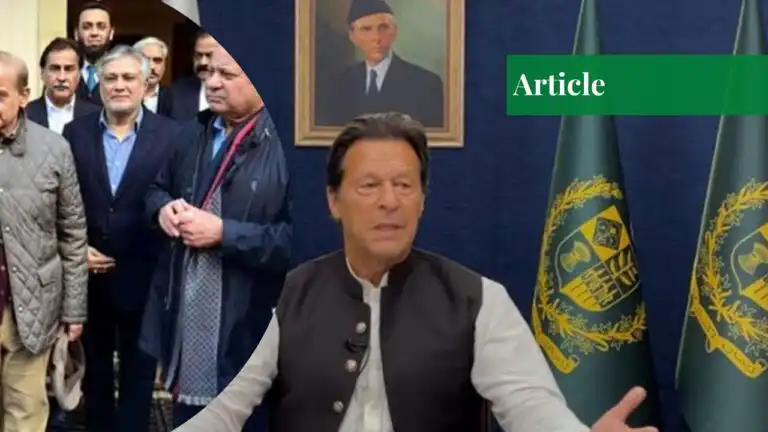
Pakistan is politically at a crossroads as of November 2024, deepening the turmoil that has exasperated over the past few years. Currently, the country is facing enormous social tension thanks to the political confrontation between Imran Khan, the ex-prime minister, and Shehbaz Sharif, the current PM. This animosity in Pakistani politics has transformed the situation into a national calamity, which was least required by this already troubled economic and social structure. The enhanced polarization between the government and Khan’s Pakistan Tehreek-e-Insaf (PTI) party is not Machiavellian strategizing but is inflicting on the people of Pakistan, especially on the masses, in ways that are more real and tangible.
This article proposes a goal of evaluating the current state of affairs in Pakistan with particular reference to the political rivalry between Imran Khan and the current government of Pakistan on one side and the implications of this conflict on the well-being of the populace of Pakistan from societal, economic, as well as political perspective, on the other side.
The Political Context: A Brief Overview
Imran Khan, a sportsman who has changed into a political leader, gained power in 2018 as his PTI triumphed in the general elections. His term in office was characterized by populist and nationalist drawl with an anti-corruption agenda, coupled with efforts towards fixing the sinking economy of Pakistan.
However, political rivalry between mass lodges for Khan and the opposition political parties increased in 2022 when, in April, Khan was impeached through a no-confidence motion. Somehow, Khan has accused his dismissal of being aided by the government, and this has led to daily demonstrations, constitutional cases, and political unrest for the past few months.
The present center-right federal government under Shehbaz Sharif, brother of ex-PM Nawaz Sharif, had also faced staunch challenges from the opposition and a highly partisan political climate. The ruling Sharif family’s PML-N has been challenged by Khan’s PTI, which accused the country of having a “failed democracy” due to political corruption.
To counter his political loss, Asia’s most famous cricketer, Imran Khan, has brought out marches, mobilized people, and has been actively posting on Twitter against the present regime. He continues asserting that he was restored from his position unfairly, the country is heading towards an economic disaster, and Pakistan’s sovereignty is at risk. Although his appeals for the early elections and the increase of transparency within Pakistani politics find a great response among his numerous supporters, they only widen splits within the country.
The State of Pakistan’s Economy: A Nation in Crisis
The political struggle between Khan and the government has worsened Pakistan’s already unsteady economy. Within the context of this research, Pakistan’s economic situation, as envisioned by The Analyst at the end of 2024, is in a critical state. The country has been swamped with unprecedented inflation rates, a weakened currency, and an unwieldy fiscal deficit. Inflation rates have risen beyond 40 percent with food and fuel costs on the rise. Since 2021, the rupee has plummeted to state that today it is 50% weaker than the US dollar, besides worsening the living standards of a native Pakistani.
This has also caused Pakistan to have a large external debt since the increase in the BOP deficit is traceable to its ever-rising external debt. Data sourced from the State Bank of Pakistan has estimated that Pakistan’s foreign liabilities already reached above $120 billion in 2024, and now Pakistan is in very bad shape when it comes to the repayment of loans to international organizations including the IMF. Again, the IMF has been very keen on fiscal consolidation and restructuring; such measures as subsidy reforms, high taxes, and austerity measures have raised the ire of the public.
Amidst such a horrible economic situation, the political crisis resulting from the confrontation between Khan and the Sharif government has thus been devastating investors’ confidence. This political uncertainty has caused continuous evolution in domestic as well as foreign investment in the recent past. The stock market of the country has been witnessed to have an up-and-down movement, which definitely demands immediate attention where the economic growth rate for FY 2024-2025 is predicted to be around 1.5%, far off from the targeted 5% to address unemployment and poverty issues.
However, if the economic situation is considered from the point of view of a Pakistani citizen, then its pressure is felt. The middle class is shrinking, and poverty statistics have gone up. Today, more than 39% of the population of Pakistan is living below the poverty line, as estimated by the World Bank. About 30 million families have no access to health care, and half of them cannot afford food due to acute hunger affecting the rural population.
The Human Cost: Social Unrest and Public Discontent
Another negative impact of political conflict between Khan and the government has also been social mistreatment. Moral demonstrations, sit-ins on the roads, and strikes have emerged as common attributes as Pakistanis show their disgruntlement with the government and politicians in general. That was when Imran Khan was arrested for corruption in May 2023, and violent incidents occurred across the nation. PTI activists clashed with security forces; many of them were killed or injured. The arrest led to the mass arbitrary arrest of Khan’s supporters: thousands of PTI members, political leaders, activists, and “ordinary” citizens were detained.
Since then, the situation has somewhat eased, but occasionally, acts of violence and civil unrest affect daily life. The mountain of instability is looming large, and with political activism picking up pace, the average Pakistani, especially the urban population, no longer holds a “passion” for politics. The political climate is already quite antagonistic, and this back and forth between the government and the opposition only serves to anger the public, and people feel as though they matter little to the major decision-makers of the country.
Also on the economic front, social services are also declining as people are economically strained. Healthcare has been one of the most underfunded sectors, and coupled with a high level of inefficiency, it has been stretched to demand this additional capital. Basic utilities, including electricity and clean and safe water, are absent or in short supply in many areas, especially in rural and less developed areas. Education is not spared either: millions of kids have no access to school education at all, and those who do often lack learning materials. The human development standards of Pakistan are among the lowest of South Asian countries, and the political crisis has only worsened the conditions to deal with these persisting problems.
A Shadow of Power
Pakistan has always had a very strong military, and perhaps the strongest interventionist role model in Pakistan has been Zia ul Haq. The country is technically democratic; however, the military has, at some point in time, seized the government through a military coup three different times and has, in the past and future of civil rule, been a key power player.
Indeed, as the differences between Khan and the government persisted, the institution entered the spotlight once again. For instance, Khan has alleged that the institution has executed a coup to remove him from power—a narrative that has served to deepen the distrust that his supporters have in the country’s political system.
Currently, the government is principally headed by Nawaz Sharif’s family, and it is assumed that the state’s institutions approve it. This makes the political situation a bit more volatile since Khan has been urging the start of an independent political process, which these institutions are allegedly against. Although the military has formally distanced itself from civil politics, its dominance in other sectors (the judiciary, media, and security) has been widely speculated.
The current political environment and the alleged involvement of other institutions that characterize Pakistan have made many citizens in the country feel helpless. The overbearing dominance of certain agencies/institutions in determining the country’s priorities makes many people feel frustrated, especially if they are working towards a more democratic state.
The Road Ahead: Chances of Stability and Peace
The question is, how can Pakistan go through this period of volatility? It has never happened before in the country that politics is this polarized, so the future course of the country is uncertain.
It can also be pointed out that one of the possible ways to solve the crisis is through the discussion process. So, if Khan’s PTI and the government can sit down and negotiate, this can open the way for a more stable political situation. However, with both sides fully dug in, such talk appears highly unlikely at the present.
For now, the people of Pakistan are still struggling to survive while having to endure the consequences of the political crisis. There is no sign of the economic downturn improving in the near future. Just like other aspects of the country, such as social and political unrest, many Pakistanis feel let down by their leaders. The only way forward is the actual political reconciliation, the change of the internal political system, and a new approach towards politicians and their main goal—to serve the people, not the elites of Pakistan.
Conclusion
However, in regard to Pakistan, the uncertain status of the clash between Imran Khan and the government puts a question mark on the country’s future. This political instability in the country has caused not only the blooming of political violence episodes but also the suffering in the day-to-day life of Pakistani people. These people, being victims of their political leaders’ war, are now suffering a crumbling economy, social unrest, and an insecure future.
Whether Pakistan can overcome these challenges lies in the hands of the leadership and their willingness to rise above their vested self and party interests for the betterment of the people. Otherwise, the state remains highly unstable, and the future of Pakistan will remain uncertain.
If you want to submit your articles and/or research papers, please check the Submissions page.
The views and opinions expressed in this article/paper are the author’s own and do not necessarily reflect the editorial position of Paradigm Shift.
Kainat Aamir is an educator, climate change activist, and volunteer at Amnesty International. She is deeply passionate about writing, particularly about environmental issues, world politics, mental health, and women’s empowerment.