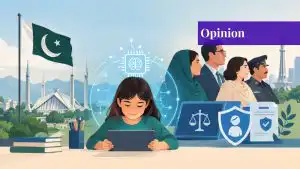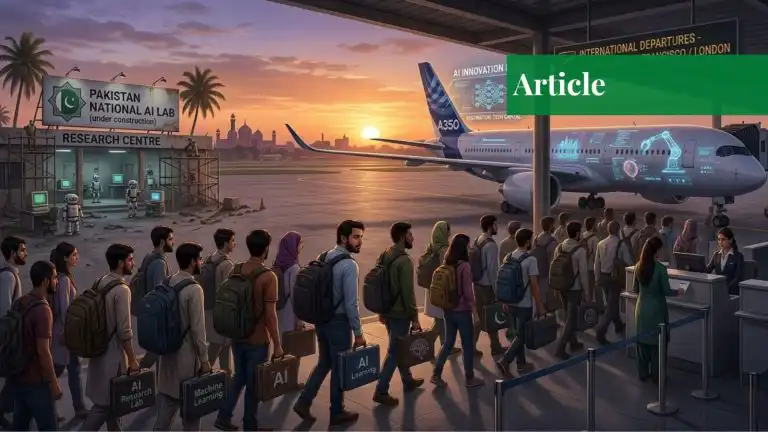
Pakistan is finally talking seriously about artificial intelligence. Universities are adding AI programs, companies are experimenting with new tools, and the government is trying to position the country in the race of the global AI economy. But there is an uncomfortable question underneath all this excitement: What happens when the people we train become good enough to leave?
In a January 2026 article published in The News, “AI brain drain or AI breakthrough?” was discussed in this context. Their argument was simple but important: Pakistan has an opportunity to benefit from AI, but only if it can create an environment where its talent has reasons to build from within the country.
That is where Pakistan’s AI story becomes more complicated.
Pakistan Has Talent. The Problem Is What Comes Next.
Pakistan is not starting from zero.
The country already has a large technology workforce, a growing freelance economy, and an IT sector that is continuously expanding. The State Bank reported that Pakistan’s ICT services exports reached $3.8 billion in FY2025, while thousands of new IT companies entered the sector.
The government is also working to speed up the process. In August 2026, Google opened its office in Pakistan in the capital city, Islamabad. The government said Google’s opening was a move to connect developers, entrepreneurs, and young people with worldwide technology opportunities.
Around the same time, Pakistan and Google announced an agreement that would provide 150,000 Google Career Certificates, more access to AI tools for students, and plans for an AI Centre of Excellence. On paper, Google and Pakistan’s agreements are encouraging technological developments.
But training someone to use AI is only the first step. The harder question is what happens after the training. If a smart student studies machine learning in Pakistan, gets certificates, becomes skilled enough to work on advanced AI projects, and then finds out that the most exciting jobs, best research places, and highest pay are somewhere else, what exactly have we created?
A training pipeline can become a talent pipeline for somebody else’s technology industry.
The Brain Drain Did Not Begin With AI
Pakistan’s struggle to retain skilled people is hardly new.
A 2025 Dawn article also discussed the issue of retaining tech people in Pakistan. It listed the causes of the AI brain drain in Pakistan. These issues include limited chances for career development, political instability, poor infrastructure, and appealing job options in other countries. No matter how much the IT industry has grown, it still has problems in retaining tech workers.
Another Express Tribune report on the migration of skilled technology professionals described brain drain as a serious problem, with industry leaders raising concerns about the departure of digital workers and the conditions pushing them abroad.
So AI has not created the problem. AI has simply raised the stakes. A talented software engineer leaving Pakistan is one thing. A researcher who could have built an AI laboratory, trained hundreds of engineers, or founded a globally competitive company leaving is something much bigger.
The loss is not only one person’s salary or job. It is the innovation that might never happen.
The World Is Competing for the Same People
AI talent is very valuable because the technology is moving fast and the number of people who can work at its frontier is still quite small. AI talent is the focus of competition among Google, Meta, OpenAI, and other tech companies. AI talent is what these companies are hunting for around the world: people who can build large language models, AI infrastructure, robotics, and other advanced systems.
For someone with those skills, the attraction is not simply a bigger salary. It can mean access to enormous computing resources, experienced research teams, better-funded experiments, and problems being solved at a global scale.
That creates a difficult situation for countries like Pakistan. I think we can ask young people to stay because the country needs talented young people. If staying means accepting fewer chances to learn, try new things, and grow, patriotism alone is unlikely to solve the problem.
Maybe the Real Problem Is Not That People Leave
There is another way to look at this. A recent Express Tribune discussion on labor migration argued that Pakistan is not necessarily short of talent. It is short of opportunities that can absorb that talent. That distinction matters. People leaving for better opportunities is not automatically a national failure. Pakistan benefits enormously from its overseas workforce through remittances, professional networks, and international connections.
The real danger comes when leaving becomes the default path to professional success. Imagine a Pakistani student who wants to become an AI researcher.
The student studies locally, completes advanced training, and eventually faces a choice. One path offers limited computing resources, uncertain research funding, and fewer opportunities. The other offers a position in a world-class laboratory with access to the technology and people needed to pursue ambitious research.
Which path would most talented people choose? We already know the answer in many fields. AI could make that difference even more visible.
Training People Is Not Enough
Pakistan’s National AI Policy recognizes the need to develop AI skills, research, and innovation. The government’s recent Google agreement is another sign that policymakers understand the importance of building an AI-capable workforce.
But certificates alone cannot create an AI economy. People need somewhere to use what they learn. That means universities capable of serious AI research. It means computing infrastructure that researchers can actually access. It means startups that can raise capital and compete internationally. It means companies willing to employ highly skilled engineers for difficult technical work rather than limiting them to low-value outsourcing.
Otherwise, Pakistan may become very successful at producing people who are ready for the global AI market while remaining unsuccessful at building a strong domestic AI industry. That would be a strange kind of success.
From Brain Drain to Brain Circulation
Perhaps Pakistan should stop thinking about this as a simple choice between “stay” and “leave.” The more useful goal may be brain circulation. A Pakistani researcher working abroad can still collaborate with universities at home. An engineer at a global technology company can mentor young developers in Pakistan. A founder in Silicon Valley can invest in a Pakistani startup. A researcher who leaves today may return later with experience, networks, and capital.
But that only happens when there is something worth returning to. Pakistan therefore needs to make staying, returning, and building locally attractive options rather than treating migration itself as the enemy.
The Question Pakistan Needs to Ask
The Google agreement, new AI programs, and growing technology exports are encouraging. But we should not measure them only by how many people Pakistan trains.
We should ask harder questions.
Where will the best students work after they graduate? Where will the machine learning engineer conduct research? Where will the next Pakistani AI startup get its funding? Where will the researcher find the computing power to test an ambitious idea? And perhaps most importantly, where will Pakistan’s most talented people believe they can build something that matters?
There is nothing wrong with a Pakistani engineer joining Google, Meta, or any other global technology company. The real failure would be if building something at one of those companies becomes the only way that engineer can reach their full potential.
If Pakistan wants to become an AI economy rather than simply an AI talent exporter, that is the question it can no longer afford to ignore.
If you want to submit your articles and/or research papers, please visit the Submissions page.
To stay updated with the latest jobs, CSS news, internships, scholarships, and current affairs articles, join our Community Forum!
Find our FREE quizzes and MCQs here!
The views and opinions expressed in this article/paper are the author’s own and do not necessarily reflect the editorial position of Paradigm Shift.

Hooria Akbar is an independent researcher and content writer with a strong interest in contemporary issues across AI, technology, society, and emerging trends. She writes research-informed articles, thought pieces, and blogs on a wide range of topics, aiming to present complex ideas clearly and engagingly for diverse audiences.