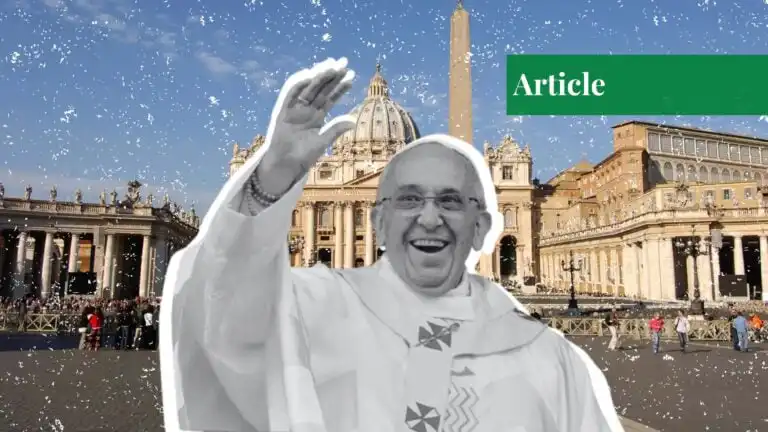
Pope Francis, “The Archbishop of the Poor” and the head of the Catholic Church for over 12 years, passed away peacefully on the 21st of April 2025.
In a befittingly poetic fashion, the Pope died one day after Easter Sunday, one of the holiest days in the Catholic faith and the day Catholics believe Jesus Christ was resurrected.
At the age of 88, he had already been battling health issues for some time; he had been hospitalized for severe bilateral pneumonia for 38 days before suffering a cerebral stroke, which resulted in a coma and a subsequent cardiocirculatory collapse.
The official announcement came from Cardinal Kevin Farrell, Camerlengo (chamberlain) of the Holy Roman Church, who stated that the Pope, “returned to the house of the Father” at 7:35 AM Rome time.
Pope Francis was elected as the 266th pontiff of the Catholic Church on the 13th of March, 2013. Historically, he was also the first Latin American Jesuit to be elected; this was monumental due to the Church’s long-standing bias towards electing Europeans and, more specifically, Italians. He also broke ground by choosing the name Francis, an allusion to St. Francis of Assisi, who was iconic for his fervent desire to help the poor and destitute, and even had an affinity for animals and nature.
 You will find more infographics at Statista
Befitting of his inspiration, his 12-year papacy emphasized compassion, empathy, and kindness to the poor, oppressed, and marginalized communities.
He advanced interfaith dialogue, prioritized environmental stewardship, and called for peace amid global conflicts. However, his critiques of capitalism, push for synodality, and openings on issues like communion for the divorced saw resistance from the more conservative elements of the Church.
 You will find more infographics at Statista
His principal documents were four encyclicals, which can be explained simply as letters/documents. They were typically addressed to the Catholic bishops of the world or to the broader Church on matters ranging from doctrine to morality and discipline.
These include:
Lumen Fidei (June 29, 2013) discusses faith in God. Then, Laudato si’ (24 May 2015) emphasized the global community’s duty towards the environment, protecting the Earth’s ecology and tempering the climate crisis since the planet is God’s gift. There was also Fratelli tutti (3 October 2020), which emphasized the integral nature of close friendships and social relations on the human soul. Finally, there was the Dilexit nos (24 October 2024), which emphasized that Catholics should serve others joyfully and spread the message of Jesus.
Known as more progressive compared to his contemporaries, he declared the death penalty inadmissible no matter the case. He also stated that the use and possession of nuclear weapons was an immoral act, regardless of intent.
Surprisingly, he also held a somewhat progressive tone towards homosexuality. At the same time, he still upheld the Church’s official stance on it. He famously said, “If a person is gay and seeks God, who am I to judge?” when asked about a gay priest.
While progressive, he still held a bulwark on the core Catholic tenets, with strong opposition against abortion, and reaffirmed the reservation of priestly ordination to men.
Ancient procedures and rites have long been codified in cases such as the Pope’s death, and it should be relatively straightforward for the Church to manage his departure.
His death initiated the Sede Vacante (the see being vacant), triggering ancient protocols for Vatican administration, mourning rites, and the preparation of a conclave. As cardinals converge on Rome, the Church reflects on Francis’s legacy and discerns its future.
On his final day, despite declining health after hospitalization, Francis powered on and delivered an Urbi et Orbi (from the city of Rome and to the world) blessing from St. Peter’s Basilica, wishing all his Catholic followers a “Happy Easter!”
Known technically as the Novemdiales, it was the nine-day mourning period that followed the Pope’s death. On the 23rd of April, Francis’s body was processed to St. Peter’s Basilica for public veneration. Due to the crowds, viewing hours were extended into the night.
The rites were streamlined in congruence with Francis’s wishes. The Church used a wooden coffin lined with zinc instead of the traditional nested caskets and a catafalque, a testament to his humility. The Mass featured multilingual prayers and a homily on Francis’s ministry.
Breaking precedent, Francis requested burial at St. Mary Major, not the Vatican Grottoes, due to his devotion to the Salus Populi Romani icon. It was also iconically the first place he visited the morning after being elected Pope.
The Sede Vacante entrusts Church governance to the College of Cardinals, as limited by Universi Dominici Gregis (The Shepherd of the Lord’s whole flock), to administrative tasks and conclave preparations.
Cardinal Farrell, as Camerlengo, manages Vatican affairs, seals the papal apartments, and organizes meetings of the College of Cardinals. General Congregations, starting the 22nd of April, saw rising attendance. They addressed logistics, oaths, funeral plans, suspending beatifications, and discussed the state of the Church.
According to church law, the conclave’s start is likely May 6–11, with preparations such as closing the Sistine Chapel on April 28 for voting setups.
Electing the 267th Pope
From the 108 cardinals appointed by Francis and currently eligible to vote, 38%, or a majority, were from Europe. The second highest was at 19%, primarily from Latin America and the Caribbean. Cardinals from the Pacific region matched their size, at 19%. The other major groups included 12% from sub-Saharan Africa, 7% from North America, and finally, the smallest, at 4%, are from the Middle East and the North African region.
Voting involves secret ballots, with four daily sessions after the first day. Ballots are burned, producing black smoke for no election or white smoke for the election of a new Pope. Upon election, the Dean asks the candidate to accept and give their name, followed by the phrase “Habemus Papam,” which translates to “We have a Pope!”
Who Will Be the Next Pope?
Predicting the next Pope is challenging. Cardinals weigh continuity versus change, geography, experience, age, theology, and charisma.
 You will find more infographics at Statista
Leading papabili include:
- Cardinal Pietro Parolin (Italy, 70): Vatican Secretary of State, a diplomat offering continuity but criticized for limited pastoral experience.
- Cardinal Luis Antonio Tagle (Philippines, 67): Charismatic, progressive, dubbed the “Asian Francis,” strong on social justice but questioned on administration.
- Cardinal Matteo Zuppi (Italy, 69): Bologna’s Archbishop, progressive, tied to Sant’Egidio, balancing diplomacy and pastoral care.
- Cardinal Péter Erdő (Hungary, 72): Conservative canon lawyer who favors tradition.
- Cardinal Fridolin Ambongo Besungu (DRC, 65): Kinshasa’s Archbishop, representing Africa’s growing Church, focused on justice.
- Cardinal Robert Prevost (USA, 69): Dicastery for Bishops Prefect, with Latin American experience, mitigating U.S. bias concerns.
The choice hinges on whether cardinals prioritize diplomacy or pastoral zeal, reflecting the Church’s internal versus external challenges. The conclave will now determine whether the Catholic Church will continue with Pope Francis’s liberal advancements or pivot with more conservative zeal.
If you want to submit your articles and/or research papers, please visit the Submissions page.
To stay updated with the latest jobs, CSS news, internships, scholarships, and current affairs articles, join our Community Forum!
The views and opinions expressed in this article/paper are the author’s own and do not necessarily reflect the editorial position of Paradigm Shift.

The author is studying Economics at the National University of Science and Technology (NUST) with a keen interest in financial affairs, international relations, and geo-politics.