
Pakistan’s court system is a perpetual reminder of how fast one protest can escalate into an illegal activity. The Supreme Court decreed in the case of the Faizabad Dharna that protests that crippled the capital and halted highways were violative of citizens’ rights to livelihood and movement. The decision established that the rights of millions of individuals to live and move without fear cannot be overridden by the right to dissent. Thus, it is legal and necessary to control where, when, and for how long assemblies occur in order not to result in chaos. It is only when a protest remains constitutional in its order that it remains a constitutional act.

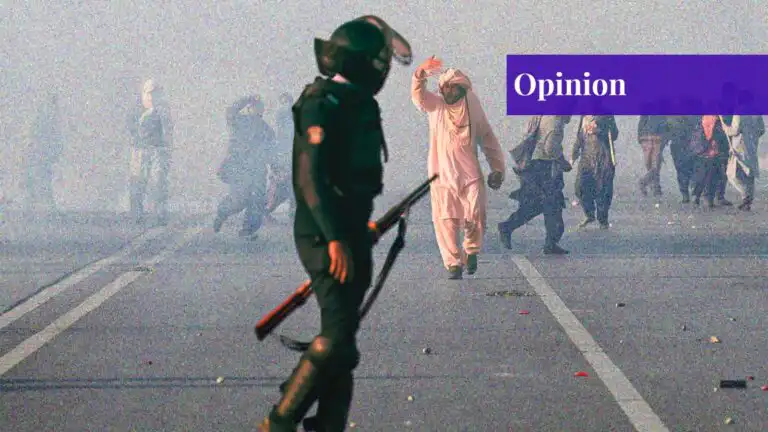
Recently, incidents when Tehreek-i-Labbaik Pakistan (TLP) initiated their march towards Islamabad best exemplify these remarks. Members of the group’s supporters had a confrontation with police in Lahore as they walked along the Grand Trunk Road, voicing support for Palestinians. The procession made its way to Muridke, where protesters set up sit-ins and blocked traffic, injuring dozens of police. To curb the situation, the government deployed over 1,200 paramilitary forces to Punjab and suspended key highways temporarily before reopening them on a limited scale.
While TLP leaders insisted that their march was peaceful, the ensuing public unease and the disruption of transportation told the tale. Economic activity had been brought to a standstill, travelers were stranded for hours, and entire sections of Lahore and its outskirts were practically walled off. Almost 90 individuals were arrested by police after they declined to move off the course despite repeated warnings. What began as a moral solidarity political gesture turned into a challenge to the state’s capacity to exercise order.
This conflict is a good example of the fine line between the right to protest and the creation of a public nuisance. Protests descend into collective coercion when they interrupt civic life or threaten public safety. But overuse of power by the state can also be as devastating, converting dissension into disobedience. The extent to which a society manages to resolve this conflict is truly the test of democracy.
Pakistan’s constitution seeks balance, not repression. It empowers the government to maintain peace through constitutional means while protecting every individual’s right to free speech and assembly. Citizens, on their part, must ensure that demonstrations remain peaceful and orderly. Causes are only discredited when chaos is created in their name. Arbitrary crackdowns do the same for institutions. Therefore, the doctrine of reasonable restriction guards freedom and not as a bar to liberty.
Seen from the perspectives of both law and sociology, the current TLP incident reaffirms that the right to protest is accompanied by a correlative obligation: respecting others’ rights and the flow of public life. If preserved, protest makes democracy stronger; if lost, it is an agent of national tension. There must be an understanding between both citizens and authorities that liberty will not thrive without order, and order is not valid without liberty.
This equilibrium remains Pakistan’s largest hindrance and greatest opportunity as it navigates its complex political landscape. National dialogue will still involve protests, but their impact must be rooted in persuasion and not paralysis. Dissent, under the Constitution, should be put forth peacefully and not disruptively. To that understanding, demonstration is a necessary expression of civic adulthood and not a nuisance, as long as it abides by the law that makes it possible.
Public demonstrations reflect the people’s will in any democracy. They are in defense of the view that citizens have the right to protest against discriminatory treatment or poor administration. Pakistan’s Constitution acknowledges this sentiment by providing guarantees of freedoms of movement, assembly, association, and expression under Articles 15 to 19. Through these provisions, collectively implied is the right to peaceful demonstration. However, all of them are absolute. Each one of them is limited by “reasonable restrictions” that ensure the welfare of the public at large. It is hard to find the point of demarcation between permissible speech and unruly behavior that infringes on the rights of others.
These freedoms have uniformly been interpreted by the courts to be conditional, not absolute. A protest cannot be regarded as a constitutionally protected exercise of freedom when it obstructs major public thoroughfares or results in the destruction of public property. Precedent in law emphasizes that any restriction must be proportionate, non-arbitrary, and legally grounded. The rights of the public at large and protesters need to be weighed when the government places controls to maintain public order. Accordingly, the right to protest is acknowledged by the Constitution, but only within parameters that safeguard civic life.
If you want to submit your articles and/or research papers, please visit the Submissions page.
To stay updated with the latest jobs, CSS news, internships, scholarships, and current affairs articles, join our Community Forum!
The views and opinions expressed in this article/paper are the author’s own and do not necessarily reflect the editorial position of Paradigm Shift.

Lahore.