
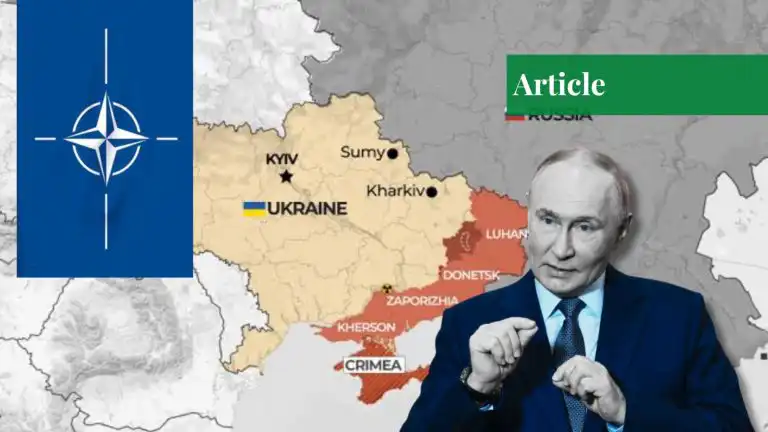
Four and a half years after Russia launched its full-scale invasion of Ukraine, one question remains central to understanding the war: Was Putin truly trying to ensure NATO stayed away from Russia, or was it the security argument that covered a much more expansive goal of preserving Russian power over Ukraine? The difference is significant because Russia’s security concerns are not necessarily at odds with its ambitions in Ukraine. There were sound reasons for Moscow to see the expanding NATO and Ukraine’s increasingly close military ties with the West as threats to its strategic position. However, such worries are not the full reason for the actions taken by Russia. The signs are that this is not just a matter of keeping Ukraine in Russia’s orbit, but also of barring it from becoming a permanent outsider of Russia’s sphere of influence and a threat to Moscow’s understanding of Russia’s place as the leader of post-Soviet space. The conflict is not just a matter of NATO encroaching on Russia, after all. What Russia feared, NATO helps to explain. It does not, on its own, tell us what Russia’s objective was.
Russia was right to be worried. In the post-Cold War era, NATO has grown eastwards, even into former Soviet bloc nations. For the people of those countries, NATO membership meant protection. For Moscow, the same process had a Western military alliance creep closer and closer to Russian soil. There were multiple reasons why Ukraine was especially sensitive, one of which was its geographic position. It is situated between Russia and Europe, and it has given strategic depth in the past. Hence the escalating military ties with NATO that raised concerns in Moscow about the Western military presence becoming closer to Russia’s borders. This is the security dilemma: what is seen as defensive can be seen as threatening. But the story of Russian policy makes that explanation with NATO only a little hard to swallow.
Russia had already proven to be a thorn in the side of Ukraine when it came to making a clear-cut choice between the West and the East. After the Euromaidan revolution in 2014, Russia annexed Crimea and backed separatist forces in the East of Ukraine. The war in Donbas also posed constant political and military challenges for Kyiv, while Crimea was politically important due to the Russian naval base at Sevastopol. These developments took place eight years prior to the full-scale invasion. That sequence matters. Russia was not a stranger to the Ukrainian threat in February 2022. Moscow had been responding to the political shift in Ukraine and its growing ties with the West for many years. It was not, then, a response to any single NATO development, but a dramatic escalation of a longstanding conflict over the direction of Ukraine. It was the question of influence that was the central issue. Moscow didn’t want to deal with Ukraine as an average neighboring country. It was strategically significant because of its geographical location, economic importance, historical ties with Russia, and owing to the fact that it was situated on the shores of the Black Sea. What was more important, however, was Ukraine’s progress toward Western institutions and the possible permanent loss of Russian influence.
Here is where history and identity take on a political dimension. Russia’s rulers have made many statements about the cultural and historical ties between the Russians and the Ukrainians. In his article on the historical unity of Russians and Ukrainians (2021), Putin linked the two nations by a long and close history. The article draws on research that shows how such stories help foster a larger concept of “Greater Russia,” not necessarily the restoration of the Soviet Union, but an attempt to maintain Russian control over areas that they would consider within their “historical and strategic” sphere. This is changing the nature of Ukrainian sovereignty in the thinking of Moscow. For Kyiv, the EU/NATO option is a matter of the will of a sovereign state. The accession of Ukraine to the Western institutions is a significant geopolitical setback for the West. Such an independent and Western Ukraine would prove that a big post-Soviet state could chart its political and security course without taking Moscow’s influence. Hence, Ukraine was more than just a border-security affair.
There was also an element of domestic politics. The Kremlin saw the Orange Revolution and Euromaidan not as a Ukrainian political phenomenon, but as something connected to the West. An effective Western-oriented Ukraine would offer an alternative political model in the post-Soviet region, as well as a threat to the stability of the Russian political system. The study concludes that this is part of Moscow’s general worry about political influence and regime security. This was the danger in Russia’s calculations that was revealed in 2022. Russia began its multi-front attack on February 24th, moving forward from Russia, Belarus, and annexed Crimea. Russian troops advanced towards Kyiv while attacks were carried out in eastern and southern Ukraine. The effort to take Kyiv was unsuccessful, and by the end of March, Russian armies were retreating from the north of Ukraine. The conflict then became a long-drawn-out war of attrition.
The result has made Moscow’s security goal, which it said it was pursuing, much more difficult. Russia wanted to block any further Western penetration in Ukraine. Rather, the invasion led to a greater conflict between Russia and the West, to a growing European fear of Russian military strength, and to the fact that Ukraine’s security has become the focus of European security discussions. That doesn’t mean NATO was a non-issue. It shows something more significant: Russia’s security concerns were not its sole goal, but were a contributing factor. It is still important for diplomacy these days. Any settlement that only considers NATO expansion will not be able to solve the underlying issue, because for Moscow, it is more than just an alliance. The conflict also involves territory, Russian influence, Ukraine’s sovereignty, and the political system of the post-Soviet region. Russia seeks security against the encroachment of the ‘West ‘. Ukraine seeks security against Russian pressure. These are areas that can’t be “reconciled” by saying a ceasefire. There must be a consensus on whether Ukraine’s sovereign right to decide its own political and strategic orientation is recognized. It is necessary to establish a consensus on the recognition of the sovereign right of Ukraine to decide on its political and strategic direction.
It is finally this that makes the argument that NATO was solely to blame for the war vulnerable. NATO expansion is a possible contributor to Moscow’s sense of threat. The reason for Moscow’s unwillingness to lose influence in Ukraine can be understood by looking at the way Russia has acted with respect to Crimea and Donbas and Ukraine’s political orientation. They combine to form a more complex answer: Russia’s invasion of Ukraine was not for one reason. The strategic pressure, generated by security concerns, was a catalyst for war, yet a vision of Ukraine’s historical role and influence in the region facilitated the transformation. Not so much now whether Russia had security concerns is the most important question. It clearly did. The more important question is whether those concerns are sufficient to decide the strategic decisions of another sovereign state. There is the crux of the conflict. Russia wanted Ukraine to stay in its orbit, but that was not the whole story of the confrontation; NATO was also involved. A ceasefire could end fighting, but not the conflict that led to it, until that distinction is acknowledged in negotiations.
If you want to submit your articles and/or research papers, please visit the Submissions page.
To stay updated with the latest jobs, CSS news, internships, scholarships, and current affairs articles, join our Community Forum!
Find our FREE quizzes and MCQs here!
The views and opinions expressed in this article/paper are the author’s own and do not necessarily reflect the editorial position of Paradigm Shift.