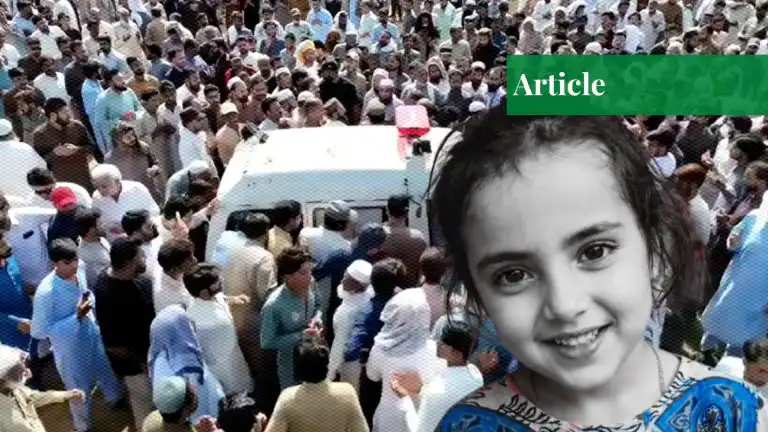
On August 25, 2026, the family of five-year-old Ayat Noor buried a child they had spent fifteen days searching for. She had gone missing from Pathan Colony in Haripur after stepping outside to play. Her father recorded video appeals, begging strangers for any word of her. Neighbours joined the search. Then police, acting on leads from suspects already in custody, pulled her body out of a well at a warehouse on University Road. A postmortem confirmed what everyone had already begun to fear. She had been sexually assaulted and killed before her body was left in the water.
Three suspects are now under arrest. One reportedly confessed before a judge. Two more are still being hunted. Pakistan is never short of official language when this happens. Condemnation. Condolence. Promises of exemplary punishment. What it is short of is a system that stops the next one.
Two months earlier, in Karachi’s Qayyumabad, an eighteen-month-old girl died at Jinnah Postgraduate Medical Centre. The man arrested was seventeen, a neighbour who used to take her out for treats. Doctors found evidence of sexual assault. He has been charged with murder. Before that, in June, a three-year-old was found dead in a sack in Malir, raped and strangled. Go back further, and the line runs to Zainab Ansari in Kasur in 2018, a case that briefly made the whole country stop and look, then let it move on anyway.
These are not isolated horrors. They are entries in a ledger that Pakistan keeps updating and rarely closes.
What the Numbers Actually Show
Sahil, the child protection organisation that has tracked reported abuse cases since 1996 using media monitoring across all four provinces, recorded 1,914 cases of child abuse across Pakistan in the first six months of 2026, or close to eleven children a day. Of those, 1,015 involved child sexual abuse. Girls made up 58 per cent of victims. Sahil’s researchers found that 45 per cent of incidents happened inside the child’s own home and that 43 per cent of alleged abusers were already known to the victim’s family, not strangers off the street.
Sahil’s separate count for gender-based violence recorded 3,172 cases nationally in the same six months, including 644 murders, 280 rapes, and 132 honour killings, plus 18 cases involving transgender victims, a group with no dedicated line in official crime statistics at all. The Human Rights Commission of Pakistan, which compiles its own count using different methods, has separately reported a sustained multi-year rise in gender-based violence cases. The two organisations do not always agree on totals. They agree that reported violence has stayed high and, in several recent years, has climbed rather than fallen.
The figure that should embarrass the state most is the conviction rate, and here the sourcing matters. A Geo News investigation that pulled data from the Police, the Law and Justice Commission of Pakistan, and the Human Rights Commission of Pakistan found that of more than 22,000 rape cases registered over a recent six-year period, only 77 ended in conviction, a rate of 0.3 percent. Independent estimates land in a similar range. The Karachi-based group War Against Rape has separately put the national conviction rate at under 3 percent.
Provincial breakdowns tell the same story in miniature. Khyber Pakhtunkhwa recorded 258 rape cases in 2024 and reached exactly one conviction. None of this reflects weak law. Pakistan’s Anti-Rape Act already permits the death penalty, up to twenty-five years in prison, and chemical castration for repeat offenders, and it created special courts meant to move cases quickly. The gap sits earlier, in the police station that does not want to register the case, the hospital that misses the six-hour window the law sets for a medico-legal examination, and the family that gets talked into a private compromise before a judge ever hears the matter.
Which Institutions Actually Answer for This
The man who commits the assault carries the first and heaviest responsibility, without exception, regardless of his age or his excuses. But naming Pakistan in the abstract lets everyone else off too easily. It is worth being specific about which parts of the system keep failing.
The police station can refuse to register a first information report or delay it long enough for pressure and payoffs to work. The hospital that misses the six-hour forensic window even though the law has required it since 2021. The prosecution system that sends cases to trial without the evidence to hold them together. The courts, where a case can sit for years while a special track meant to finish in months goes unused. And the family and community layer around a victim, where a relative or elder brokers a quiet settlement instead of a police file. Sahil’s finding that 43 per cent of abusers were already known to the victim’s family points squarely at that last layer. It is not a stranger danger problem. It is a circle of people who saw something, or should have, and chose silence.
What should not be on that list is Ayat Noor’s own parents or the parents of the eighteen-month-old in Qayyumabad. Neither family failed. The institutions above did, by leaving every household to guard its children alone, with no sex offender registry, no habit of background checks on the people who spend time around children, and no functioning backstop for the moment trust is broken from inside.
Three Reforms, in Order
First, make reporting and forensic response actually work. That means fully staffing the anti-rape crisis cells the 2021 Act already created, so the six-hour medico-legal deadline is met rather than routinely missed, and funding forensic labs so DNA evidence does not sit untested for months.
Second, make prosecution and conviction more certain rather than harsher on paper. Dedicated prosecutors, functioning fast-track courts, and published, province-by-province conviction data would let the public see whether the 0.3 per cent figure is moving at all. Sindh’s rape conviction rate reportedly rose from about 5 per cent in 2020 to roughly 17 per cent in 2025 in districts where special courts began functioning properly, which suggests the architecture works when it is actually used.
Third, build the preventive layer that is currently missing. A working juvenile pathway matters because several recent Karachi cases involve teenage suspects, which means earlier screening and supervision, not only punishment after the fact. Extending forensic and prosecutorial machinery to transgender victims would end their near-total absence from official counts. And Pakistan already has draft language sitting unused: the Senate passed a bill in 2025 restricting social media access for under-sixteens, and the Punjab Assembly passed a similar resolution in July 2026. Neither has become enforceable federal law. Finishing that work would close one more gap through which predators reach children.
There is loud public demand right now for a public execution in the Ayat Noor case. That demand deserves an honest answer, not a comforting one. Pakistan already permits the death penalty for rape and has done so for years. What it lacks is the machinery to convict anyone in the first place. A hanging for the rare case that reaches a verdict will not touch a system where, on the official government’s own reckoning, roughly ninety-nine cases out of every hundred never get that far. The same public anger, redirected at a forensic lab, a fast-track court, and a police station that stops treating a rape complaint as an inconvenience, would protect more children than any single execution ever could.
None of this is an ecosystem. It is a short list of specific institutions, run by specific people, making specific decisions that Pakistan keeps choosing not to fix. That is a harder thing to say than “rape is an ecosystem.” It also happens to be true, and it is the only version of this argument that points toward something Pakistan can actually do before the next well, the next sack, the next child.
If you want to submit your articles and/or research papers, please visit the Submissions page.
To stay updated with the latest jobs, CSS news, internships, scholarships, and current affairs articles, join our Community Forum!
The views and opinions expressed in this article/paper are the author’s own and do not necessarily reflect the editorial position of Paradigm Shift.

Azhar Ud Din is a student of international relations at Government College University, Lahore.