
South Korean Martial Law Declaration
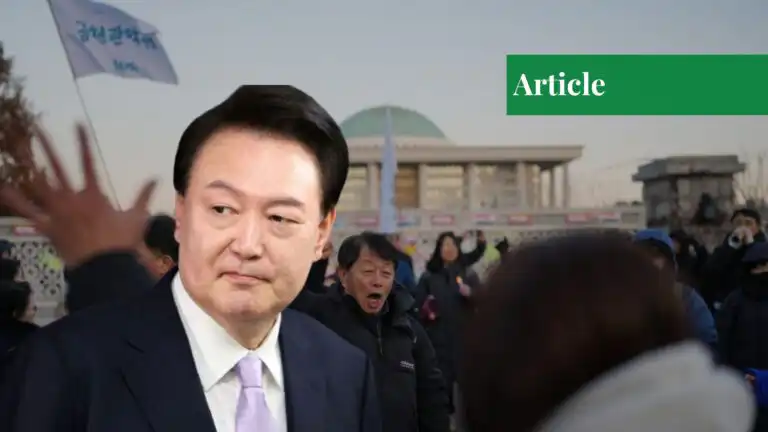
Late Tuesday night, 3 December 2024, the South Korean president, Yoon Suk Yoel, made an emergency broadcast stating that martial law had been declared in the country. Claiming that he was left with no other option and that the reason for the enforcement of martial law was that the government had become “paralyzed,” he accused the opposition Democratic Party of sympathizing with North Korea and stated that this step was necessary “to protect the citizens of the Republic of Korea” from anti-state forces.
Furthermore, he vowed to safeguard the democratic constitutional order of South Korea through martial law. Following the announcement, the media was put under military control, and security forces were ordered to seal the National Assembly with nearly 300 soldiers deployed to attempt a lockdown.
In the midst of these chaotic minutes, the scenes outside the National Assembly weren’t less than a dystopian film, as a mass number of outraged protestors swiftly gathered outside the building in freezing temperatures and began chanting slogans such as “take down the dictatorship,” “lift the martial law,” and “impeach Yoon.” Lawmakers from the Democratic Party were also called to the National Assembly to pass a resolution for the overturning of martial law.
On multiple instances, officials, aides, and citizens came face to face with the soldiers deployed outside the building in epic standoffs where even Ahn Gwi Ryeong, a female spokesperson for the opposition Democratic Party, grabbed the gun of an armed soldier and pushed him back while shouting, “Are you not ashamed?.” Other lawmakers as well as the Democratic Party leader, Lee, were seen jumping over the walls and barriers of the National Assembly just to get into the building and were seen live streaming on social media platforms the entire time.
At around midnight, the troops and soldiers broke down the windows of the National Assembly and entered the building despite the parliamentary staff, lawmakers, and aides blocking their way in by using fire extinguishers and barricading the entrances with the help of sofas. Later on, the footage was released of the incidents happening inside the building, and the opposition party claimed that the troops had been given specific orders to “target or arrest at least the high-profile politicians.”
Null and Void
Despite all of the hindrances and threats put forth by the troops, the lawmakers succeeded in gathering inside the building and were able to approve the resolution that demanded a repeal of the martial law by a staggering 190-0 voting result. 18 votes were from Yoon’s own party.
Article 77(5) of the Constitution of the Republic of Korea was cited in the resolution, where it has been stated that the president must repeal martial law if a majority of the lawmakers demand it. The South Korea martial law was deemed null and void by the lawmakers on the passing of the resolution, and the troops and soldiers were seen being withdrawn and dispersed by the surroundings and the gates of the National Assembly. At around 4:20 am, Yoon, while addressing the nation, announced the lift of martial law.
Why Did Yoon Impose Martial Law?
The president’s sudden announcement of martial law came as a surprise not only to the South Koreans but to the entire world. Many argued that the act was ill-conceived and carelessly planned, even for a president, but Yoon’s fall in ratings, constant declining public support, numerous impeachment motions against his administration, and being a part of constant controversies and scandals played a huge role in this irrational and unreasonable announcement of martial law.
A survey conducted in October 2024 recorded that Yoon’s rating had fallen to an all-time low with a staggering 19% approval in ratings. Representing the People’s Power Party in 2022, Yoon won the election by a narrow margin of 0.7%, being the closest election win since 1987 in South Korean history. In April 2024, the media labeled Yoon as a “lame duck” president as the opposition Democratic Party had won the general elections by a landslide victory, with his government failing to pass the laws it wanted and instead was just left with the option to veto the bills presented by the opposition.
It was noted by experts that in his initial speech for the announcement of the imposition of martial law, Yoon did not highlight any specific threat to South Korea from DPRK rather, he inconsistently mentioned the 22 impeachment motions that were filed against his administration since he took office in May 2022. Another factor that has played a huge role in the public’s distrust of Yoon and his administration is that the president refused to hold independent investigations into the Dior handbag scandal involving the first lady, his wife Kim Keon-Hee.
The first lady has been in multiple controversies and scandals during Yoon’s time in office, but the Dior bag scandal is said to be the “proverbial needle that broke the camel’s back” in the words of Professor Cho Hee-Kyoung, a law professor at Hongik University Seoul, while having a conversation with CNN. Visual clips were also leaked where Kim was clearly seen accepting a $2,250 Dior handbag from a pastor who is well-known to be a constant advocate for developing closer ties with North Korea. Yoon, after all this time, had failed to apologize for his wife’s mistake rather shifted the blame and accused the bag of being a “political ploy” used by his political enemies.
Looking back at these dramatic turns of events, which are nothing less than a K-drama plot, it makes one wonder how accountability by the ones in power and swift action by the people of the nation are so vital for an efficient government and administration. We have multiple accounts where leaders have gotten away with doing whatever they please.
Whether it be the constant military coups in Pakistan or Indira Gandhi’s emergency period, it is seen quite often that leaders get away from such illicit and criminal activity due to the lack of accountability on the part of the people. A recent example of demanding accountability from leaders is Sheikh Hasina, who was ousted from power and with her 13-year single-party rule coming to an end in August 2024 following an intense round of protests in Bangladesh.
What’s Ahead for Yoon?
The swift response of the citizens of South Korea made the lifting of martial law possible within hours; it was because of the immediate gathering of crowds outside the National Assembly that helped the opposition members enter the building for the voting process. This whole fiasco is a gentle reminder that people have power, and rather than people fearing their governments, it is the governments that should fear their people.
It is rightfully believed that the beauty of democracy lies in the separation of powers, their checks and balances, the rule of law, accountability, and transparency. As said by Thomas Jefferson, “When the government fears its people, there is liberty. When the people fear its government, there is tyranny.” South Korea’s current political situation is a reminder for us that democracy is very fragile yet very beautiful if handled in the right manner. Demanding accountability from our leaders is protecting democracy.
Yoon has been suspended following his impeachment from office and is currently seen avoiding his second arrest attempt. It is only a matter of time before he and his wife would have to face the repercussions of their actions, as many have labeled Yoon’s acts as treason. On 9th January 2025, Yoon’s lawyer stated that the president is ready to accept the decision of the Constitutional Court, whatever it may be. On 15th January, Yoon was finally arrested, and on January 19, a court in Seoul issued a warrant to detain him for 20 days over his botched martial law imposition.
If you want to submit your articles and/or research papers, please check the Submissions page.
The views and opinions expressed in this article/paper are the author’s own and do not necessarily reflect the editorial position of Paradigm Shift.

The writer is a final year law student at Pakistan College of Law. She can be reached at rameenhabib23@gmail.com.