

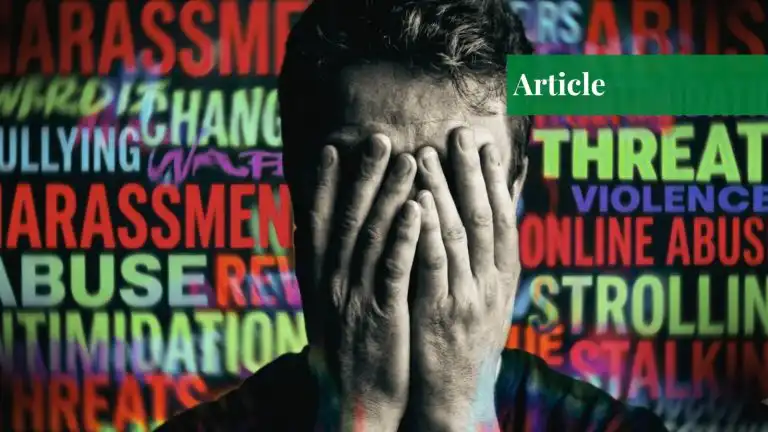
Introduction
In the modern world, social media plays a crucial role in shaping public opinion. Out-of-context clips and any post can trigger the public within hours. The public, without checking all facts and figures, believes in those posts and videos and starts reposting on their accounts. Hashtags and online campaigns play an essential role in spreading awareness about sexual violence. Sometimes, wrong information with hashtags can also spread and create chaos and distress in public.
One of the most persistent narratives on sexual harassment is that men are perpetrators and women are victims. Some people say that this perception is rooted in the reality that women have suffered very much from physical and mental violence. But the reality is that women and men both face sexual harassment and violence on an equal basis; the issue is that harassment against men doesn’t make the news headlines. We can say that this is media propaganda that tilted the narrative in favor of women while turning a blind eye to violence against men. Yes, there is news regarding men facing harassment by men, but flipping a coin presents another narrative that men are also facing harassment by women.
As far as justice and accountability are concerned, online activism is very much essential. Raising the question of whether some experiences, such as harassment of men by women, have become so important. If the objective of having a fair discussion about harassment is to be achieved, then it is necessary to accept that men also experience harassment from women. Men have to be recognized as victims of women’s harassment. Not always is a man involved in harassment; sometimes, a woman is also a perpetrator of harassment against men. There is no need to diminish the suffering of women by recognizing men as victims; rather, it will introduce a principle that should apply to every person: All victims should be heard, no matter what their gender is.
The Missing Perspectives: Men as Victims
According to research, 73% of men have faced sexual harassment, of which 70% are victims of harassment by women. In social media, people, especially feminists, post frequently that women can’t be comfortable in a room full of men, but men can feel comfortable in a room full of women. From this post, they highlight a narrative that only men can be perpetrators rather than women. But this is not true; a victim of women’s sexual harassment says that “he is, to this day, afraid to be alone in a room with a woman.” Point to be noted: he was only a child when he was harassed so brutally that, till now, he is suffering from that trauma so badly that he is afraid of sitting in a room alone with a woman.
There are many cases in which men are harassed by women, but they are not highlighted in the news; however, if there is any case in which a woman is harassed by a man, without fact-checking, people start spreading the news without it. Recently, a case of a girl in Jhang was in the news, and many official social media accounts labelled her cause of death as rape by three boys. Later on, after a few days, doctors declared that there were no signs of sexual abuse. The public, especially our youth, didn’t wait for the verification of news; they just re-posted the fake narrative.
Recently, there was an acid attack on Dr. Mahnoor. In those days, there was also an acid attack on a man by his own wife due to an unresolved separation dispute. Social media gave that much coverage to the acid attack on women that the acid attack on men faded and was ignored. Even if it is not covered by many media channels. Other than this, there are many reports where men are harassed by women in their workplace, but many people don’t know this due to the strong narrative created by society that men are always the perpetrators, not the victims. Social media is creating awareness regarding this issue, but the irony is that the same media criticizes men when they share their experience of harassment. Even the media normalizes the situation. The same act is framed as “interest” when women are involved, and “harassment” when men are involved. This is the double standard in media perception.
If a man goes to the police station and says that he is being harassed by a woman, he would be mocked, and no one would believe him. There are some gender norms created by society that a man cannot be harassed by anyone. Men are raised in an environment where they are taught to be strong and brave. And according to our society, not sharing your feelings and emotions is considered to be strong. From childhood, they are taught not to cry over small things; from that early stage, their sacrifices and sufferings begin.
In this society, there is a strong belief that men cannot be victims, and even if he shares his sufferings with proof, society does not believe him and tells him that he is not a man because “how can a man be harassed by anyone?” We have to change this narrative; men are being harassed by women, and they are the victims who are unable to speak out about their sufferings. In workplaces where the leader is a woman, complaints of harassment from the male staff have reportedly been ignored due to gender bias. Due to this, many cases where men are the victims of harassment from women are not highlighted in the media. Here, the point is not to pit feminism against men’s rights; both can be discussed without any comparison.
Legal Gaps in Gender-Neutral Harassment Cases
Legal frameworks are changing, and now they define sexual harassment in gender-neutral terms, but still, there is a lack of its practical implementation due to certain gaps. Police stations generally report FIRs regarding female harassment, and they ignore men as victims of sexual harassment. As a result, cases involving male complaints are not handled with seriousness. In some cases, the male victim hesitates to report the issue due to the gender norms that say so much about men’s masculinity. This gap between legal frameworks and their implementation contributes to not highlighting men as victims of female harassment.
Awareness campaigns should also be promoted regarding this issue. Not only men but also women should take part in these campaigns. Just as men promote female rights, women should promote men’s rights. This would be the equality and fairness in treating harassment and violence issues regardless of gender. Without institutional sensitivity toward male victimhood, the broader goal of justice and accountability remains incomplete, as certain experiences continue to fall outside the dominant narrative of protection.
Conclusion
Sexual harassment is not an issue that can be understood through a single lens; instead, one has to flip the coin and see the other side of the story. The public, especially our youth who are the nation builders, should question everything. They should know that if women are harassed by men, women are harassed by women, and men are harassed by men, so it might be possible that men are also harassed by women. If it is, then why has this issue not gotten as much attention as it needs? Once our society, our youth, start questioning this, they will start recognizing men as victims, not only as perpetrators. A balanced approach doesn’t mean comparing or diminishing female suffering to men’s. Instead, it will expand our understanding so that empathy and justice will be received equally, regardless of any gender discrimination.
“Men are victims of domestic abuse too, but they are often overlooked in research, policy, and support services.”
Dr. Elizabeth A. Bates, domestic abuse researcher
If you want to submit your articles and/or research papers, please visit the Submissions page.
To stay updated with the latest jobs, CSS news, internships, scholarships, and current affairs articles, join our Community Forum!
The views and opinions expressed in this article/paper are the author’s own and do not necessarily reflect the editorial position of Paradigm Shift.

Syeda Farani Fatima is an undergraduate student of International Relations at the International Islamic University of Islamabad, with a strong interest in anti-corruption, counter-terrorism and geopolitics. Strongly committed to fighting corruption, terrorism, and supporting national reform through research and public service.