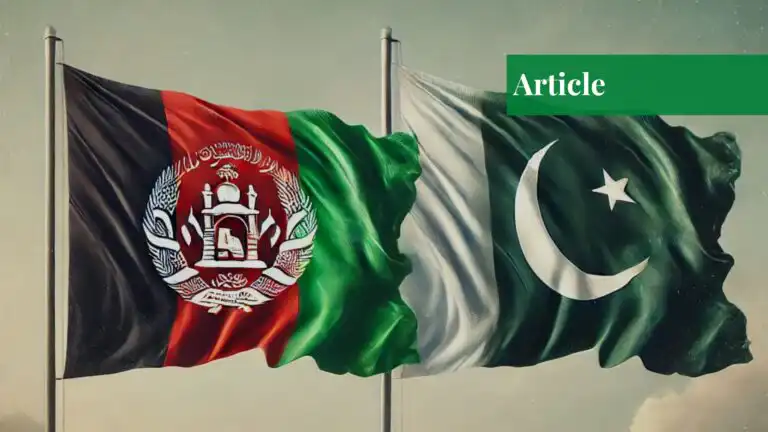
The relations between the Taliban and Pakistan are the subject of an elaborated history and offer a complex picture of shifting alliances, conflicting interests, and withdrawal of interest that runs across decades. As pure political entities, they seem tied by certain ideological, cultural, and geo-strategic affinities, but under the surface, full of conflicts do develop into a series of competing interests hampering the dynamic of relations. Are the two true allies with common strategic interests, or are they ultimately enemies navigating through a long, hard path of power play, fragile cooperation, and inevitable recoil against each other’s interests?
Understanding the relations between the Taliban and Pakistan requires a consideration of the history of the ascendance of the Taliban to power, the pivotal nature of Pakistan in the region, and how the relationships have evolved. From mutual cooperation in the 1990s, throughout the past several years, the cooperation between the Taliban and Pakistan has remained dynamic and fluid, generating increasing tensions mostly due to the inconstant tides of international diplomacy, regional power struggles, and fast-evolving Afghan politics.
The Genesis of the Relationship: A Shared Ideological Foundation
The Taliban-Pakistan relationship can be traced back to 1991, after the Soviet withdrawal from Afghanistan. However, it quickly descended into civil war with different factions fighting for power. Since Pakistan had played an important role in supporting the Afghan Mujahideen during the course of the Soviet occupation, it was heavily invested in the outcome of the Afghan conflict. During the course of the civil war, Pakistan began to support the Taliban, which was a Pashtun-dominated group that started in southern Afghanistan in the mid-1990s.
The Taliban, under the leadership of Mullah Omar, was, in the beginning, supported by Pakistan due to historical ethnic links between the two groups since they are predominantly Pashtun. Furthermore, another reason was that the Taliban emerged as a religiously aligned force working to impose a strict interpretation of Sharia law; this was in accordance with the philosophy shared with one of the Islamist factions backed by Pakistan’s military regime.

Pakistan perceived the Taliban as a potential force for stability in Afghanistan that could restore normality in the country long beset by civil war. For Pakistan’s military and intelligence institutions, the Taliban would provide an opportunity for Pakistan to possibly extend its influence in Afghanistan and to maintain a friend-client state regime in Kabul.
In the 1990s, Pakistan’s support for the Taliban was strategic and ideological. Strategic in nature, Pakistan sought to establish itself in close proximities in Afghanistan, arguably one of its most immediate neighbors, for the purpose of securing its western flank from India, its longstanding regional rival. Ideologically, certain institutions in Pakistan long regarded Islamist groups as a way of effectuating its vision of a Muslim-centric regional order itself. The attainment of power by the Taliban would thus naturally appeal to Pakistan, given its aforementioned ideological sympathy, even though it was certainly far more secular-inclined when it came to actual governance.
The Taliban’s Ascendancy: Strategic Gains for Pakistan
When the Taliban gained control of Kabul in 1996, Pakistan was among the first nations to recognize the new regime. For Pakistan, the victory of the Taliban was a strategic victory, giving it direct access to Afghanistan, setting up trade routes, and opening the door for further expansion in the region. The Taliban also echoed a pledge to control the warlords who increasingly grew hostile to Pakistan’s interests and control the Pashtun areas of Afghanistan, resonating with Pakistan’s own Pashtun-majority areas, notably the Khyber Pakhtunkhwa province.
From the geopolitical consideration, the Taliban government added a strong asset to Pakistan’s regional schemes. Moreover, Pakistan saw the Taliban in the framework of cooperation against India in Central Asia, where Pakistan aspired to further its influence through regional economic and military alliances.
However, Pakistan’s relationship with the Taliban was not trouble-free either. Though Pakistan had provided enormous logistical, financial, and military support to the Taliban, it sought to control the Taliban’s actions on several issues, especially with regard to its relations with Pakistan’s long-standing enemies. Pakistani support for the Taliban was not unconditional. Pakistan expected allegiance from the Taliban in terms of its regional policies, mainly in preventing the influence of Iran and India in Afghanistan.
Post-9/11: A Shift in Allegiances
It was not just the equation of Pakistan and the Taliban that changed, but Pakistan’s geo-social structure, too, was hit due to the impacts flowing from September 11, 2001. The US invasion of Afghanistan and the removal of the Taliban regime changed the geopolitical map in ways that Pakistan never imagined. An unparalleled dilemma was posed to Pakistan after 9/11: the US wanted Pakistan to cooperate in the fight against terrorism within that bad new world as it was seen as a major ally in the War on Terror. With Pakistani President Pervez Musharraf pressed into an alliance with the United States in support of the removal of the Taliban regime, Pakistan had no option but to change the priorities of its foreign policy.

This compounded the rift between Pakistan and its erstwhile allies in Afghanistan. The exile of the Taliban in Pakistan’s tribal areas thus represented defiance against both the US-backed Afghan government and Pakistan’s new treaty with the West. While publicly condemning Taliban rule and cooperating with US forces in the region, Pakistan was simultaneously criticized for harboring the Taliban in its tribal areas. Many analysts would argue that support for the Taliban from Pakistan was never withdrawn because even the ISI continued supplying, letting the Taliban slowly regroup and reclaim their strength in Afghanistan over the years.
The Post-Taliban Era: A Tenuous Partnership
Over the years, the resurgence of the Taliban in Afghanistan created new complications for Pakistan: it had initially sought to distance itself from Taliban extremism with increasing complicity as the group recovered its grip on power in Afghanistan, especially following the withdrawal of US forces in 2021. Pakistan is under increasing pressure from the international community to continue walking a very fine line: open support for the Taliban while professing an ongoing commitment to anti-terrorism activities.
Today, there is a complex mixture of pragmatics and skepticism defining the relationship between the Taliban and Pakistan. On the one hand, Pakistan still regards the Taliban as an ally of its own interest, a partner for maintaining stability in the region that would, therefore, form a counterweight against Indian influence. In any context, the Taliban being in power in Afghanistan improves Pakistan’s strategic position in that effort to have a friendly, ideologically aligned neighbor. There are also worries like the growing influence of a tightly knit Taliban that inspires the radicalized communities in Pakistan, particularly the Pashtun-majority areas in the FATA region.
The prospect of blowback from its years of support for the Taliban has long been a concern for the Pakistani government. Since the emergence of the Tehrik-i-Taliban Pakistan, which is a breakaway group largely seen as an offshoot of the Afghan Taliban, the instability of Afghanistan has returned to haunt Pakistan. The TTP has been implicated in countless attacks across Pakistan, especially in Khyber Pakhtunkhwa Province, and its improving scope has raised fears of an outright armed insurgency. Over the years, the regular Pakistani Armed Forces have had to increase operations against TTP militants in recent years while still maintaining friendly ties with Taliban affiliates.
Conclusion: Friends or Foes?
Determining whether the Taliban and Pakistan are true friends or foes is not such a simple task. Though they have certain ideological affinities and shared strategic objectives, they have also had contradictions and competing interests stemming from the very beginning of their relationship. Pakistan supported the Taliban in the past, right from the beginning, and both cooperated on numerous issues regarding regional security. However, rising concerns in Pakistan originated from the Taliban’s encroaching influence on its borders and the growing instability within Pakistan’s tribal regions, which create avenues of distrust between them as well.
This partnership is based on convenience, not a substantial alliance. Their mutual interests are shared in theory, but such shared interests are sometimes cast aside in favor of a different set of collective interests. In the wake of the uncertain unfolding of events in Afghanistan, the relationship between the Taliban and Pakistan continues to be an important consideration in maintaining the region’s balance of power; such a dynamic will continue to change under the pressure of both internal and external forces. The future remains uncertain, except in the view that this is a complex and multi-layered relationship that will remain a determinant of the geopolitics of South Asia for years to come.
If you want to submit your articles, research papers, and book reviews, please check the Submissions page.
The views and opinions expressed in this article/paper are the author’s own and do not necessarily reflect the editorial position of Paradigm Shift.

Momina Areej is currently pursuing an MPhil in Clinical Pharmacy Practice. With a passion for writing, she covers diverse topics including world issues, literature reviews, and poetry, bringing insightful perspectives to each subject. Her writing blends critical analysis with creative expression, reflecting her broad interests and academic background.