
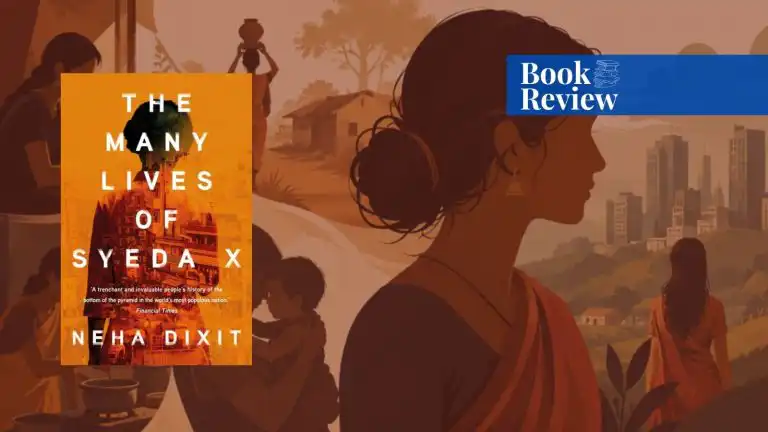
As you read history from the sweep of gigantic political narratives, great men standing at the centers of social and political upheavals. Do you wonder what history might look like when viewed through the eyes of ordinary people? The events that you come across in the books, newspapers, or on your screens- how they unfold in the lives of people, what happens when they enter the homes, neighborhoods, and workplaces of ordinary people? About the social history in making, in the towns, urban centers, and informal workplaces? It is this social history that Neha Dixit captures in “The Many Lives of Syeda X: The Story of an Unknown Indian”, through the life and world of a working-class Muslim woman, Syeda.
Set in working-class neighborhoods of the Indian capital, Delhi, the book reconstructs India’s social history from the 1990s onwards, through the life of a working-class Muslim woman. Syeda was born into an artisanal weaver’s family in Banaras, one of the oldest cities of India, and married while in her early teens. In the mid-1990s, she migrated to Delhi with her husband and three children. Syeda’s migration was prompted by communal violence and economic liberalization; handloom weavers couldn’t compete with the cheaper production of power looms; those who relied on weaving as a primary source of income for generations were not ready for the transition, as they lacked the necessary resources to set up power looms in the wake of the new industrial policy. Riots affected the business as well; the looms were destroyed and valuables looted during raids on Syeda’s house.
In search of a better life, Syeda moved to Delhi; however, her life was marked by constant uncertainties, poverty, displacement, and various other daily life hardships faced by the urban poor. From renting a room in the Khari Baoli area of old Delhi, close to India’s largest wholesale market, to moving to Sabhapur (Northeast Delhi) following court orders to move industries responsible for polluting the city’s air, and to Karawal Nagar, every part of the City brought unique challenges for Syeda. She took up over 50 jobs in the period of almost three decades. “From trimming the loose threads of jeans to cooking namkeen, and from shelling almonds to making tea strainers, pressure cookers, and photo frames, among many other things”. The chapters of the book are named after the things Syeda made during different time periods: zari, raisin, gajak, doorknob, almond, soft toy, incense stick, tricolor, wedding card.
Through the life of Syeda, we come across so many people, the informal workers like her who make up 82 percent of India’s working women. How they unionized and led the longest and biggest strikes of informal workers, refusing to work for contractors who were paying them merely 50 rupees for a 12- to 15-hour labor of shelling and cleaning almonds. Husbands, unsupportive of the strike, later turned to support; the intimidation of police and disruption of the almond processing supply chain resulted in a 40 percent increase in almond prices globally, and at last the success of their strikes, resulting in increased wages. The long chain of contractors and subcontractors, those who used child labor, and global brands getting their manufacturing done by people working in hazardous conditions. How people dodge the implementation of regulations by using a proxy to run a small-scale factory. A slumlord who aspired to climb the social ladder but was considered a nuisance by the landlords.
There is also a depiction of how people profit from polarization and division and how certain narratives of hatred are perpetuated from the grassroots that later alter the course of the lives of many. Syeda’s elder son falls in love with a Hindu and elopes to marry, and her life continues; then come the Delhi riots, a horror that Syeda and her family had escaped, came back haunting.
The book is a result of decade-long ethnography and 900 interviews; with her captivating writing style, she walks her reader through every world she explores. The story of Syeda is not portrayed as merely a story of an individual caught in the turbulence of larger transformations. Her life becomes a way of witnessing those transformations themselves. While economic liberalization, industrialization, rapid urbanization, communalism, and outsourced global supply chains may appear as the economic and political transformations, in the life of the likes of Syeda they take the form of migration, informal housing and employment, the lowest wages, and constant struggle to secure the means of survival. The book not only brings the ordinary person into history but shows how the ordinary person experienced that history.
Further reflected in the treatment of informal labor, it’s not treated simply as a space outside the formal economy, occupied by people left behind by development. Syeda’s work is shown to be connected to larger systems of production and consumption. The contractor, subcontractor, and global brands associated with her working life form a chain where risks and costs of production are outsourced to the downtrodden, and in this chain, the most vulnerable are workers like Syeda.
Syeda’s over fifty jobs in three decades show the fragmented character of the life of the urban poor. Her work cannot be described through a single occupational category, just one job after another: “If she ever took time off, to nurse an illness or to attend to her children, her job would be lost to another faceless migrant fighting to take her place.” In a labor market where there is a systematic absence of security, she has to quickly learn different kinds of work and reinvent means of survival.
The life of Syeda is not only presented as a worker or a migrant, but there is also a gendered character to it; her life is entangled with marriage, familial responsibilities, and relations of household authority. The strike by the almond workers and what followed shows the significance of collective action that not only alters workplace relations but also household relations. Similarly, in the treatment of communalism, the book shows how its effects are diffused. Religious identities penetrate the workplaces, neighborhoods, families, and decisions about where one can live safely.
Every chapter and section starts with a headline from the media about a grand happening in the country or city, followed by different events in the lives of the protagonists. The ethnographic accounts show how those grand events unfold and are experienced by ordinary people. This is perhaps the real strength of the book, making it a work of social history. Asking us to reevaluate our reading of history and headlines after seeing how they are experienced by ordinary people.
If you want to submit your articles and/or research papers, please visit the Submissions page.
To stay updated with the latest jobs, CSS news, internships, scholarships, and current affairs articles, join our Community Forum!
The views and opinions expressed in this article/paper are the author’s own and do not necessarily reflect the editorial position of Paradigm Shift.
Muhammad Yameen is a sociology graduate from the School of Sociology, Quaid-i-Azam University, Islamabad. His academic interests centre on urban inequalities, class, gender, and anti-colonial movements.