

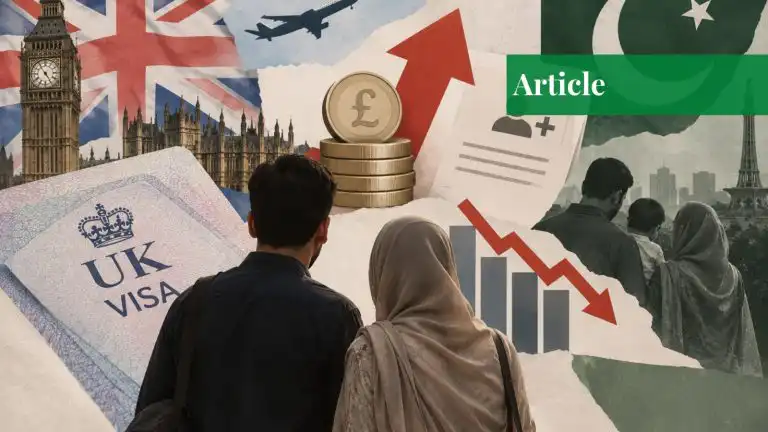
What is the ontological cost of institutionalising domestic cohabitation on individual autonomy? In the UK, this is largely answered in the language of pounds sterling. When a married couple can be kept apart despite a genuine relationship based on a salary threshold, the question is no longer simply whether public funds can be preserved through immigration policy but where economic control ends and legal recognition of family life begins.
On a given morning, upon entering UK visa application centres across Pakistan’s major urban centres, namely Lahore, Islamabad, and Karachi, one immediately observes that family reunification applications constitute the predominant administrative caseload. The issue carries significant weight for Pakistani families, since Pakistani nationals have remained the largest nationality group among those receiving UK family visas. This accounts for almost 14% of all family visas granted in the year ending March 2026, with more than four-fifths of these applications falling into the category of the partner route.
For this reason, these figures represent more than just immigration statistics, and they express that a substantial number of families whose ability to share a life in the United Kingdom may depend largely on satisfaction of applicable financial requirements. For a British-Pakistani sponsor residing in cities like Bradford or Birmingham and a spouse residing in Pakistan in cities such as Sialkot or Gujranwala, the £29,000 threshold can become a prevailing criterion. This criterion would potentially decide whether their family can reunite in the United Kingdom through the partner route.
A Threshold That Hit This Corridor Hardest
The Minimum Income Requirement (MIR) for the United Kingdom, established under Appendix FM of the UK Immigration Rules, came into force in 2012 and required sponsors to demonstrate an annual income of £18,600 before bringing their partners to the United Kingdom. This was predicated on the premise that sponsors should be able to financially sustain their partners without relying on public funds.
The threshold was altered paradigmatically on April 11, 2024, when it was increased to £29,000. This represents a rise of approximately 56%. The rise was not primarily intended to impose a full stop there; the previous government had consistently proposed progressively increasing the requirement to £38,700.
Nonetheless, the Migration Advisory Committee (MAG), with its June 2025 review, subsequently investigated the level at which the requirement had been set. The MAG stated that this threshold of £29,000 was high by ‘international standards’ and recommended a lower range of approximately £23,000 – £25,000. The government did not alter the prerequisite by mid-2026, even with the aforementioned recommendation, and left £29,000 as the applicable threshold.
The repercussions of the accentuated threshold are significantly visible along the UK-Pakistan migration corridor. As for the statistics from the Home Office, there has been a decline of 19% in partner visa grants in the year ending March 2026. This represents one of the more considerable reductions among nationalities using the family route. This considerable decline has been associated with the introduction of the higher financial prerequisite by the Home Office itself. This is not something surprising when the underlying demographics are considered.
The pertinence of the change becomes even more conspicuous when considered against the employment conditions of many British-Pakistani sponsors. It also includes those who are working in occupations like retail, hospitality, taxi driving, and manufacturing, where annual gains may usually fall below the £29,000 threshold. The prerequisite specifically places particular pressure on those sponsors whose earnings are primarily concentrated in lower-paid sectors, and this accounts for almost half of UK employees earning less than £29,000.
With that stated, to establish whether British-Pakistani sponsors are actually impacted disproportionately, specific income data for that population would be required rather than merely considering broader UK earnings figures.
The Practical Weight of the Rule, Seen from This Side
The Minimum Income Requirement (MIR) is not the only problem that is usually faced by potential candidates, as per the practitioners who handle applications from a Pakistan-based office. As the application is being submitted from Pakistan, there are additional pertinent prerequisites and practical steps in the application process. Financial and logistical challenges are accentuated by this, and it opens a Pandora’s box. Prior to a visa grant to any applicant, a tuberculosis certificate, which is usually only valid for six months, must be issued to applicants living in Pakistan by a Home Office-approved TB testing centre.
Those who do not fall into the exempt categories will have to appear in an approved test, such as an A1 or A2 English test. This is to meet the relevant English language prerequisite due to Pakistan’s exclusion from the list of nations with a majority of English speakers. The process also requires biometric and document appointments through specialised visa service centres, like FS Global and Gerry’s centres in Islamabad, Lahore, Karachi, and Mirpur, meaning that applicants living outside major cities may have to travel considerable distances and incur additional expenses to complete the procedural requirements.
Each prerequisite may primarily seem manageable when viewed separately, but their cumulative effect can get on nerves when imposed on families who are already struggling to satisfy a specified income threshold. Altogether, this becomes a considerably more expensive, time-consuming, and demanding process for a family who is already struggling with a financial threshold that half the sponsoring population cannot satisfy. It transubstantiates a routine family reunification into a multi-year undertaking for many genuine relationships.
The Legal Safety Valve and Its Real Cost
Judicial scrutiny has also brought the Minimum Income Requirement rule to light. It has been ascertained by the UK Supreme Court in MM (Lebanon) & Others vs. Secretary of State for the Home Department [2017] UKSC 10 that, provided the governmental legitimate objective is to limit reliance on public funds, an income requirement could be lawful in principle. In addition, the Court also identified deficiencies in the manner the Immigration Rules operated.
The court found that the rules, as drafted, did not actually cater properly to the duty imposed under section 55 of the Borders, Citizenship and Immigration Act 2009 to treat the best interests of children as primary consideration. This particular judgment, somehow, left room for Article 8 of the European Convention on Human Rights, where an application’s refusal would consequently lead to unjustifiably harsh consequences.
Practically, applicants who fail to satisfy the financial prerequisite of £29,000 may consequently have to rely on the alternative 10-year partner route instead of the standard five-year route. This makes judicial protection a considerably longer path to settlement.
It is pertinent to explain the practical implications of the 10-year route to applicants from the baseline stage of application. It cannot serve as a quicker alternative when it becomes difficult to meet financial requirements. In fact, this extends the usual five-year route to settlement into a whole decade of transitory immigration status. In addition, during that period, the applicant is required to meet the conditions of their leave, including payment of renewal fees, satisfaction of English-language requirements, and demonstration of the fact that the relationship continues to meet the relevant prerequisites.
The consequences are exaggerated for those Pakistani families that must already meet considerable upfront expenses to make the application, including the partner visa fee itself, additional expenses for biometrics, and tuberculosis testing and language tests. It is not a minor consequence, and the spouse visa fee alone, converted at the Home Office’s quarterly exchange rate, amounts to roughly Rs. 788,341. In this way, not just the financial requirement gets postponed through this alternative route; it can give rise to a predominantly longer period of recurring financial and administrative obligations even before permanent settlement becomes possible.
Courts Are for Opening the Door, Not Lowering the Bar
The distinction established mainly by the MM (Lebanon) case is important to understand why the Minimum Income Requirement has remained where it has been despite the subsequent increases. The Apex Court was not determining whether £18,600 constituted the appropriate level of income, nor did it establish a particular figure which the government must adopt as a constitutional requirement. Instead, its pivotal concern was whether the Immigration Rules as a whole provided an efficient safeguard for cases in which “unjustifiably harsh consequences” would become the fate of their application.
The subtle approach to this exceptional Article 8 route was substantially made clear by the case Agyarko and Ikuga v Secretary of State for the Home Department [2017] UKSC 11, which required the consequences for the particular family to be assessed on an individual basis. The significance for both practitioners and clients is that Article 8 of the ECHR can be invoked as a recourse for an individual applicant in an exceptional case, but it does not ordinarily validate any mechanism for resetting or challenging the financial threshold itself. A broader modification of the baseline MIR threshold therefore remains principally a matter of immigration policy and governmental decision-making, including whether to act on the Migration Advisory Committee’s recommendations.
How The Line is Drawn by Other Countries
A comparative analysis provides useful context for the assessment given by the Migration Advisory Committee that the UK’s £29,000 threshold is high when it comes to international standards. It’s been demonstrated by Canada’s approach towards spousal sponsorship that concerns about financial dependence can be addressed by a state without imposing a minimum income threshold on the sponsoring spouse. Canada, being a country of comparable economic development, allows sponsors to sign a legally binding three-year undertaking to support their partners (a defined period), subject to the applicable rules, rather than requiring the sponsor to earn a specified amount.
This illustrates the creation of a fundamentally different policy model from that of the UK, where a fixed income requirement filters the ability of a sponsor to sponsor a spouse. This comparison becomes comparatively relevant for practitioners advising Pakistani families exploring both sides because it shows that financial protection can be pursued through mechanisms other than a minimum-income threshold, which may prevent otherwise eligible couples from using the usual family reunification path.
What This Means in Practice
None of this necessarily equates to the notion that a financial prerequisite would have no legitimate position in the family migration system. Safeguards against genuine dependence on public funds may be sought lawfully and reasonably by the state. However, it becomes really pertinent for the firms advising the Pakistani clients to get them well-acquainted with the existence of the requirement and deal with the matter meticulously.
The first step is to pragmatically assess whether the sponsor can meet the set standard on the basis of their documented income. In case it becomes difficult to meet the income threshold, other financial routes permitted under Appendix FM-SE must be equally evaluated and considered by the practitioners. These routes may include self-employment income, qualifying savings, and some other applicable sources of income, but it should not be presumed that Article 8 of the ECHR application under the ten-year route is the only available option.
Where going for an alternative route becomes inevitable in any situation, then clients should be informed from the outset about the hassle of additional years, costs, and renewals involved so that they may make an informed decision about their immigration route.
Practitioners must work in accordance with the rules as they exist for now, till the time the government responds positively to the Migration Advisory Committee’s recommendation to reconfigure the threshold to move it closer to the £23,000–£25,000 range. The appropriate stance, henceforth, is not about the insurmountable obstacles to family life continuing abroad, but it’s about the route that has become substantially more demanding for many Pakistani-British families. The door is not necessarily closed, but for families that face difficulties meeting the higher financial requirement, it now leads to a substantially longer and more burdensome path than it once used to be.
If you want to submit your articles and/or research papers, please visit the Submissions page.
To stay updated with the latest jobs, CSS news, internships, scholarships, and current affairs articles, join our Community Forum!
Find our FREE quizzes and MCQs here!
The views and opinions expressed in this article/paper are the author’s own and do not necessarily reflect the editorial position of Paradigm Shift.

Ahmad Zubair is a law graduate of Government College University, Lahore and currently works as an immigration paralegal, assisting with UK immigration matters. His areas of interest include immigration law, public policy, and legal writing, particularly issues affecting individuals and families.