
Abstract
This paper examines the structural dimensions of bureaucratic waiting in Pakistan, theorizing temporal delay as a transformative mechanism of social stratification. Focusing on state institutions such as the National Database and Registration Authority (NADRA), passport offices, courts, and public banking services, it focuses on how procedural latency produces and reproduces inequality. Drawing on Hartmut Rosa’s theory of social acceleration, Auyero’s theory of waiting as power, and Bourdieu’s theory of symbolic capital, this investigation argues that temporal control is a form of governance that is subtle but widespread.
By conceptualizing waiting as simultaneously a political phenomenon and a social phenomenon, we locate the experience of delay within the frameworks of state authority, class structure, and access to public services more broadly. The analysis finds that bureaucratic temporality in Pakistan operates not merely as a form of technical inefficiency but as a structural mechanism of stratification, resulting in policy recommendations for administrative bureaucratic reform, providing citizen-centered governance, and creating equitable access to public services.
Introduction
Although time is commonly represented as a neutral measure in social life, temporality is always political in bureaucracies. In Pakistan, citizens traverse a complex array of state offices (NADRA centers, passport services, judicial courts, public banks, and more). The only action citizens engage in is waiting; an excuse is often provided that the delays are a result of technological inefficiency or under administrative capacity. Such justifications do not go far enough to explain waiting’s structural significance as a power and inequality. Waiting is neither trivial nor coincidental; it is a governing practice through which state power is exercised, class orders are perpetuated, and access to material resources is mediated.
The contemporary Pakistani state illustrates how control over time is intertwined with social stratification. Urban elites often sidestep the same bureaucratic delays that lower-income borrowers experience by using their personal connections to facilitate the process for them or by paying informal fees. The impact of waiting as a temporal experience is not only an inconvenience but also presents measurable consequences on economic opportunities, political participation, and social mobility. By concluding that bureaucratic waiting should be understood as a social phenomenon (rather than a deficiency), this paper situates the temporal experience of governance in relation to inequality and state power in its entirety.
The study is guided by three key research questions:
- In what ways does bureaucratic waiting function as a structural mechanism of inequality in Pakistan?
- How do delays in bureaucratic institutions reflect and reproduce wider hierarchies of class?
- What theoretical frameworks could help us understand how temporal experience interacts with state authority?
Using sociological and political theory, we develop a conceptual framework for thinking about waiting as a form of governance, as a form of social capital, and as a site of symbolic power.
This paper adds to existing scholarship on state-society relations, the politics of time, and social inequality in three ways. First, we reframe bureaucratic delay as a social and political object of study by extending Auyero’s conceptualization of waiting in Latin America to the South Asian context. Second, we link Rosa’s theory of social acceleration to highlight variations in the lived experience of time between elites and marginalized populations to show how different forms of access to time work to consolidate power. Finally, we draw attention to the intersection of bureaucratic structure, procedural latency, and inequality, which has significant policy implications for reforming service delivery in the public sector.
The paper employs an ethnographically informed conceptual methodology, which includes observational data, secondary research, and institutional analysis to understand and analyze the temporal dynamics of bureaucracies in Pakistan. It unpacks administrative practices in relation to lived social realities and the material effects caused by waiting. By understanding waiting not only as a tool of governance but also as a social practice, the paper suggests a re-evaluation of time in policy making, noting implications for both equity and efficiency in state institutions and the lack of transparency.
Literature Review
Scholarly attention has been increasingly devoted to the sociological and political aspects of bureaucratic waiting, much of which is found within studies of state power, social inequality, and time governance (Girard, 2023). Interestingly, the physiologist studies of Hartmut Rosa on social acceleration provide an essential analytical lens for understanding how contemporary concepts of time, through bureaucratic regimes, structure human life.
Rosa (2013) develops acceleration as a complex phenomenon, which includes technological and social, as well as existential dimensions. There are multiple aspects of acceleration, where the rhythms of life and institutional processes overtake individual capacity for autonomous action. The complex interplay of acceleration and deceleration is less evident in bureaucracies: elite populations race through the institutions that govern their lives, while those on the margins are forced to abide in static temporalities, experienced as waiting, bureaucratic impediments, and delays in access to rights and entitlements (Dromgold-Sermen, 2023).
Rosa’s framework aptly describes the chasm of perceived time between formal time and the subjective working temporalities of individuals who allow themselves to be clothed in bureaucratic processes while existing in a space of waiting. Thus, by disaggregating bureaucratic time, we can see a structural inequality that is woven into the fabric of lived time.
Auyero’s (Auyero, 2011) ethnographic studies on Latin American public services complement Rosa’s conceptions of waiting in that they highlight how the politics of waiting can be seen as a governance technique. In his examination of social welfare offices and state-administered aid programs, Auyero argues that waiting is not simply an outcome of administrative inefficiencies, but an intentional mechanism through which state authority is exerted, and social stratification is maintained.
Waiting constitutes a location of moral judgment, social disciplining, and resource rationing, creating a temporally stratified experience where those who are elite, who are able to cut the line, do not have to wait, while those who are poor must endure the conditions of a slow-moving bureaucracy. As Auyero conveys, it is precisely in the political efficacy of waiting which causes the visibility of citizens is caused, while simultaneously rendering them docile. Those who wait become objects of bureaucratic and state surveillance and action, but in doing so, their act of waiting provides a space, or time, for the demonstration of bureaucratic and state action.
Foucault’s theories of state power and governmentality illuminate the normative and regulatory aspects of bureaucratic waiting. Foucault (Lemke, 2015) identifies the mechanisms through which modern institutions organize the lives of populations, not just through coercion, but through the arrangement of everyday practices, norms, and rhythms of time. Bureaucratic delay operates on this logic: the regulation of time within institutions is a mode of population management, where compliance, patience, and habituation are expected and regarded as normative (Beyond the Red Tape, n.d.).
Therefore, waiting is both disciplinary and biopolitical, producing docile subjects who internalize the obligations of the bureaucracy. In the South Asian context, the temporal regulation of citizens is made more complicated by colonial legacies where the administrative systems aimed to surveil, categorize, and control populations while embedding hierarchical temporalities into institutional practice.
Empirical work focused on South Asia and Pakistan confirms the theoretical claims of Rosa, Auyero, and Foucault (Pakistan’s Kafkaesque Identity Problem, n.d.). Historical and more contemporary studies demonstrate that state institutions in Pakistan perpetuate social stratification by providing unequal access to bureaucratic processes. Interviews conducted in large urban areas such as Karachi, Lahore, and Islamabad have shown that citizens from lower socio-economic backgrounds are routinely forced to wait in lines of unrelated paperwork at NADRA registration offices, passport facilitation centers, and lower courts, sometimes for weeks and months.
On the other hand, citizens who have social capital, funds, or political connections can accelerate the same process through an intermediary or make an informal payment (Aftab et al., n.d.). The language of waiting time highlights larger structural inequalities: the bureaucratic wait remains its own signal of class, gender, and regional inequality, as well as a mechanism through which processing is reproduced.
In addition, bureaucratic waiting has gendered dimensions in Pakistan. Women, especially those from rural or low-income contexts, face additional delays from overlapping social, cultural, and logistical constraints. Gendered domestic labor, constraints on mobility, and cultural dictates intersect with bureaucratic inefficiency, leading to gendered temporal burdens, which serve to reinforce patriarchal systems of public service provision (Privacy and Digital Identity: The Case of Pakistan’s NADRA, n.d.). In this connection, waiting is more than just a bureaucratic inconvenience; it is the point at which state practices intersect with social norms to create systemic inequities.
The literature also highlights that delay is normalized, indicative of engaging with public service agencies (Iqbal et al., 2020). Citizens internalize the expectancy of delay; they have developed strategies to deal with the time it takes for service delivery, including intermediaries, planning for multiple visits, and sequencing “urgent” tasks based on potential bottlenecks. These forms of coping make bureaucratic temporality seem natural, concealing structural inefficiencies and hiding the overall social cost of forced waiting (Auyero, 2011).
Overall, these studies place bureaucratic waiting as a very dimensional site of inquiry, drawing on sociological, political, and historical perspectives. Rosa highlights the differentiated experience of speeding up and slowing down time. Auyero framed it as a dimension of power, and Foucault framed it within a set of normative and regulatory functions of temporal governance. These insights and analyses ultimately align within the Pakistani context into an argument that waiting is neither incidental nor neutral. Wait is a structured, deliberate, and socially consequential practice that produces measurable outcomes tied to access, equity, and social mobility.
Methodology
This study utilizes a multi-method research design involving qualitative ethnographic observation, conceptual analysis, and a documentary study to analyze the structural, temporal, and social aspects of bureaucratic waiting in Pakistan. In addition to these methods, it acknowledges the challenges for quantitative or survey-based designs to represent the lived temporalities of state institutions. The design offers a mixture of depth and analytical granularity, situating empirical observation in more theoretical literatures on social acceleration, bureaucratic power, and structural inequality.
The main methodological approach is ethnographic and interpretive. Ethnography in this context is used broadly to include observation in the field and indirect fieldwork through ethnographic accounts in textbooks, media reports, and testimony from citizens. The site selection centers on institutions that embody state-administered waiting in urban Pakistan, such as NADRA offices, passport facilitation offices, municipal services counters, lower courts, and local branches of banks.
Observation in the field involved timing the procedural steps, recording queue lengths, and timing processing intervals and visible interactions with the administrative staff. We documented points of divergence in service delivery while noting demographic markers, including gender, apparent socio-economic class, and mobility limitations, to account for varying experiences of waiting. Observational data were supplemented by informal interviews with citizens and administrative staff members, when possible, to gain insights into procedural reasoning, individual coping strategies, and individual perceptions of institutional time management. Due to concerns about confidentiality and ethical issues, the use of direct identifiers or quotes was prohibited, but we rendered indicative accounting to aid analysis of social and temporal inequity.
Beyond fieldwork, this research involved a document-based and archival methodology that situates findings from ethnography. Government documents, such as policy manuals, official letters, and notifications (including DRAP), procedural guidelines, service charters, and associated laws, were reviewed to map the formal structures surrounding administrative timelines. Records of parliamentary debates, policy papers, and audits also help reveal historical and institutional rationales for delays in service provision. Media analysis provides context on public storytelling of encounters in access, reporting on bureaucratic blockages, and citizen workarounds to bypass waiting. Collectively, these documentary forms of data source triangulate and locate the empirical observation into the regulatory and discursive processes of Pakistani bureaucratic state institutions.
Conceptual analysis serves as an additional component of the methodology. By utilizing Rosa’s(Rosa, 2013) representation of social acceleration, the research distinguishes between temporalities that are institutional and subjective, and identifies a disjunction between procedural timelines and experiences of citizens. Auyero’s (Auyero, 2011) theory of the politics of waiting aids in the reading of waiting as a mode of governance, which allows the research to interrogate time’s status as both a tangible and a symbol of the authority of the state.
At the same time, Foucauldian ideas of governmentality and disciplinary power supply a lens for analyzing the ethical and regulatory implications of waiting for a long time. Their theoretical frameworks shape both data collection and analysis, supporting conceptual coherence and analytical robustness.
As an analytical approach, the data were coded thematically to consider patterns of inequality, structural bottlenecks, and strategies of adaptation. Coding categories include: (i) procedural inefficiency, (ii) temporal stratification across socio-economic groups, (iii) gendered patterns of waiting, (iv) informal means of acceleration (including bribery, intermediaries, and social networks), and (v) discursive framing of waiting in media and policy. Triangulation across observational, interview, and documentary data enables cross-validation of the data and minimizes possible biases of single-method studies.
The method used in this study also has a comparative-historical aspect. By looking at colonial administrative practices, bureaucratic reforms that took place after independence, and contemporary forms of service delivery, this study situates present-day temporal inequalities within a longer history. The use of historical context helps to identify enduring structures and disruption in bureaucratic time, and foregrounds waiting as an entrenched political and social practice rather than as a random byproduct of inefficiency.
Ethical considerations were paramount in the design of the method. All observations occurred in public spaces to limit intrusion into private interactions, and informed consent was obtained for all interviews. Demographic data with sensitive implications were anonymized to prevent the identification of participants. The study also recognized the power difference in researchers engaging with citizens, particularly when working in the bureaucratic context, where participants may fear reprisals, nonetheless. Methodological safeguards were taken to prevent direct attribution to any critical commentary on institutional performance, and careful contextualization of observations only if they did not misrepresent intended meanings.
Results & Discussion
The practical experiences that were documented in NADRA offices, passport facilitation centers, municipal courts, and banks show that waiting in Pakistan is much more than an inconvenience; it is a socially constructed form of stratification. Scheduling bureaucratic delays is not neutral but is produced, organized, and sustained in specific ways to disadvantage particular social groups and structures. Agreeing with Auyero’s notion of waiting as governing, waiting times become a form of conditionality: they manage social divisions in hierarchies of access and exposure, causing some lives to remain perpetually held back, while accelerating time for others, who have capital, social, economic, or cultural. Waiting, therefore, is not simply due to inefficiencies; rather, it is a deliberate organization of time that constitutes enduring social inequality.
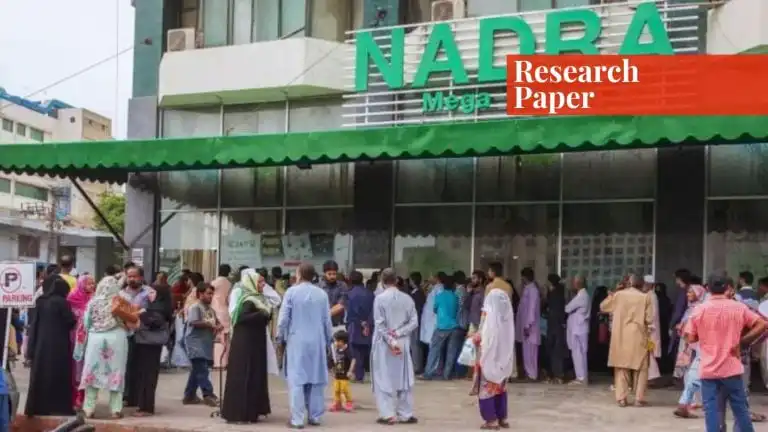
While taking observations in different institutional contexts, it becomes clear that waiting is socially as well as spatially differentiated. For instance, in NADRA offices, people from lower socio-economic positions often arrive before dawn and wait in informal networks and queues outside formal premises to access services. Whereas, citizens who possess educational attainment, social networks, or the means to hire intermediaries have privileged access and avoid long waits in queues through either paid priority appointments or informal facilitation services.
This indicates Bourdieu’s idea of capital as multidimensional: economic, social, and cultural resources easily convert to time. In this case, time becomes a type of capital with the poor incurring temporal cost through protracted, uncertain, and opaque interactions with bureaucratic procedures. These temporal distinctions only multiply with gender, for women, particularly those with caregiving exposure, consistently incur added temporal costs when navigating bureaucratic processes, a pattern confirmed by interviews with citizens at municipal service centers. Ultimately, waiting operates as a site where social inequalities are materialized, felt, and displayed, replicating and reinforcing social hierarchies of class, gender, and urban citizenship.
An important characteristic of Pakistani waiting politics is that it operates as a policy of normalization in public discourse. In media reports, policy documents, and official pronouncements, long lines and bureaucratic delays are depicted as unfortunate, but necessary means of governing. These depictions emphasize individual waiting and patience, rather than systemic change. This kind of depiction corresponds with some Foucauldian ideas about governmentality: the state is not required to force someone to comply; it simply alters the time expectations and dispositions of citizens to generate docile subjects who willingly accept delay as part of their civic obligation.
Bureaucratic waiting is a form of temporal discipline in that state authority is exercised through the management of time, rather than through physical coercive means. Citizens learn to anticipate places and situations in which they will likely experience time constraints, navigating the temporal constraints with different strategies, including intermediaries, social networks, and repeated visits to mitigate the structural costs of waiting. This results in citizens absorbing the various inequities in power relations that relate to time and delay.
Delays in courts and municipal offices can function as a means of social control as well as an inconvenience. Cases can linger for years, applications remain pending, and bureaucratic requirements will constantly be adjusted or inconsistently enforced. This element of time, a temporal liminality, corresponds with Auyero’s theorization of waiting as a politics of delay, whereby the state is said to exert power when outcomes are deferred. Waiting becomes performative: citizens learn to condition themselves for basic rights and services upon persistence, tenacity, and adaptability.
When bureaucratic procedures create a form of temporal liminality, it works as a mode of governance: it creates subjects whose agency is composed of waiting, disruption, and delay, and whose negotiation strategies, through informal networks, coercion, or outlay, reveal their position in a broader social stratification.
These structural dynamics are complicated by technology and infrastructure issues. Although digitization and online portals offer faster service, these services were not equally available in all spaces, creating a hybrid temporal regime of digital facilitation and analogue delay. Online appointment systems have not succeeded due to system crashes, incomplete integration with institutional databases, or procedural obfuscation, forging a “digital waiting” experience rife with offline waiting problems.
Stratification and access to technological acceleration exist for citizens with digital use, device use, and stable internet connections, creating another axis for petty time inequalities steeped in social and socio-economic issues. In this sense, technological solutions have not reduced structural waiting but layered distinct temporal regimes, creating differentiated experiences/mistakes based on access to capital and connectivity.
Waiting is actually a form of affective governance. Citizens internalize the temporality of bureaucratic institutions and modify their everyday schedules, occupational scheduling, and family obligations around bureaucratic delays. Thus, the anticipation of waiting also causes a type of stress, anxiety, and time poverty, with the brunt of those emotions falling on vulnerable populations. In cities, waiting for long periods of time in public, often crowded, bureaucratic offices, experiencing indifference from bureaucratic actors, and the uncertainty of the speed of service delivery can impose costs, both materially and psychologically.
These experiences live and breathe in the social hierarchy; those with more temporal flexibility, namely, wealthy and well-connected citizens, have the luxury of waiting more easily, while more marginalized individuals experience the delays of waiting cumulatively. Bribery, favoritism, and networking also become strategies to deal with temporal stratification when the waiting system becomes burdensome. In this way, informal networks allow some individuals to expedite the process when they have social currency or social capital, while those citizens without accounts to call upon are bound by formal, bureaucratic waiting. The opaque rationality of institutions and unequal distribution of temporal resources ensures that waiting will always be a form of social reproduction.
In analytical terms, bureaucratic waiting in Pakistan illustrates a confluence of Foucault’s governmentality with Rosa’s social acceleration. Waiting can be conceived as a mode of state power, a vehicle through which inequality is materialized, and a species of temporal capital used to stratify citizens on the basis of access, agency, and resilience. The temporality of waiting is both socially constructed and, in this instance, materialized through institutional scheduling, procedural opacity, and selective acceleration, which together produced temporally unequal modalities of citizenship. The social and political ramifications of this system are considerable, creating persistent disparities in accessing documents, in accessing justice, and in accessing economic opportunity.
Policy Implications
The structural examination of bureaucratic waiting in Pakistan highlights the pressing need for policy reforms that respond to both inefficiencies in procedures and the reproduction of social inequities through temporal stratification. Consequently, policy frameworks should be designed with acknowledged waiting, not just as an inconvenience of a logistical nature, but as a means of governance that can produce cumulative disadvantage for marginalized communities. As a result, reform efforts should occur at multiple levels and involve the administrative, technological, and social dimensions of temporal equity and accountability within the structures of state institutions.
One key point for intervention is the organizational design and workflow of bureaucracy. It is clear from systematic data that excessive waits are often due to a lack of transparency in these processes, the availability of discretionary scheduling, and unevenly checked adherence to rules. Thus, institutional changes could focus on standardized ways of operating, transparent case tracking systems, and accountability methods to lessen discretion.
This could include: operational checklists, digitizing application checks, and time-stamped updates on applications to reduce variability in service delivery and give a non-bureaucratic “temporal” expectation to applicants. Accountability metrics should also route through time when metrics are rolled up to performance evaluations in bureaucracies, so that efficiency is not only linked to output within the bureaucracy, but also to provide equitable access to service for all applicants, with equity defined thresholds as “temporal” focuses. If temporal equity accountability is added to the structure of the bureaucracy, then we can address the structural mechanisms through which waiting reproduces inequality.
Secondly, the concept of digitization and digital delivery should be framed as an inclusion strategy rather than an efficiency strategy. Although online portals, mobile applications, and automated appointments offer the prospect of faster services, by nature, they exacerbate existing inequities across populations as they are not all equally accessible. Therefore, when policy measures are applied, they should include approaches to levels of digital literacy, equitable access to devices that connect to the internet, and technology that is multilingual and user-friendly.
In addition, services should use a dispatch prioritization algorithm to account for exposure to social vulnerability in the delivery of services, whether it be from low income, care responsibilities along gendered lines, or geographic liminality, so that the burden of time in bureaucratic processes is not on the most disadvantaged citizen. Ultimately, digital tools should be designed to mitigate the burden of time contributing to relative rights of access for all citizens, thus aligning innovative technology with a just social framework.
Third, statutes and regulations ought to intentionally integrate the principle of temporal justice. Time spent engaging state institutions should be acknowledged as a public form of resource, and measures ought to be taken to quantify and remedy temporal harm. Examples of relevant policies could include: Maximal allowable periods of time to wait for service, guarantees around service delivery timelines that are enforceable, and pathways to redress for individuals who are subjected to excessive delays in procedures. By making temporal injustice codified in the form of standards, the state is recognizing time as a protected dimension of citizenship and not merely a byproduct of administrative processes that have abridged personal agency.
Lastly, coordination and monitoring across and between institutions is required to avoid temporal displacement, where delays in one institution or case can be an indirect cause of delays in another. For example, a long wait in NADRA for an identification document can lead to a system-wide inefficiency when accessing banking, health services, or having representation from legal aid. Coordinated case management systems, communications protocols between agencies, or centralized coordinating bodies can diminish these systematic deferments by tracking delays.
It is also important to make sure that temporal injustices do not accumulate from fragmentation among institutions or systems. Those monitoring the systems need to collect relevant data and monitor empirically when designing projects so that they can both measure the success of intervention in an individual instance and the ongoing peripheral implications, rooted quantitatively or qualitatively across social groupings.
Collectively, these measures articulate a comprehensive approach to the politics of waiting, grounded in empirical observation, theoretical insight, and a commitment to social equity. By treating waiting as both a procedural and social phenomenon, policy interventions can move beyond cosmetic efficiency improvements to address the structural reproduction of inequality. Temporal equity should be conceptualized as a core dimension of governance, where access to state services is defined not only by eligibility but by the equitable allocation of time.
Conclusion
The study of waiting bureaucracy in Pakistan shows that a delay in time is not a neutral bureaucratic act of inconvenience; it is a powerful tool of creating social inequality. Using a theory of social acceleration from Hartmut Rosa, Auyero’s theory of waiting as power, alongside Foucault’s ideas of social capital and governing, it shows waiting to be the ability to be both a structural and symbolic technique. Indiscriminately, the time of citizens, mainly the time of the poor, rural, or those who occupy a social position, is going to be appropriated, access to their agency subjugated, and reified cycles of disadvantage. Specifically, privileged actors exercised their social, economic, and digital capital to negotiate, circumvent, or speed up the bureaucratic process, indicating that inequitable time is embedded in the institutional structure of the state.
Empirical investigations conducted at NADRA offices, passport facilitation centers, courts, and public service organizations emphasize that waiting has both material and symbolic meanings. Long queues, uncertainty around processes, and discretionary attempts to enforce processes beyond policy reflect not only operational inefficiency but also a manipulation of state time to function as a regulatory tool.
Such practices create a differentiated time-space where the poor are compelled to spend disproportionately more of their labor, attention, and mental capacity on processes designed to help them. The literature demonstrates that waiting exacerbates already existing structural inequities: citizens unable to afford to miss work, travel to facilities multiple times, or pay informal fees accumulate disadvantages, while resources allow for strategies of temporality to be converted into forms of social capital.
From a theoretical perspective, bureaucratic waiting must be conceptualized as a spatialized and temporally mediated form of governance. Rosa’s notion of social acceleration offers insight into the effects of neoliberal temporality, where the state relaxes its procedural slowness in contrast to society’s desire for speed and efficiency, contributing to the friction that unfairly burdens the most marginalized.
Auyero’s ethnographic insights further demonstrate how waiting becomes a terrain of struggles of power, where power is exercised not just through legal or institutional processes but through the control of temporal access. Foucault’s biopolitical frameworks elucidate how temporal resources are managed in a socially endemic way, providing symbolic boundaries that sustain social exclusion and hierarchy of citizenship.
The central insight of this research is that waiting is a form of social currency in Pakistan: a measure of privilege, a mechanism of control, and a site of institutional power. The problem of bureaucratic waiting requires us to shift our focus from mere efficiency to reimagining temporality, from administrative time to a new system of governing individual temporality, of which administrative time is one component. Reform has to include not only increasing the speed of services but also finding equitable measures in temporal access in ways that contribute to a broader social equity and justice agenda. Understanding time as a public resource changes the province of the state’s role and responsibility; access to services is tied to an equitable notion of time and access, and changes a bureaucratic practice into a practice of social inclusion rather than exclusion.
References
- Aftab, N., Khan, M., S. A. (2020). Pakistani bureaucracy: Crisis of governance, prospects and recommended reforms. Electronic Research Journal of Social Sciences and Humanities, Retrieved December 1, 2025, https://papers.ssrn.com/sol3/papers.cfm?abstract_id=3549924
- Auyero, J. (2011). Patients of the state: An ethnographic account of poor people’s waiting. Latin American Research Review, 46(1), 5–29. https://doi.org/10.1353/LAR.2011.0014
- Beyond the red tape. (n.d.).
- Dromgold-Sermen, M. S. (2023). The bureaucratic waiting tolls: Social consequences of uncertain and prolonged waiting in U.S. lawful permanent residence processing. American Behavioral Scientist.
- Girard, B. (2023). Of violence, paper and neoliberalism: bureaucracy and the everyday state in South Asia. South Asia Multidisciplinary Academic Journal, 30, 27. https://doi.org/10.4000/samaj.8649
- Iqbal, F., Ahmad, M. B., Hussain, R. I., Aslam, S., & Ali, H. F. (2020). Time poverty among working females in pakistan: a qualitative study. International Journal of Economics and Financial Issues, 10(4), 170–175. https://doi.org/10.32479/IJEFI.10251
- Lemke, T. (2015). Foucault, governmentality, and critique, 1–133.
- Pakistan’s Kafkaesque Identity Problem. (n.d.). Retrieved December 1, 2025, from https://www.dawn.com/news/1863377
- Privacy and digital identity: The case of Pakistan’s NADRA. (n.d.). Retrieved December 1, 2025, from https://www.openglobalrights.org/privacy-and-digital-identity-the-case-of-pakistans-nadra/
- Rosa, H. (2013). What Is Social Acceleration? Social Acceleration, 63–94. https://doi.org/10.7312/ROSA14834-006
If you want to submit your articles and/or research papers, please visit the Submissions page.
To stay updated with the latest jobs, CSS news, internships, scholarships, and current affairs articles, join our Community Forum!
The views and opinions expressed in this article/paper are the author’s own and do not necessarily reflect the editorial position of Paradigm Shift.

Momina Areej is currently pursuing an MPhil in Clinical Pharmacy Practice. With a passion for writing, she covers diverse topics including world issues, literature reviews, and poetry, bringing insightful perspectives to each subject. Her writing blends critical analysis with creative expression, reflecting her broad interests and academic background.