Pakistani Women in STEM: Talented but Underrepresented
Pakistani women have proved their talent not just nationally but internationally. Theoretical physicist Tasneem Zehra Husain, computer scientist Asma Zaheer, astrophysicist Mariam Sultana, and biologist Asifa Akhtar, to name a few notable names, represented Pakistan globally and made major contributions in their fields. Compared to some developed countries, where female researchers make up only 38.8% of total researchers, Pakistani women contribute a higher share to research. However, this percentage does not translate to the STEM women’s workforce as a whole; in engineering and technology, women’s participation in Pakistan remains far lower. As much as 70 percent of women engineers are not employed. On average, the situation in STEM-based institutes remains challenging for Pakistani women.
An Overview of the STEM-based Gender Gap
STEM is a rigorous career choice, requiring candidates to clear multiple entrance tests, demanding exams, and projects throughout their degree. After the completion of the degree, the graduate has to compete for scarce jobs. Women’s contribution to STEM is low all across the world. However, in Pakistan, a country with almost as many females as males, the female workforce in STEM remains less than 10 percent. While participation in scientific research and academia has improved compared to previous years, women remain underrepresented in leadership roles. Prominent women in STEM are bringing meaningful change through subtle yet powerful ways. Women-led social media campaigns and initiatives are supporting thousands of aspiring women professionals. However, the pace at which Pakistan is trying to close the gender gap in STEM is too slow compared to the needs of the situation.
A Girl’s Early Childhood and Social Conditions
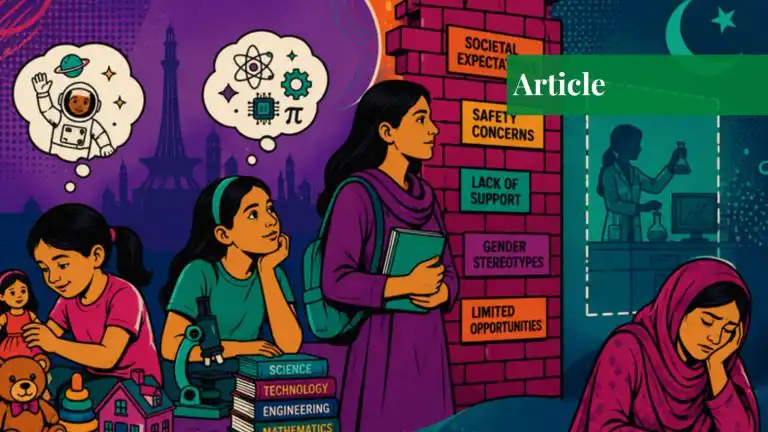
In Pakistan and globally, it is not the difficulties of STEM itself that push women away. It is a fact that STEM remains a male-dominated field. Differential treatment begins in early childhood, when boys and girls are given different toys. This practice indirectly shapes different patterns of thinking in them. Compared to boys, many girls may have limited exposure to and understanding of the technical aspects of technology during their adolescence. Voltaire has said that one should be judged by one’s questions.
The early lack of exposure restricts the depth and confidence of girls’ questioning in STEM. The government and institutional-level initiatives, where they exist, only support women with already developed critical thinking skill sets needed for the scientific and engineering fields. The question is: how can the system support a student who is making every effort to access these opportunities but is restrained by gaps in knowledge, skills, and experience?
The Institutional Barriers for Pakistani Women
In formal education, indirectly, the discriminatory pattern repeats. The idea that curricula and academic quality are equal across institutions is a myth in Pakistan. Arguably, there are many educational institutions where the system indirectly reserves leading roles for male students. To prove their competence, the female students need to work more than their male peers, who are more likely to be called on to answer a question. On the whole, the academic system has lower expectations of female students, which makes them reluctant to pursue this career.
Mehreen Qaiser found in her research that women with high performance in STEM subjects in high school often changed to non-STEM fields later in their careers. Lack of familial support and the location of the university and training centers are the determinants of whether a girl will pursue higher education. The family responsibilities and financial costs are also high for women, making it difficult to pursue science even if they wish to. These challenges are predominant for girls coming from underprivileged and lower-middle-class backgrounds.
Workplace Challenges
Once women complete their degrees, new challenges emerge in the workplace itself. In the STEM institutes, many Pakistani women report getting a lower salary than their male peers. For married women in STEM, securing a job after a career break is increasingly difficult. STEM careers often demand long work hours and create a work-life imbalance for women.
Various factors, from primary to higher education to professional careers, challenge Pakistani women as they navigate their STEM careers. The women in STEM often part ways with the system as it demands hard work at the expense of their lives beyond work. This work-life disruption earns them at most the same recognition as their male peers. Cultural expectations for women, security concerns, lower wages, and stereotypes associated with STEM careers are also responsible for some women’s abandonment of STEM careers.
The Fix for the Leaky Pipeline
To increase the retention of women in STEM, grassroots-level changes are required. Many provincial and national-level interventions are made to strengthen women’s retention rate in STEM. But what these interventions do not address is that the problems of girls in the underprivileged and middle classes start from the bottom. The gap has to be addressed from where it began: at a point where the girl child was placed at a different part of the thinking spectrum from the male child.
Instead of randomly gifting children, the parents should gauge the interests of their children. The exposure to the technical aspects of technology must be increased for both male and female children. Within academic institutions, the learning environment must be equalized for both genders. Particularly, in a professional career, the roles should be offered without prejudice and with policies that support work-life balance. Pakistan’s university curricula do not largely align with industrial requirements, which impedes all graduates’ paths to securing a job, but it particularly impacts women as they may enter a career with different perspectives from the ground up on industrial realities. This, of course, is not the story of all women and all institutions of Pakistan. However, a woman in STEM from an average background faces at least one of these challenges.
Can a nation truly advance in science and technology while a significant portion of its talent pool quietly exits the workforce or never enters? The answer is a big no, and the solution lies in increasing public awareness of grassroots-level challenges and structural changes at the institutional and policy level. Some revolutionary steps are already in place. Accomplished women in STEM are developing initiatives and platforms to support the coming generation of women in science and technology. However, what a girl from an underprivileged area needs is a societal shift, a familial shift, which demands increased public awareness and every individual’s willingness to shoulder personal responsibility.
If you want to submit your articles and/or research papers, please visit the Submissions page.
To stay updated with the latest jobs, CSS news, internships, scholarships, and current affairs articles, join our Community Forum!
The views and opinions expressed in this article/paper are the author’s own and do not necessarily reflect the editorial position of Paradigm Shift.

Fiza Bibi Ameen is a gold medal qualifier in BS Physics from Riphah International University, Islamabad. She also contributed a prize-winning submission to the HEC inter-university essay writing competition held in 2022. She enjoys researching and writing about science, technology, and informative topics in various niches. She is also a freelance writer.