
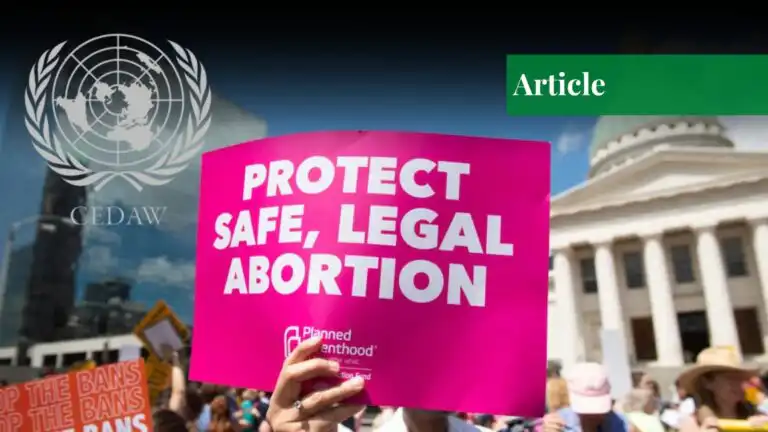
International Human Rights Law is a body of international law that aims to foster and protect basic human rights at the national, global, and regional levels. It consists of treaties and customary international law. Gender has emerged as a new factor in the international human rights framework. Within the domain concerning human rights, the framework has become significantly advanced since the adoption of the Universal Declaration on Human Rights in 1948. Among one of the most significant conventions worldwide, CEDAW still has some limitations, especially in abortion rights protection, and it’s widely criticized internationally due to its lack of explicit guidelines on abortion rights, a large number of ratifications with reservations, and weak enforcement and complaint systems. This weakens its aim, commitment, and capacity as a rights-guaranteeing instrument. These limitations have significant implications for international law.
Gender Bias, Human Rights, And International Law:
Liberal political views condemn human rights breaches and punish those who disregard them, based on human equality. Radical feminists argue that there is significant discrimination between public and private issues, with women’s rights being considered private, while men’s rights are considered public. International law often imposes accountability on states but overlooks private matters like domestic violence and reproductive rights. For example, the International Covenant on Economic, Social, and Cultural Rights has been criticized for only recognizing economic rights regarding production and for overlooking reproductive and housework rights.
Specific Obligations Of The State Under CEDAW:
CEDAW is a comprehensive bill of rights for women. The following are some of the obligations that member states are obliged to fulfill under the treaty regarding women’s rights, particularly reproductive rights.
According to Article 2, states are obliged to change their legal and administrative policies that hinder the protection of women’s rights. This includes taking affirmative action and changing social and cultural norms.
According to Article 12, states must adopt appropriate measures to ensure women’s access to health care services and full freedom of family planning.
Similarly, in Article 16(1)(e), states are also obliged to adopt all progressive measures to ensure women’s full freedom to decide their children’s numbers and spacing.
CEDAW And Its Shortcomings Regarding the Protection Of Abortion Rights:
The Convention on the Elimination of All Forms of Discrimination against Women (CEDAW) is a prime example of this new gender dimension. The adoption of CEDAW by the UN General Assembly in 1979 was the culmination of decades of international efforts to protect and promote the rights of the world’s women. It deals with those issues that were previously handled inconsistently across the UN system. Among the most significant conventions worldwide, CEDAW has many shortcomings and gaps in protecting women’s reproductive rights.
No Explicit And Universal Guidelines Regarding Abortion Procedures:
Firstly, CEDAW doesn’t explicitly include provisions on abortion rights. CEDAW only ensures general medical care services for women, pregnancy planning, and unrestrictive rights for choosing the number and spacing of their children under its articles 12 and 16(1)(e), but it lacks exclusively providing family planning information for women and does not address men’s role in reproductive matters.
CEDAW just leaves it to the member states to take appropriate measures regarding women’s reproductive issues rather than providing universal guidelines of what should be done in cases related to abortion issues, and that’s why it is considered an insufficient treaty system for safeguarding women’s rights as human rights. For example, in the cases of Mellet and Whelan, Ireland’s abortion law violated the right to privacy by interfering in their abortion-related decisions and exiling them, which directly impacted their right put forward under Article 16(1)(e).
Reservation Challenges:
Secondly, CEDAW has various reservations that contradict its core clauses. Therefore, it has been widely criticized among various scholars, like Rebecca Cook, Christine Chiklin, etc. The majority of the states have reserved articles 2 and 16, citing their legal, traditional, and religious-based reasons. As a result, states find a reason to defend themselves for their unfair practices. Therefore, the treaty’s main purpose is effectively defeated by the states, and it weakens CEDAW’s commitment to abolishing unfair treatment towards women, which eventually results in women’s inability to access abortion services.
For example, Bahrain, Egypt, Algeria, and Morocco have entered reservations to Article 2 and Article 16 based on their contradiction with Islamic Sharia. This weakens its aim, commitment, and capacity as a rights-guaranteeing instrument.
Lacks Strong Enforceability On National Laws:
CEDAW also lacks implementation and strong enforcement systems to ensure the state’s strong compliance with its main clauses. Feminist critiques of the global norms present a deeper analysis of the influence that national laws have on women’s access to reproductive services. Although it has widely criticized rigid abortion laws, especially those that restrict women’s rights and see abortion as an illegal action. But it can only urge states to eliminate their prohibited laws to ensure women’s legal and safe abortion access. It can also only provide recommendations to states for their legislative changes. Although some member states have removed constitutional prohibition and have legalized abortion upon its recommendations, due to the unavailability of direct methods of enforcing the convention and its non-binding nature, states often simply don’t bother with its recommendations or engage in inconsistent and inadequate measures. As a result, the convention’s ability to advance gender equality is diminished.
 You will find more infographics at Statista
“The Northern Irish view on abortion law” by Statista licenced under CC BY-ND 4.0.
For example, Ireland has been regularly requested by the CEDAW committee to reexamine its restrictive abortion laws since 2005. Abortion was banned in Ireland. It was not until the 2018 amendment that abortion was legalized, but only up to 12 weeks under specific circumstances. But still, it holds some limitations, like the compulsory waiting period for about 72 hours, which was raised by the patients, and in certain situations, the waiting period increases above three days if the first appointment was held in the middle of the week. It delays a woman’s immediate access to abortion care. This further increases the vulnerability of women who need timely services and medical care.
Complex And Inadequate Complaint Mechanism:
The optional protocol of CEDAW has a mechanism for taking individual complaints regarding violations of rights. The main concern with OP-CEDAW as a complaining instrument lies in its unenforceability. Moreover, these mechanisms fail to provide access to average women due to the complex nature of the system. For example, extensive documentation requirements, domestic procedures, and difficulties in pursuing financial assistance that is needed to file a complaint. As a result, it causes delays in addressing their immediate concerns.
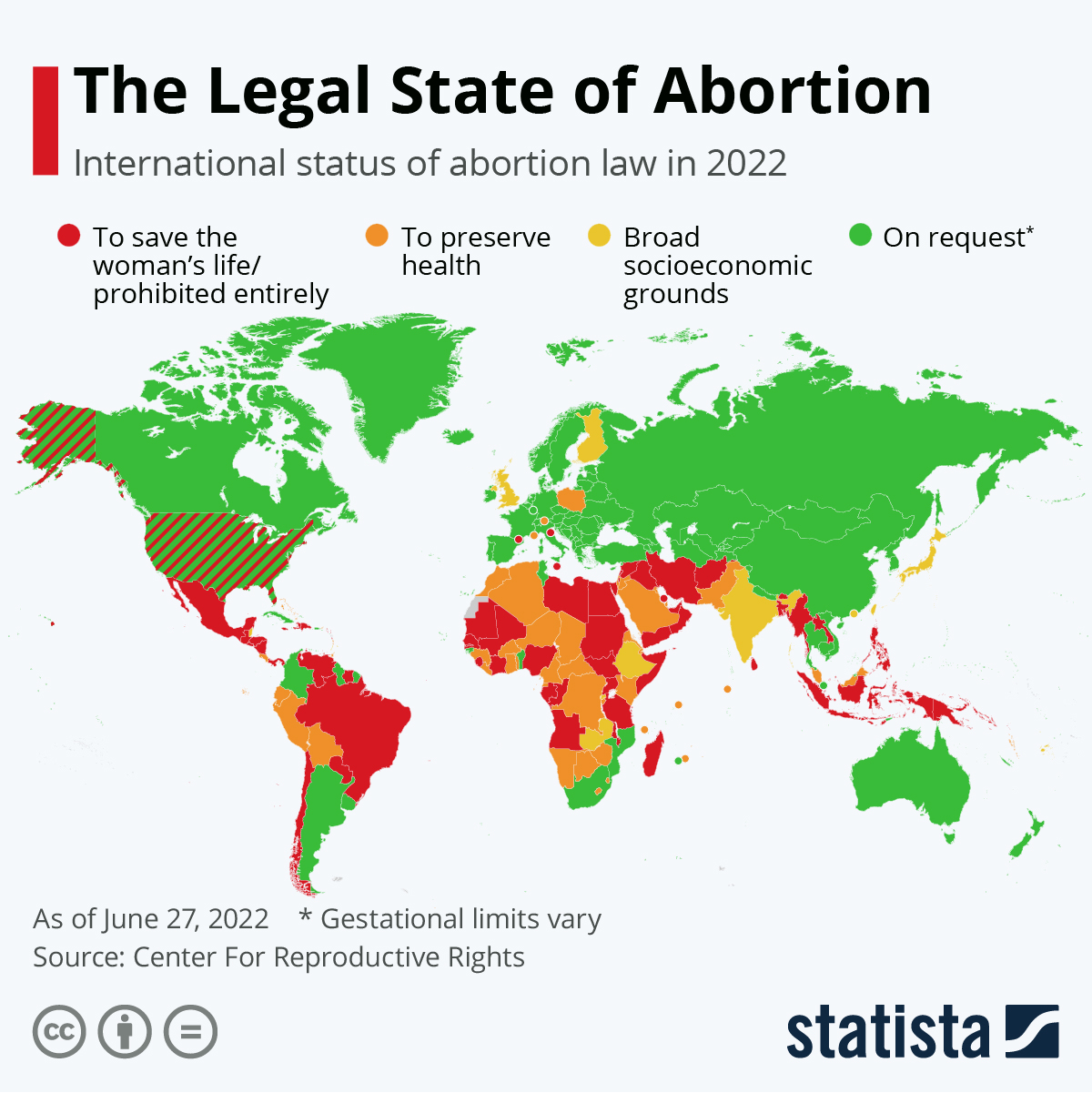 You will find more infographics at Statista
“The Legal Status of Abortion Worldwide” by Statista licensed under CC BY-ND 4.0
This is exemplified by the case of L.C. v. Peru, a girl who was raped by a 34-year-old man. She attempted suicide and needed immediate medical surgery, but she was denied by the doctors for almost four months due to fear of legal consequences, which eventually paralyzed her. This incident directly impacted her right to put forward under articles 12 and 16(1(e). This decision is widely criticized due to the insufficient evaluation by the CEDAW committee on equality in health and the inadequate examination of what constitutes equitable access.
However, this lessens the treaty’s dedication and ability to serve as a safeguard for women’s rights and reduces the confidence of women and civil society who interact with CEDAW.
Recommendations:
- Amend article 12 to add a clause on safe and legal access to abortion services.
- Incorporate a new clause in Article 28, similar to the Convention on the Elimination of Racial Discrimination (CERD), allowing reservations to be deemed inappropriate and rejected as invalid with a two-thirds vote of member countries.
- Strengthen enforcement systems by establishing online public information portals in administrative offices to enhance state and judicial accountability and transparency, making them more responsive towards their citizens.
- Set up procedures for establishing specific timelines for the implementation of the treaty’s recommendations.
Conclusion:
In conclusion, CEDAW is an inadequate framework to protect women’s rights due to its various limitations, which then limit its effectiveness and undermine its goal of protecting women’s rights. These limitations further hinder global commitment to women’s rights protection, particularly reproductive rights. States that don’t fully implement CEDAW, therefore, undermine the aims and objectives of the treaty in breach of Article 18 of the Vienna Convention on the Law of Treaties and also limit the influence of international law as a tool for achieving gender equality. This critique of the CEDAW highlights the need for more gender-inclusive international law.
If you want to submit your articles and/or research papers, please visit the Submissions page.
To stay updated with the latest jobs, CSS news, internships, scholarships, and current affairs articles, join our Community Forum!
The views and opinions expressed in this article/paper are the author’s own and do not necessarily reflect the editorial position of Paradigm Shift.

Kanza Sohail is currently pursuing her bachelor's in international relations at Kinnaird College for Women University. She has completed a significant internship at the Research Society of International Law (RSIL). She has a keen interest in writing on topics related to regional studies, global environmental politics, conflict resolution, and international law.