In the world of classical economics, price determination is meant to reflect the laws of supply and demand. Yet, in Pakistan’s recent economic environment, petrol prices have been decoupled from global supply and demand. In a country where the middle class is already grappling with the highest CPI (Consumer Price Index) inflation in history, the ever-increasing price of petrol is more than a logistical issue; it is a symptom of a “fiscal trap” where the government’s short-term cash flow takes precedence over the sustainability of the macroeconomy.
The Disconnect: Global Supply vs. Local Desperation
Technically, the global oil markets have exhibited some level of normalcy. Given that the global supply chains are now returning to normal and the spread of the trade of crude oil is foreseeable, the normal economic postulate would be that the retail prices would start to go down. But there is one exception: Pakistan. The main reason is the so-called “sticky price” phenomenon, which is not the market law but the fiscal postulates of the state. The price of landed petroleum is not the only variable.
A fixed petroleum levy, the exchange rate, and inland freight equalization margins have been added to that commodity before it reaches the pump. For the same reason, when the international prices go down, the state uses that “margin” to extract the difference into the exchequer rather than the wallets of the public. While it helps in meeting the primary surplus targets set by the IMF, it also creates a price floor that defies the global trends and undermines the productive segments of the economy.
The Human Toll: A Story From the Pump
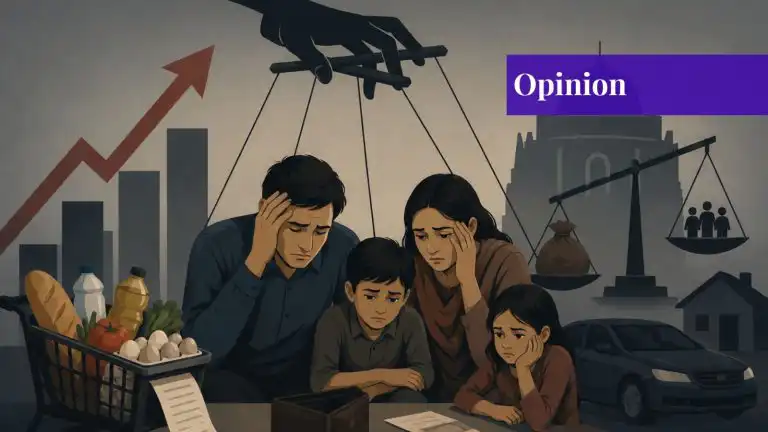
To understand the macroeconomic crisis, it is important to consider the micro reality. Let’s take Zubair, a middle manager of a local firm who has been married for the last decade. Zubair has been paying a fixed fare, but now, it is a monetary crisis. Last week, when he was standing at the fuel station in the early morning, he noticed that the digital counter on a pump was rotating at a terrifying pace. He saw that it is now almost impossible to fill the small car tank, which now costs him almost the same as his grocery shopping at the end of the month. That evening, Zubair made a silent, painful decision: he was selling his vehicle and looking for a 70cc second-hand motorbike.
It is not only a lifestyle change but also a consumption of its crudest, desperate justification. The economy is not losing only the fuel revenue when the professional class itself is pushed out of the road system due to the high cost of mobility; the economy is losing the morale and productivity of the most important portion of the population.
The Perils of Revenue Maximization
The common reason cited by policymakers is revenue raising. But this argument fails to consider the principle of price elasticity of demand. In a developing market, petrol is often assumed to be an inelastic commodity—people need to commute to work, and goods need to be transported. However, there is a tipping point. As an economist, the study of the logic of the Laffer Curve as it applies to petrol is called for. Above the affordability of the masses, the total volume of sales begins to shrink.
The extra fuel tax per liter of fuel sold will not be able to deliver the planned revenue if the number of liters sold drastically decreases due to the presence of people like Zubair who are leaving their cars. In addition, the velocity of money slows because the disposable income is being consumed by the fuel tanks, to the detriment of other industries such as retail, manufacturing, and services.
The Domino Effect on Cost-Push Inflation
The impact of rising petrol prices never settles down in the transport sector. It leads to the second round of cost-push inflation. When a nation’s transport industry is excessively dependent on road transport, every rupee that adds to the price of a liter of fuel is passed on to the price of a kilo of flour or a liter of milk. This creates a vicious cycle: trying to rectify the budget deficit but increasing the social deficit. The argument that we are obliged to do so by the international lending conditions is a stereotyped justification for technical incompetence. There are global terms, but the decision is about how to deal with them. The technically feasible option is to broaden the tax base to the undocumented sector rather than constricting the “easy target” of the fuel consumers.
Unless the government stops viewing petrol as an ATM that will never run out, they can be sure that they will witness the end of private-sector productivity. Current prices are not market-driven; this is a survival tax. The government should focus more on structural change rather than taxation to achieve economic stability. Without creating an exit for the middle class through special taxation of low-power vehicles or heavy investment in public transport, the current price-setting remains an economic delusion that will result in a country with declining returns.
If you want to submit your articles and/or research papers, please visit the Submissions page.
To stay updated with the latest jobs, CSS news, internships, scholarships, and current affairs articles, join our Community Forum!
The views and opinions expressed in this article/paper are the author’s own and do not necessarily reflect the editorial position of Paradigm Shift.

Hamza Nasir is a graduate of economics from Balochistan University of Information Technology, Engineering and Management Sciences (BUITEMS). He currently serves as a researcher at the Balochistan Think Tank Network (BTTN), Quetta. His work focuses on political economy, economic resilience, and policy reform with a regional lens.