
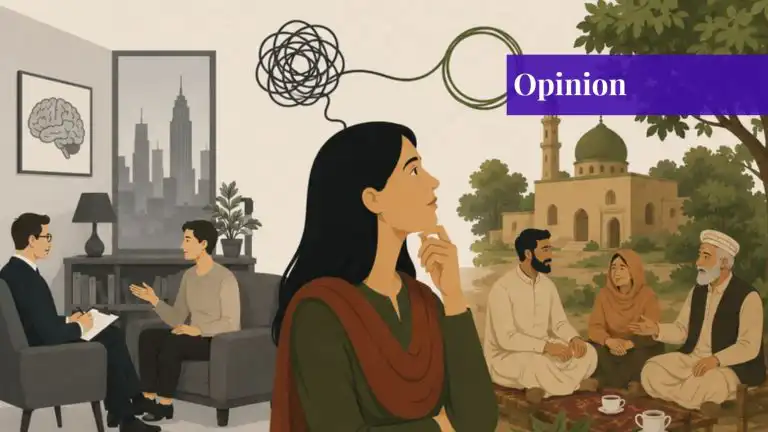
Watching the Decolonizing Mental Health series made me realize how quietly radical its premise is. The digital series containing twenty short films produced by WORLD Channel and PBS does not open with a tragic case. Its premise is an observation: that the mental health field has a center and that this center is not neutral. It is, in the series’ own words, defined by a “whiteness of theory and practice,” and it is so rarely questioned that most of us have long stopped noticing it is there at all.
Throughout the episodes, the series shows therapists, peer support workers, and patients of color and different faiths in the United States as they try to create something more responsive and inclusive that does not require them to translate themselves into a clinical language that is designed by and for someone else. The films are short and moving but also sharp. And watching them from Pakistan, I found myself responding in agreement and also in a kind of disagreement. It suggests something true: psychiatry is not a view from nowhere. It emerged in particular places in Europe and North America. To call that being based on “whiteness” is not an insult. It is the description of a default system, something that has been globalized so successfully that it now passes for the natural order of things.
The disagreement really comes down to geography. Decolonizing Mental Health is a film about the United States. There, Western psychiatry is the default system, and the culturally rooted practices the series follows are the struggling alternative trying to be heard. So the series argues for inclusion and for making room for letting those alternatives in. But the situation in Pakistan is almost the opposite. Here, the Western model isn’t one option competing with others; it is more or less the entire formal mental health system. There is very little besides it that the state treats as real care. We don’t even have a mental health policy, and it didn’t develop here on its own either. It came with colonial rule, the British setting up “lunatic asylums” across the subcontinent in the nineteenth century, and after 1947, it simply stayed. The series can question psychiatry because, in America, people can see it as one approach among several. In Pakistan, it was never presented to us as a choice. It was just the system we were left with. It arrived, like the railway and the penal code, and became the credentialed standard. It was never put on trial.
This is what mental health whiteness looks like in a country like ours: not a center we can clearly see and resist, but an imported idea so thoroughly naturalized that it now reads as plain, neutral medicine. The most revealing evidence is in the instruments. The two screening tools most widely used to detect depression and anxiety in Pakistan, the PHQ-9 and the GAD-7, were developed and validated in Western clinical settings. They were never built to ask why a person is suffering; they were built to count symptoms. As the psychiatrist Murad Moosa Khan has argued, a woman who is exhausted and sleepless because of domestic violence at the hands of an unemployed, drug-dependent husband may comfortably meet criteria for depression on such a questionnaire, while the tool itself stays completely silent about the conditions producing her despair.
Khan draws on the work of the scholar China Mills, whose book Decolonizing Global Mental Health gives this process a name: “psychiatrization.” It is what happens when distress that is rooted in injustice, such as poverty, unemployment, gender violence, and displacement, is reframed as individual pathology. When we screen, diagnose, and medicate that response without touching the conditions, we have not cured anything. We have, as Khan puts it, performed a medicalizing of social problems, and in doing so, we have subtly shifted the burden from institutions onto the individual. The system fails and asks the individual to be more resilient.
None of this is an argument against care because the decolonizing critique is often misheard as a rejection of medicine in favor of tradition. Mills does not argue against psychiatry; nor does Khan. Medication helps. Anyone who has watched a relative being pulled back from psychosis by treatment knows this is not a debate to be won with slogans. And the traditional alternatives are no innocent paradise either; the world of faith and folk healing carries its own shame, secrecy, neglect, and the quiet hiding of the unwell. A decolonized mental health is not a contest between a white clinic and a wise village. Both have failed people.
What the critique actually asks for is humility and honesty. It asks that we treat the imported model as one component of a broader system rather than the entire system, a system that also includes social protection, labor, and gender rights. It asks that we invest in local research into how these issues are actually understood, named, and cured in Pakistani lives instead of importing an alien system wholesale. And it asks that we resist the temptation to see mental health only through the narrow slot of diagnosis and treatment and to recognize it instead as a mirror of the society that produces it.
This is where Decolonizing Mental Health both succeeds and falls short for a South Asian audience. Its main idea is powerful: psychiatry has a hidden central perspective, and that perspective should be questioned instead of being treated as the standard. However, its solution does not fully fit every context. Having more therapists who share the background of their patients and more clinics that understand cultural differences is an important and valuable goal, and Pakistan could benefit greatly from this. But in a country where the Western model is not the center but the inherited default, decolonizing means something more demanding than diversifying its clinics. Watching it from here, the harder task is not only to question that center but also to notice how much of our own distress was never an illness at all.
If you want to submit your articles and/or research papers, please visit the Submissions page.
To stay updated with the latest jobs, CSS news, internships, scholarships, and current affairs articles, join our Community Forum!
The views and opinions expressed in this article/paper are the author’s own and do not necessarily reflect the editorial position of Paradigm Shift.

Maham Yaseen is a law student, researcher, and writer from Turbat, Balochistan. She writes on human rights, gender justice, and legal developments in Pakistan.