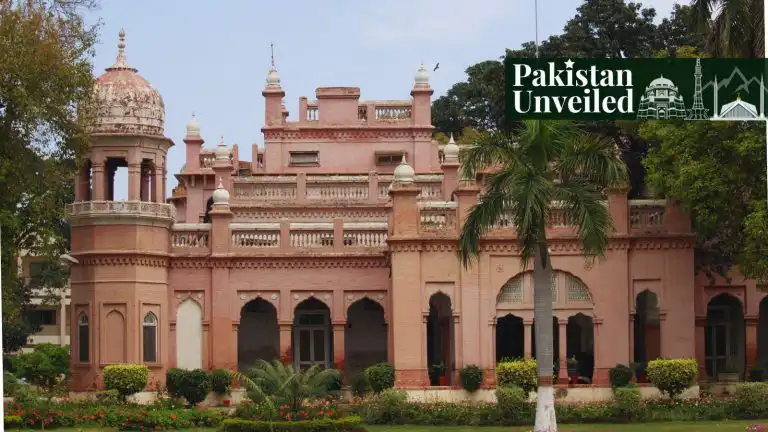
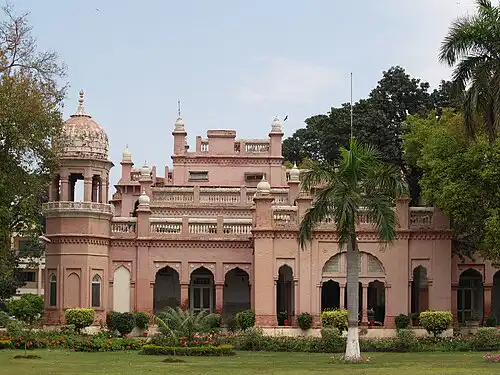
Hiding within one of the quietest yet most elite areas of Lahore is a building that people drive past, unaware of its history. Located on Golf Road in G.O.R.-I, Lahore, Chamba House is one of Lahore’s most notable pre-partition buildings. It was previously used as the winter retreat of a Himalayan king and now serves as the government guest house. Chamba House is a red-brick building that offers insight into a forgotten era of Lahore’s history.
Where Is Chamba House Located?
Chamba House is situated on Golf Road, in the area known as Government Officers’ Residences (G.O.R.-I), which is one of the most exclusive housing colonies in Lahore city. This locality has its own history as well, having previously served as a camping ground during the 1880 durbar before being renamed Government Officers’ Residences. The land area occupied by Chamba House is around eight acres, which is relatively large in comparison to other properties situated close to the heart of the city.
History of the Royal House of Chamba
The history of Chamba House does not begin in Lahore but rather in the princely state of Chamba, which is currently part of the Indian state of Himachal Pradesh. Chamba was one of the oldest princely states of India, and its ruler enjoyed the dignity of an 11-gun salute, which made him one of the most prestigious rulers in terms of the number of salutes. Chamba House was built for Raja Ram Singh, the son of Sir Raja Bhuri Singh, on an eight-acre plot in G.O.R.
Sir Raja Bhuri Singh, who was famous for his administrative innovations and cultural achievements, ordered the construction of Chamba House during the British period to serve as a residence for his family when travelling and as a diplomatic guesthouse for dignitaries from other places. At that time, many princely states in India had similar guesthouses in different cities because they wanted to have contact with the colonial administrative centers, and Chamba House was their house in Lahore.
The Architect Behind Its Design
Chamba House was designed by Bhai Ram Singh, an important architect in Punjab before the partition. Bhai Ram Singh ruled the architecture world in Lahore for almost two decades since the 1890s, and his most famous architectural works are the Lahore Museum, Aitchison College, the National College of Arts, Punjab University, and the Durbar Room in Osborne House in England, Queen Victoria’s summer house on the Isle of Wight.
It is believed that Chamba House is a real example of Indo-Saracenic architecture because it met all the requirements of the English style house while being influenced by Indian architecture. It was not by accident. Chamba House’s architectural style is a product of a certain architectural trend promoted by Lockwood Kipling. He was very fond of Indian arts and crafts and promoted them through the Mayo School of Arts, the first colonial institute that taught Indian craftsmen rather than using them just for decorative purposes.
Thus, the result is a magnificent architecture of grand entrance arches, ornamentation, domes, columns, and the whole structure, which reflects the Anglo-Mughal style. Even nowadays, people visiting Chamba House can still notice the high quality of the craftwork made more than a hundred years ago.
A Small Detail That Still Connects It to Chamba
An intriguing element of Chamba House’s story is how much of the property’s history and heritage it managed to preserve amid all the changes made to the structure since. Even though it was renamed “Federal Lodge” by the government of Pakistan, the original royal seal of the Chamba state can still be seen on the building’s gate, thus connecting it to its true history.
What Happened After Partition?
The 1947 events significantly altered the destiny of Chamba House. As a result of the partition of India, the ruler of Chamba acceded his state to the Dominion of India. However, the Lahore property became the property of the Government of Pakistan, which turned it into a guest house. Thus, the building became a state guest house after the partition and was later transferred for further use.
Chamba House enjoys protected status under the law today. Chamba House is classified as a protected site and monument under the Antiquities Act of 1975 and the Special Premises Ordinance of 1985 in Punjab. It is important to note that the protected status is legally significant because it means the property is officially recognized as historically and architecturally significant and therefore cannot be altered or demolished without official approval.
What Is Chamba House Used For Today?
Today, Chamba House is used as a government guest house or Federal Lodge, providing accommodation for various officials, bureaucrats, politicians, and dignitaries who visit Lahore on their official visits. The building is not available for public use, and visitors will find no way to get accommodation there, even if they try to reserve it.
Yet, the building has found a new purpose in modern times, as it has become widely used as a photography location. Its red brick facade, trees, lawns, and other features of the colonial-style architecture make the building a popular place for bridal photoshoots and other purposes.
Why Chamba House Is Important Even Today
Buildings such as Chamba House have a unique status in Lahore, representing the era when the city’s architecture was shaped not only by the colonial government but also by princely rule. As a result, the architecture of the buildings does not belong to either culture but takes the best from both. The architectural legacy of Bhai Ram Singh across different parts of Lahore, from the Lahore Museum to Aitchison College to Chamba House, has shaped the city’s architectural perception for more than a century.
Chamba House can be called an important element of Lahore’s history for anyone interested in it, whether you are planning a heritage walk or conducting academic research. This building has managed to survive the collapse of the princely state, the violence of the partition, and the changing national identity, leaving a symbol of its origin in the form of a seal above its gate.
If you want to submit your articles and/or research papers, please visit the Submissions page.
To stay updated with the latest jobs, CSS news, internships, scholarships, and current affairs articles, join our Community Forum!
The views and opinions expressed in this article/paper are the author’s own and do not necessarily reflect the editorial position of Paradigm Shift.

Paradigm Shift is an official staff account.