
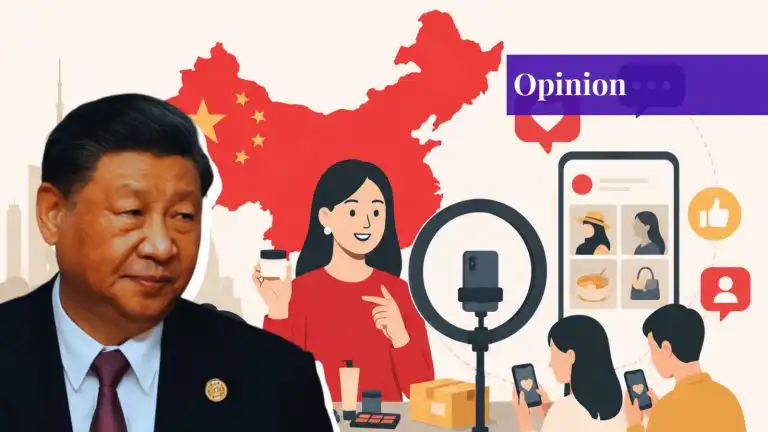
From being caught in the web of darkness and misinformation to exploring boundless horizons, technological advancement has transformed every aspect of modern society. The world is now a digital space where knowledge and information can easily travel across boundaries without any time limits. This boundless connectivity has turned social media influencers into powerful opinion leaders who can shape public behavior, discourse, and attitudes across multiple domains. This democratization is a double-edged sword as it has paved the way for digital falsehood and misleading narratives as well. Confronting this growing menace of misinformation, China’s Cyber Space Administration has introduced new legal obligations requiring influencers to verify their credentials before offering expert advice on health, finance, law, and education.
Salient Features of China’s Influencer Law
Misinformation is not only a harmful product of revolution. It is also a serious threat to public welfare. One notable feature of this legislation is the requirement that content creators possess a relevant degree or qualification. These credentials must be verified by the relevant social media platforms. This shows that digital platforms are not passive hosts of content and play a profound role in shaping public opinion. The spirit of this law lies not only in its specialization requirements. It also relies on robust and clear enforcement mechanisms. Authorities can impose fines of up to 100,000 Yuan (about USD 14,000) in the event of violations. Content may be removed. Livestreaming and publication may be restricted. Accounts can be suspended. In the digital age, a single post can impact millions; accountability is therefore an essential prerequisite. By targeting misleading information, pseudoscientific claims, and incorrect expert advice, China’s legislative measures seek to create a safe and responsible online ecosystem.
Guarding Truth or Governance: The Global Debate on China’s Influencer Law
China’s social media regulations seem to be a necessary legislative measure to deal with false claims, but they have emerged as one of the most controversial experiences in the digital world. Critics argue that the imposition of certain restrictions is a direct hit to public discourse and freedom of expression. International organizations, including Reporters Without Borders, Human Rights Watch, and Amnesty International, have repeatedly criticized the control and censorship policies, arguing that government response should be tailored and proportional against any act that restrains legitimate public debate. Digital rights advocates are of the view that China’s influencer law is a serious threat to open internet principles, creating a chilling effect and weakening democratic discourse of lawful content. This global debate reflects the building tension between the enshrined principle of freedom of expression under Article 19 of the Universal Declaration of Human Rights and international concern to curb the spread of harmful and unverified claims. Article 19 of UDHR states that “Everyone has the right to freedom of opinion and expression; this right includes the freedom to hold opinions.”
This article clearly protects the individual’s right to receive and impart information and to formulate relevant opinions, and viewing China’s credential requirement through the lens of international law presents a scenario of violation of this internationally agreed obligation.
In Ivcher Bronstein v. Peru, the InterAmerican Court held that states cannot weaponize administrative tactics to deprive individuals of their right to opinion. However, China’s recent mandate of credential verification and professional status operates as a s digitized restraint, shedding light on the fact that Beijing’s authoritarian and censorship policies fracture the universal rights codified under international law.
Ultimately, this debate has now transcended the national boundaries as it takes into account the significant question: how can authorities balance free exchange of ideas and accountability? As nations continue to search for the right answers, China’s Influencer Law serves both as a warning and a model.
Balancing Regulations and Freedom: Key Lessons for Pakistan
Pakistan’s supreme Law serves as a guardian of fundamental rights. Article 19 of the 1973 Constitution guarantees freedom of speech and expression subject to reasonable restrictions in the interest of national security, public order, and legally recognized principles. While protecting free speech, Pakistan can draw some important lessons from China in terms of regulating online platforms. Pakistan can introduce a verified expert advice system to draw a distinction between entertainment and useful content. The urgency of cybercrimes in the digital age requires a strategic and proactive response and investment in digital literacy programs that can offer a targeted solution. These programs will play a vital role in empowering citizens to critically evaluate decisions, identify falsehoods, and make informed choices. This digital investment should further be complemented by the establishment of independent reviewing bodies and a digital ethics council under the Pakistan Telecommunication Authority (PTA) and Pakistan Electronic Media Regulatory Authority (PEMRA).
As Pakistan is confronted with digital challenges, the real objective lies in strengthening the credibility of content, not in limiting the democratic space for constitutionally recognized rights. The future of digital connectivity must be rooted in the responsibility of protecting truth without eroding the spirit of healthy dialogues and fundamental freedoms.
If you want to submit your articles and/or research papers, please visit the Submissions page.
To stay updated with the latest jobs, CSS news, internships, scholarships, and current affairs articles, join our Community Forum!
The views and opinions expressed in this article/paper are the author’s own and do not necessarily reflect the editorial position of Paradigm Shift.