
“Maritime trade remains a cornerstone of real economic activity and growth. The rise in reported maritime incidents highlights the importance of protecting seafarers and securing key shipping routes not only for crew safety, but for the stability of global supply chains and the economies that depend on them.”
ICC Secretary General John W.H. Denton AO
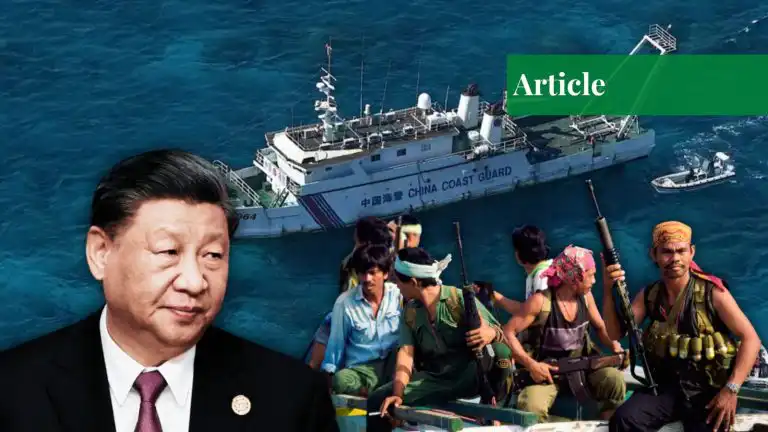
As a vital international shipping corridor, the South China Sea handles one-third of maritime transportation and around $3.4 trillion in goods transiting annually. Approximately 60% of international trade moves through Asia, and nearly 24% of sea route trade is accommodated by the South China Sea itself. Although it serves as a critical gateway to the international sea corridor, transiting roughly 90,000 to 100,000 vessels from the Strait of Malacca and Singapore annually, the route remains unchecked and faces piracy threats. In 2025, reported global piracy incidents rose by 25%, to 137 from 116 in 2024, and alone, 58% of these incidents happened in the Singapore Strait.
The major causes behind the rise of piracy are poverty, overfishing, regional issues, and weak governance. These factors constitute a serious threat to maritime security and create a sustainable threat for ship crews, locals, and regional trade. Addressing the piracy threat demands a cooperative policy response at the regional and domestic levels.
Brief Overview
The piracy challenge is not new in South Asia; it has been endemic for years. In the 18th to 19th centuries, the Sulu Sea (located in Southeast Asia) became infamous for pirate attacks and raids on commercial ships and coastal villages. Moreover, the well-known phrase “Pirates of the South China Sea” underscores the historical legacy of this issue in this important geopolitical route. Although piracy was historically driven by political tension and trade rivalry, modern piracy stems primarily from economic crises and governance failure.
Current Piracy Statistics
Piracy and armed robbery incidents have surged in 2025, with more attacks, kidnappings, and use of guns. While the Singapore Straits became the world’s most critical piracy hotspot, incidents were significantly down in the South China Sea.
| Indicator | 2023 | 2024 | 2025 | |
|---|---|---|---|---|
| Total Incidents | 120 | 116 | 137 | +25% |
| Vessels Boarded | – | – | 121 | – |
| Vessels Hijacked | – | – | 4 | – |
| Vessels Fired Upon | – | – | 2 | – |
| Attempted Attacks | – | – | 10 | – |
| Crew Hostage-Taken | – | – | 46 | – |
| Crew Kidnapped | – | 12 | 25 | +108% |
| Guns Reported | – | 26 | 42 | +62% |
| Region | Total Incidents Reported |
|---|---|
| Southeast Asia | 95 |
| Africa (Gulf of Guinea) | 21 |
| Indian subcontinent | 8 |
| Africa (Off Somalia) | 8 |
| Americas | 5 |
The Singapore Straits witnessed a catastrophic deterioration in maritime security:
| Indicator | 2024 | 2025 | Change |
|---|---|---|---|
| Total Incidents | 43 | 80 | +86% |
| Firearm Reports | 8 | 27 | +238% |
This single location now accounts for 58% of all global maritime incidents, making it the world’s most dangerous waters.
| Indicator | 2024 | 2025 | Change |
|---|---|---|---|
| Q1 Incidents | 29 | 43 | +48% |
| Indicator | 2023 | 2024 | Change |
|---|---|---|---|
| Total Incidents | 14 | 10 | -29% |
The significance of this channel is no doubt massive for global sea trade. It facilitates a sustainable share of international trade and commerce. Despite all this, it poses a significant challenge to trade called “piracy” that disrupts global supply chains, threatens maritime security, and erodes regional peace.
Economic and Political Causes of Piracy
Poverty: A Primary Driver
The foremost concern of this problem is poverty. In a deprived society, for their survival, people resort to illegal means to run their lives. The Asian financial crisis of 1997-1998 caused long-term economic instability in many Asian countries. According to the current poverty report of the World Bank, the latest national poverty rate of the Philippines is 15.5%, and Indonesia is 8.57%. However, extreme poverty remains in villages or coastal provinces. Hence, those communities belong to low-income areas and their means of earning turn to piracy for survival.
Illegal Overfishing
Another aspect of piracy, excessive fishing, is a significant contributor to environmental degradation. This harms marine habitats through large-scale fishing operations, blast fishing, and cyanide fishing. For instance, China’s massive expansion of fishing industries has forced common coastal societies to lose their livelihood sources and push fishermen into disputed water zones that increase geopolitical tensions.
- Unmonitored Areas: Home to Pirates
The South China Sea has a vast region of 3.5 million square kilometers and has approximately 200 isolated islands that provide refuge for pirates. These larger areas and unidentified safe havens on islands become a challenge for authorities to monitor and control crimes. As a result of complex geography, pirates can operate from these landscapes
Territorial Claims: A Barrier to Anti-Piracy Cooperation
Despite cooperation, effective policies demand the reduction of territorial tensions that are happening in South Asian countries such as China, Vietnam, the Philippines, Malaysia, Indonesia, Taiwan, and Brunei, which hinder effective anti-piracy cooperation and progress. Current problems, such as China’s Nine-Dash Line and fuel disputes, undermine trust and cooperation among South Asian countries. Similarly, sovereignty concerns also limit regional cooperation.
Institutional Corruption and Law Enforcement Flaws
The involvement of law enforcement personnel in illegal activities and coordination with pirates on shared interests is one of the important problems in achieving the desired outcomes. The areas that are involved in piracy and illegal crime have a high level of public sector corruption. As per the Corruption Perceptions Index 2025 report, Indonesia ranks 109, and the Philippines stands at 120, placing them at a high perceived corruption level.
Victims of Maritime Piracy
Piracy targets mostly ship crews or members, who face physical assault, injuries, fatalities, and kidnapping. Global kidnapping cases of crew surged from 12 in 2024 to 25 in 2025. In the Singapore Straits alone, there have been 14 hostages, 8 threatened, 3 injured, and 1 assaulted. Similarly, small fishing boats in the Sulu Sea are an easy and common target but are unreported due to fishermen’s fear of authorities or illegal fishing. Thus, these affected communities suffer heavily yet remain overlooked. Another victim of piracy is tankers and cargo ships.
Despite being difficult to target, these are economically beneficial for getting high amounts of ransom, valuable commodities, and fuel for illicit markets. Similarly, smaller ships like tugs and barges are experiencing frequent attacks due to a lack of security. These result in significant losses for shipowners and cargo owners, affecting shipping routes and contributing to reduced trade activity.
Regional Security Initiatives Against Piracy
For cooperation, reviving regional organization frameworks is one of the steps to counter piracy. Such as ReCAAP (Regional Cooperation Agreement on Combating Piracy and Armed Robbery against Ships in Asia) in 2006. ReCAAP, through its Information Sharing Centre (ISC) in Singapore, exchanges piracy and armed robbery intelligence among its contracting parties and shipping partners and is now a recognized regional “Centre of Excellence” for information sharing.
The recent report of ReCAAP indicated the importance of the organization in improving regional surveillance and combating it and sharing information. Although it showed progress, it remained uneven and geographically constrained because of sovereignty concerns and political tension among countries. This prevents larger regional coordination and cooperation.
Moreover, another protocol, the Malacca Straits Patrol Network, was introduced in collaboration among Indonesia, Malaysia, and Singapore and achieved notable success, such as the decline in attacks in the Malacca Straits after this framework was implemented. Similarly, the Trilateral Cooperative Agreement for the Sulu Sea in July 2016 is a great example of a collective framework in which enhanced intelligence sharing and a collective border guard are encouraged. It also establishes maritime command and control centers in Tarakan, Tawau, and Bonga.
Country-Level Strategies
The domestic-level measures are:
- Strong coastal security and better coordination between official personnel to address Indonesian ports that are disrupted by poor cooperation.
- Countries such as Malaysia have adopted the Malaysian Maritime Enforcement Agency Act 2004 (Malaysia’s Coast Guard), a security measure that is designed to track and prosecute sea robbers.
- However, the Philippines has strengthened regional cooperation through joint protocols such as the Sulu-Sulawesi Seas Patrol (SSSP); the lack of country-specific security protocols, such as ongoing conflicts involving militant groups such as MILF (Moro Islamic Liberation Front) and Abu Sayyaf, limits the effectiveness of anti-piracy operations
- China has improved its maritime security, revising its strategy called the China Maritime Code that puts its coast guard under direct military control to eradicate piracy.
These measures have shown improvement, although major results of improvement remain a challenge.
In conclusion, piracy is a challenge in the South China Sea, which has multiple causes, for instance, economic hardship, environmental pressure, and ineffective policy initiatives that fuel illegal activities. Recent statistics show an increase in violent incidents of piracy in this region, suggesting weak security. This impacts many groups, including crews on ships, fishing communities, and commercial ships. Victims are abducted, kidnapped, and abused. Countering piracy is multifaceted, such as regional cooperation on a counterpiracy framework and dealing with deep domestic security and socioeconomic issues
If you want to submit your articles and/or research papers, please visit the Submissions page.
To stay updated with the latest jobs, CSS news, internships, scholarships, and current affairs articles, join our Community Forum!
Find our FREE quizzes and MCQs here!
The views and opinions expressed in this article/paper are the author’s own and do not necessarily reflect the editorial position of Paradigm Shift.
Mahnoor Gujjar is a student of English literature and linguistics at the National University of Modern Languages (NUML), Hyderabad Campus.