
For many years, the civil services have been one of the most sought-after careers in Pakistan. The Federal Public Service Commission (FPSC) conducts the CSS exam in February every year. Thousands of aspirants from across the country join different CSS preparatory institutes, investing roughly one to two lakhs, to prepare for the CSS examination. However, due to the low passing ratio in the CSS exam, many aspirants remain unable to join their dream job in the civil services.
In the past few years, the civil services have been glamorized by social media and electronic media. In many TV dramas, bureaucrats have been shown living a luxurious lifestyle and moving their middle-class and lower-middle-class families up the social ladder. Moreover, some CSS officers from groups with comparatively lower office burden have been seen showing off their protocol and luxurious lifestyle on social media to gain fame among CSS aspirants. Moreover, through their social media profiles, they also gain PR campaigns from different local businesses and companies.
This strategy resulted in increased interest among the Pakistani youth in the CSS examination. However, over the past four years, FPSC data show that CSS registrations in Pakistan have declined from 35059 in 2022 to 18,139 in 2025. Various factors contribute to this decline in CSS registrations in the FPSC.
Why Are CSS Examination Registrations Declining?
Low Passing Ratio in CSS Exams
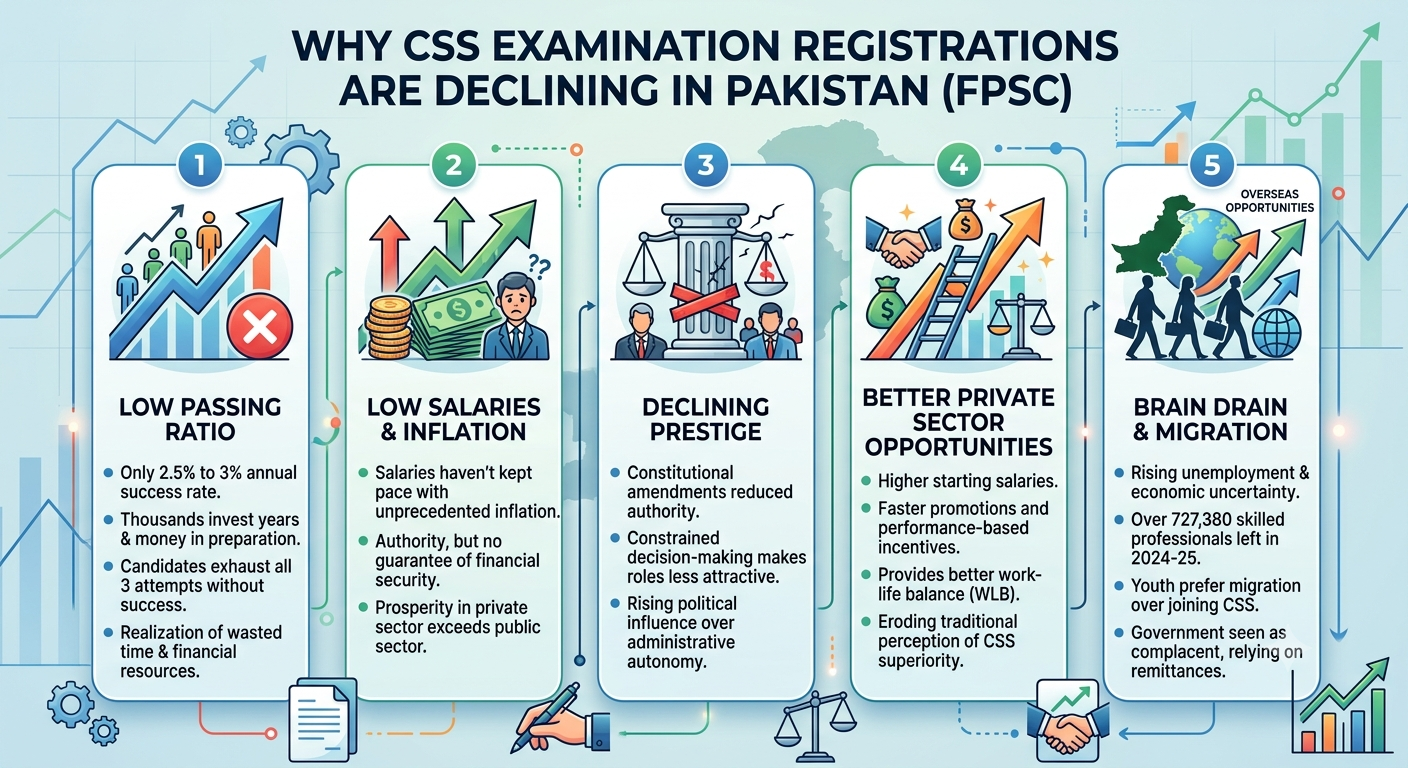
One of the main reasons behind this sharp decline in CSS examination registrations is the low passing ratio. Over the past few decades, only 2.5 to 3 percent of candidates appearing in the examination succeeded in passing the exam annually. In most cases, youngsters invest the most precious years of their lives in preparing for the CSS exam. They also invest huge sums of money to prepare for the CSS examinations through different CSS preparatory institutes. However, after exhausting all three attempts, they realize that this preparation not only wasted their money but also the most important years of their lives. Their fellows gain years of experience in their relevant fields in the private sector and earn handsome salaries during the years CSS aspirants prepare for the competitive examination.
Low Salaries amid Rising Inflation in Pakistan
Another major reason for this decline in CSS registration in the FPSC is the low salaries in the federal government jobs. The Central Superior Services were once considered among the most prestigious jobs in Pakistan. However, over the past few years, inflation in Pakistan has increased to an unprecedented level. However, the salaries and income of the bureaucracy have not increased much, leading to the realization that the civil services may give the authority but will not guarantee a secure and prosperous future.
Declining Prestige of the Civil Services in Pakistan
Over the past few years, the prestige of the Civil Services has declined in the country due to numerous factors. Due to constitutional amendments, the bureaucratic authorities in Pakistan have declined. Moreover, decision-making in Pakistan’s bureaucracy is strictly constrained, which makes the civil services less attractive. In addition, limited administrative autonomy due to rising political influence over the civil services has also contributed to this decline.
Better Opportunities in the Private Sector
One of the main aspirations behind the interest of CSS candidates in the civil services was career progression and social prestige. The widespread use of social media has eroded the traditional prestige of Pakistan’s bureaucracy by increasing public awareness of its institutional challenges, political interference, and career limitations. The suicides of some CSS officers in the past few years have further strengthened the public narrative about political pressure and a corrupt bureaucratic structure in the country.
On the other hand, the private sector provides better opportunities to youth. In the private sector, the employees not only enjoy higher starting salaries, but they also get promotions faster. Moreover, the private sector also offers performance-based incentives to employees. In addition, unlike the bureaucracy, private sector jobs also provide work-life balance to employees.
Brain Drain and Overseas Migration of Pakistani Youth
Due to rising inflation and unemployment in the country, a huge number of Pakistani youth prefer overseas migration over joining the civil services. In 2024-25, around 727,380 skilled Pakistani professionals have left the country in pursuit of a better and more secure future. The government of Pakistan, being unable to produce jobs and employment opportunities, appears complacent, as this migrated youth is a source of remittances.
Is CSS Really a Life-Changing Career in Pakistan?
A huge number of Pakistanis still find CSS an attractive opportunity to change their social stature. Many CSS candidates also aspire to this job due to prevalent power hunger in Pakistani society. This power hunger and pursuit of a better lifestyle in Pakistan have resulted in the wastage of around 3-5 years of many CSS aspirants. However, in the past few years, this trend has changed. The FPSC’s official data shows that the number of registered CSS candidates has declined sharply in 2022-2025. The number of candidates appearing for the CSS written part is even lower. The reason for this is the realization that private-sector jobs offer more lucrative packages than the civil services in Pakistan. In addition, the lack of meritocracy in the country, political pressure, and corruption have eroded the confidence of Pakistani youth in federal jobs. Therefore, the country has witnessed a decline in applications for the CSS exam registrations.
If you want to submit your articles and/or research papers, please visit the Submissions page.
To stay updated with the latest jobs, CSS news, internships, scholarships, and current affairs articles, join our Community Forum!
The views and opinions expressed in this article/paper are the author’s own and do not necessarily reflect the editorial position of Paradigm Shift.

Muhammad Hamza Tanveer is a political analyst specialising in South Asian and Middle Eastern affairs. His work focuses on religious nationalism, regional security, and minority rights. He has been featured in Stratheia, Pakistan Today, Pakistan Observer, and the Asian Mirror. He is also working as a research analyst and political commentator for Paradigm Shift and contributes to the monthly magazine of Nearpeer.