
The Root Causes of Instability and the IMF Cycle
For almost its entire history as an independent state, Pakistan has been beset by recurrent economic crises. Going to the IMF for a record-breaking 24 bailouts, one more than second-place Argentina. One of the major factors contributing to the instability faced by Pakistan, from the standpoint of macroeconomics, is its dependence on foreign energy, thereby making it vulnerable to changes in international energy prices. But over the past couple of years, it looks like Pakistan may have finally gotten hold of a fast solution to its age-old problem.
So, in order to understand how transformative this solar boom has been for Pakistan, some sort of context is needed. In short, Pakistan’s long-standing dependence on energy imports, especially fossil fuel imports, is one of the main reasons that its economy has been so crisis-prone. That’s because, since the 60s, oil and gas have accounted for the vast majority of Pakistan’s energy consumption. Even the electricity generation, which is essentially a subset of total energy consumption, gas and oil are still two of Pakistan’s three main sources of electricity, with the other being hydro power. Although the share of electricity generated by hydro power has actually fallen over time.
Market Driven Energy Revolution
Unfortunately, Pakistan has limited reserves of crude oil, and while it does have some natural gas reserves, including most notably the Sui gas fields in Balochistan. However, a lack of discoveries in existing fields has meant that Pakistan’s domestic gas production essentially peaked in 2012 and is now down by about 25%. This led Pakistan to import more gas, and since 2014, Pakistan’s natural gas imports have skyrocketed.
Oil and gas account for a majority of both Pakistan’s total energy consumption and electricity generation, but the country doesn’t produce enough domestically to meet demand, which has left Pakistan dangerously reliant on imports. And this is one of the big reasons that Pakistan has faced recurrent macroeconomic crises in recent decades. Now, this is a bit of a simplification, but the TODR ( time of day pricing ) is that when international energy prices rise, Pakistan’s government has a habit of borrowing lots of money to finance its
Oil and gas imports can help avoid an energy crisis. Often, Pakistan borrows in US dollars. Both because most oil and gas trade is denominated in US dollars and because Pakistan can borrow dollars at lower interest rates due to the reduced risk of currency depreciation when compared to the Pakistani rupee, but if energy prices stay high for too long or Pakistan’s economy underperforms, which happens pretty often, Pakistan then has to essentially default on the debts and go to the IMF for a bailout.
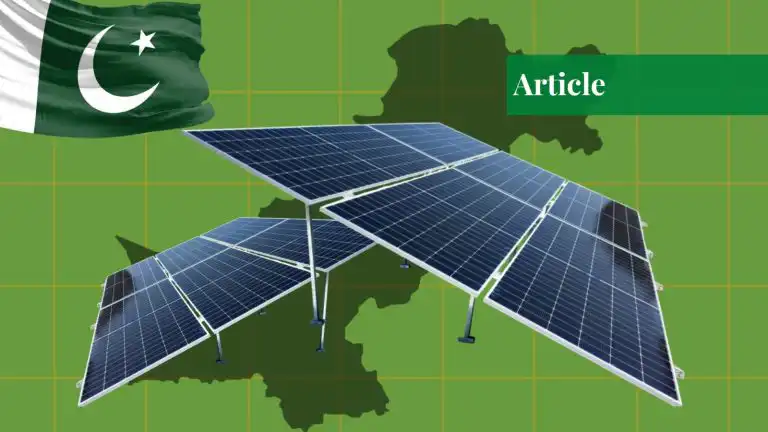
Something that it has done a record-breaking 24 times since 1958. However, in the past couple of years, it looks like Pakistan has found a partial solution to its precarious dependence on energy imports. Solar panels, especially solar panels from China. In 2024 and 2025 alone, Pakistan imported something like 35 gigawatts worth of solar panels from China, with a further few gigawatts from other third countries. The sheer magnitude of this capacity cannot be overstated. For comparison, the total installed solar capacity of France is around 28 gigawatts. This means that within the last 2 years alone, Pakistan has imported and installed more solar capacity than France has in its history.
Despite the fact that the French economy is roughly 10 times the size of Pakistan’s, Pakistan is even importing more solar panels from China than all of Africa, despite the fact that Africa has a total population roughly six times that of Pakistan and a similar GDP per capita. What’s made this solar boom all the more remarkable is that it hasn’t really been driven by the Pakistani government so much as it has been by market forces.
In lots of ways, it’s a classic story of supply and demand. On the supply side, Chinese companies have been producing way more solar panels than the Chinese economy can actually absorb, hence the ongoing surge in Chinese solar panel exports, and the price of Chinese solar panels has fallen by about 60% since 2022. On the demand side, there’s a lot of demand for new sources of electricity in Pakistan because electricity is too expensive. Prices have risen by 155% in the past 3 years, in part because of the IMF.
Economic Implications and Global Lessons
Pakistan’s electricity grid suffers from frequent blackouts, and access remains below 80% in more rural provinces like Sindh and Balochistan. This made solar panels particularly attractive to Pakistan’s farmers, who are more likely to live in rural areas and account for about 38% of the national workforce. Richer households, who tend to consume more electricity, also have an extra incentive to find new sources of supply because, in order to make sure that poorer, low-consumption households can still afford electricity, Pakistan uses a volume-based pricing system where prices increase the more you use. Importing solar panels, therefore, allows rich households to consume more electricity while only using a bit from the grid and thus enjoying lower prices.
Moreover, Pakistani government policy has also helped things along. There’s no tax on solar panels, for instance, and a generous net metering system essentially offers subsidies to people with solar panels willing to sell excess power back to the grid. All in all, this surge in solar imports has nearly doubled Pakistan’s total electricity generation capacity, which stood at 46 gigawatts at the start of 2025, and this excludes the vast majority of new solar panels because only a small minority actually get attached to the grid. This means that solar panels alone could soon account for more than half of Pakistan’s total generation capacity, up from functionally zero before the pandemic.
Not only could this reduce Pakistan’s reliance on energy imports, but it could also be great for the economy, given the correlation between energy production and GDP. So what lessons might the rest of the world learn from Pakistan’s solar boom? Well, first, a state doesn’t necessarily need big, fancy government programs to make the energy transition. In many cases, solar panels are cheap enough to be competitive on their own terms, and the government should just get out of the way. It doesn’t mean that the governments can’t help; they definitely can, but there’s now at least a risk that even well-intentioned governments could get in the way of market-driven energy transitions.
Second, Chinese overcapacity isn’t always a bad thing everywhere. Lots of countries see China’s overcapacity, i.e., its tendency to produce more than it consumes, the recurring trade surpluses as a threat to their industrial bases, which are struggling to compete with a flood of super cheap Chinese exports. They’ve generally responded with protectionist measures, essentially limiting trade with China. There are ways for countries to essentially take advantage of China’s overcapacity. Unless you’re really set on having a domestic solar industry, for instance, super cheap Chinese solar panels look like a great deal, something that’s both good for the environment and your economy.
If you want to submit your articles and/or research papers, please visit the Submissions page.
To stay updated with the latest jobs, CSS news, internships, scholarships, and current affairs articles, join our Community Forum!
The views and opinions expressed in this article/paper are the author’s own and do not necessarily reflect the editorial position of Paradigm Shift.

Muhammad Haseeb Sulehria is a student of Defense and Strategic Studies at Quaid-i-Azam University, and a former internee at Pakistan’s Ministry of Defense. With a keen interest in national and international affairs, he actively explores issues of security, strategy, and global politics, aspiring to contribute to policymaking and peacebuilding.