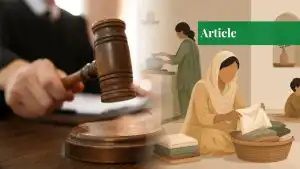
Being a woman in this world means inheriting struggles, whether it is from unpaid labour or in the classrooms where they are outnumbered by their male peer or in halls of parliament where women’s voices are stifled. They face systemic disadvantages in education, healthcare, and political participation. We see devolved countries have long made it their mission to praise and ensure equality in countries, especially like Pakistan, and to address this crippling problem; they give aid. Pakistan receives gender-targeted assistance from international donors and institutions. But aid, no matter how well-intentioned, is rarely neutral.
Pakistan’s population presents a fairly even gender split men making up 51.46%, while women 48.54%. Yet, this statistical balance is not reflected in the country’s social or political structure. According to the World Economic Forum’s Global Gender Gap Report 2023, Pakistan ranks 142nd out of 146 countries, having closed just 57.5% of its gender gap. That’s a slight improvement from 2022, but it is nothing to celebrate, given the pace of change and the challenges ahead. It is estimated that it might take 136.5 years to close the gender gap, as per the gender gap report by the Women’s Economic Forum, a timeline activists call a “life sentence for generations of Pakistani women.”
In this article, I argue that gender-targeted aid is not just a tool of empowerment—it’s also a diplomatic instrument. When examined through a neoliberal lens, this aid becomes a way to influence Pakistan’s foreign policy, align domestic reforms with international expectations, and even shape how the country is perceived globally.
Understanding Gender-Targeted Aid
At its core, gender-targeted aid aims to close gender gaps by providing financial and technical support to improve women’s lives. This support might fund educational access, health services, entrepreneurship training, or even legal reform. But in a place like Pakistan, where societal change is complex and often slow, such aid plays a larger role than just improving service delivery.
Over the past decade, Pakistan has received billions in gender-related aid. Projects like the Benazir Income Support Programme (BISP), funded by the World Bank, have supported women with direct cash transfers. It has disbursed over $1.3 billion to 7 million women since 2008. For recipients like Fatima, a widow in rural Sindh, these funds mean her daughters can attend school instead of working as domestic labourers. Other schemes, such as scooter initiatives for working women or reproductive health services, have tried to reduce mobility and healthcare barriers. Other NGOs have taken an advocacy role as well, which has educated women and encouraged political participation.
More recently, programs like USAID’s “Moments That Matter” (2022–2024) and UN Women’s EVAWG (Ending Violence Against Women and Girls) initiative have taken root in Pakistan’s development framework. These projects fund maternal health outreach, train female community leaders, and establish women’s protection centres in underserved regions like Balochistan and KP.
However, beyond direct impact, gender-targeted aid also puts pressure on the state. Assistance comes with built-in expectations, whether it’s ensuring women’s participation in politics or passing legislation on workplace protections. NGOs, donor agencies, and platforms like UN Women, UNDP, and the EU actively lobby the Pakistani government. In many cases, this lobbying is what drives legal reform.
It’s fair to ask: are these reforms being pursued for the sake of justice or to unlock the next funding tranche? Or just a way for the West to feel good about making the world a better place?
Gender Aid Through a Neoliberal Lens
Neoliberalism, a foundational theory in international relations, treats states as rational actors that engage in cooperation to maximise mutual gains. Aid, in this context, becomes more than a humanitarian tool; it’s an instrument for influencing policy and, ultimately, good behaviour.
International organisations promote values like gender equality, but they also create structures that encourage compliance. Countries like Pakistan often adjust their domestic policies to meet these international standards, not purely out of conviction, but to secure economic assistance, political legitimacy, and a better soft power standing. Considering its global position, it is supposed to be a good move as it allows the state to be in good standing.
Take, for example, Pakistan’s ratification of the Convention on the Elimination of All Forms of Discrimination Against Women (CEDAW) in 1996. In doing so, Pakistan committed itself to 16 core articles and began submitting periodic reports to the CEDAW Committee. In return, the country received technical expertise and financial assistance of $50 million from UN-linked agencies to implement reforms. This is more than goodwill. It’s strategic alignment.
By adopting internationally favoured norms, Pakistan gains access to more aid for other causes, greater diplomatic engagement, and platforms that can protect it from criticism in global forums. However, critics argue it reduced women’s rights to a transactional checkbox. Scholar Ayesha Khan notes: “CEDAW reports became receipts to keep aid flowing, not blueprints for justice.”
Soft Power and Rebranding Pakistan
In 2019, when the BBC labelled Pakistan’ the world’s sixth-most dangerous country for women, the backlash was swift. This shows Pakistan’s long struggle with how it is portrayed on the world stage. Narratives of extremism, instability, being a terrorist hub, and authoritarianism from military regimes have dominated headlines for decades. In this context, gender-targeted aid offers something valuable: a way to rebrand the country, which the government much needs in the international arena.
By aligning with donor expectations and emphasising women’s empowerment, Pakistan can present itself as a progressive and reforming state. This can be seen in efforts to boost women’s political participation, such as the drive to register female voters, and in policy discussions where women’s roles in peace-building and economic development are now frequently highlighted. It is important to mention Pakistan’s latest achievement for women Federal Parliament has passed the Child Marriage Restraint (Amendment) Bill, 2024, which seeks to prohibit marriages before the age of 18. This aligns Pakistan’s legal framework with international standards and aims to protect minors from early and forced marriages, another example of image rebranding.
These narratives are carefully projected during Pakistan’s engagements with bodies like the UN Human Rights Council or the Organisation of Islamic Cooperation (OIC). Whether or not they reflect reality on the ground is another matter, but the projection itself strengthens Pakistan’s soft power.
And soft power, as any student of neoliberalism will tell you, is currency.
Strategic Partnerships and Political Leverage
Gender aid doesn’t just serve social development goals. It aligns with broader diplomatic and strategic interests. A case in point is Pakistan’s involvement in the U.S.-led Women’s Global Development and Prosperity (W-GDP) Initiative. Participation unlocked not only funding—reportedly over $2 million in gender-related grants but also helped facilitate renewed bilateral dialogue on security, development, and trade.
This is a perfect example of diplomacy via development.
Aid donors increasingly attach their funding to specific policy goals. For Pakistan, agreeing to these goals means not just securing money but also gaining favour in security partnerships, multilateral forums, and bilateral trade discussions. It’s easy to see how gender-targeted aid becomes a lever of influence not just for donors but for recipient states navigating global politics.
But Is It Enough? The View from Within
While international organisations may applaud Pakistan’s compliance with gender equality benchmarks, local feminist groups paint a more complicated yet real picture.
Activists from Aurat March, Feminist Collective Pakistan, and the Women Democratic Front have argued that much of this aid is superficial. They point out that programs often focus on urban elites while ignoring the structural patriarchy that affects women in rural, tribal, and conflict-prone regions. This was seen at the 2023 Aurat March in Karachi, where activist Sheema Kermani held a sign reading: ‘Aid funds offices, not freedom.’ Her words encapsulate a grassroots frustration: urban-centric projects like Lahore’s‘ scooter initiatives’ may empower middle-class women but overlook rural realities. Although there are organisations like POODA, a local NGO working for rural women, it’s still too little in comparison.
In their view, gender reforms are often performative, enacted to satisfy external donors rather than rooted in genuine domestic change. As one activist put it during the 2023 Aurat March in Karachi, “Empowerment isn’t a grant, it’s a fight.”
This internal critique adds a much-needed layer to our understanding. Gender-targeted aid may be reshaping foreign policy, but whether it is transforming society in a meaningful way remains an open question. Is the aid achieving its goals, or is it just for Pakistan to get more fan following is a question for the citizens to decide.
The Path Forward
Through the lens of neoliberalism, we can see that gender-targeted aid is much more than development assistance. In Pakistan, it has become a powerful tool for diplomacy, negotiation, and image management.
The country has adapted its laws, policies, and political narratives to align with international gender standards. In return, it has gained funding, soft power, and strategic alliances. But not everyone is convinced this path leads to real transformation.
Ultimately, the question isn’t whether gender aid helps Pakistan—it does. The real question is: who decides what that help should look like, and who benefits from it? Is it the state, NGOs, donor agencies, or civil society?
The path forward demands more than performative reforms. Imagine a future where Pakistan’s gender aid priorities are set not in Geneva or New York boardrooms but in Sindh’s villages and Baluchistan’s refugee camps. This requires donors to fund and trust local movements like Aurat March and WDF, even when their demands challenge the status quo. As the late feminist Fouzia Saeed once said, “Real change begins when we stop asking for permission.” Until then, gender-targeted aid risks being a well-funded echo chamber loud in global forums but silent in the alleys where nations’ daughters still sweep floors.
If you want to submit your articles and/or research papers, please visit the Submissions page.
To stay updated with the latest jobs, CSS news, internships, scholarships, and current affairs articles, join our Community Forum!
The views and opinions expressed in this article/paper are the author’s own and do not necessarily reflect the editorial position of Paradigm Shift.

Sana Mumtaz is a scholar of international relations. She advocates for women’s and minority rights in Pakistan, with a strong focus on inclusive policy, diplomacy, and social justice as well as public administration