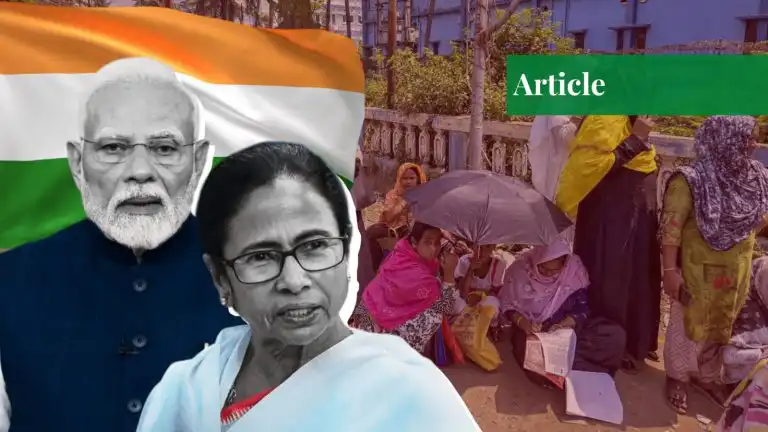
It’s not only the Muslims of Kashmir facing a dire situation; it’s the entire Muslim population living in India – a legitimate target of the current radical and fascist BJP regime. From Kashmir to Gujarat and now West Bengal, the Modi administration is inflicting severe blows on its Muslim subjects. Narrative building, fake news propaganda, street violence, etc., are all various tactics being used to suppress the voices of the innocent Muslims living in India.
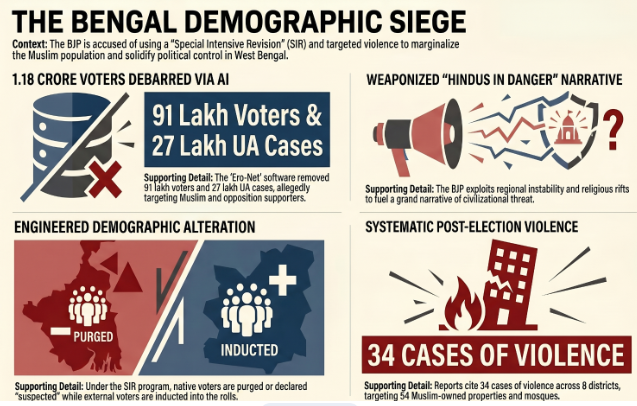
This time, West Bengal is at the epicenter of tensions. A large proportion of voters are being wiped out from the list. Foreign voters are being inducted. Muslims’ religious and cultural places are being targeted. The BJP is now determined to alter West Bengal’s demography to promote and strengthen its Hindutva ideology.
Political Landscape
West Bengal has always remained at the epicenter of regional and ideological rifts throughout the course of history. For decades, the political landscape of West Bengal was dominated by the leftist faction, the ‘Communist Party of India,’ whose entire policies were based on socialist and secular fundamentals. Later on, the All-India Trinamool Congress won the elections in West Bengal. In the last few years, however, the Bharatiya Janata Party (BJP) has made strong progress in West Bengal, stoking the nationalist, ideological, religious, and anti-incumbency narrative against the TMC government.
The BJP’s growing strength has resulted in the popularity of the Indian National Congress being downgraded, and the current Modi government is exploiting West Bengal’s delicate religious and ideological climate. This is being done to not only strengthen its foothold but also to wipe out a large population of Muslims, in particular those who migrated from Bangladesh – a demographic assault similar to what’s been happening in Kashmir for so long.
‘SIR’ Controversy
In April 2026, a very astonishing development occurred in West Bengal. An enormous number of 91 lakh voters were debarred from the electoral rolls. Besides this, there were 27 lakh voters who lost their voting rights due to the court decision regarding Under Adjudication (UA) cases. All this has been done under the special intensive revision (SIR) through a new AI-based ‘Ero-Net’ software. Just imagine, a novel and unchecked software deciding automatically which vote to count or not.
The BJP government is using such software primarily for two reasons: first, to sideline the TMC supporters and second, to banish the votes of the Muslim population. Under SIR, not only are the native voters either eliminated or declared suspected, but also external voters from other Indian states are being inducted into the voting list. No one can be certain of which candidate the particular voter added or removed may have supported. Thus, this simulation becomes a mathematical test for the candidates.
Hindus in Danger
As mentioned above, the ideological and religious rifts in West Bengal have always been exploited by the BJP government. And the 2024 student revolution in Bangladesh further provided an impetus to this. Bangladesh instability post-2024 and news of attacks on Hindus have strengthened the BJP’s rhetoric of “Hindu Khatre Mein Hain” (Hindus are in Danger) in Bengal. The communal riots in West Bengal were described as a broader threat to Hindus in the region, and attempts were made to spread fear among the masses about the consequences of the TMC’s “appeasement of minorities,” which might take Bengal to Bangladesh levels.
This facilitated the BJP’s articulation of how local instances of Ram Navami conflicts, Durga Puja clashes, Waqf-related violence, and social media conflicts had become part of a grand narrative of Hindu civilization being under threat from both outside and within Bengal. In the border regions, this story became intertwined with traditional motifs of migration, the Constitutional Amendment Act, the National Register of Citizens, citizenship, and the Matua-Namasudra vote bank.
West Bengal Elections
The Narendra Modi-led government has decisively won the election in West Bengal, where the opposition parties had a tough time till recently, and has secured a clear victory in the state, further consolidating its unassailable power in India. It is the first time that the BJP of the Indian PM has won the assembly polls in WB. Extensive use of ‘SIR’ and the discourse of “Hinduism under threat” led to such a victory. Before the elections, the Prime Minister of India had said “illegal immigration” had led to demographic changes in West Bengal.
Addressing a public meeting in the district of Malda, Mr. Modi said, ‘illegal immigration was promoted by the patronage mafia of the Trinamool Congress party and was also provoking riots in Malda and Murshidabad.’ All these events have clearly indicated that the elections were engineered, and the BJP has employed its evil tactic once again.
Violence Against Muslims
The post-election scenario in West Bengal has further substantiated the claim made above, i.e., the BJP’s intentions of implementing their fascist and radical policies in West Bengal. According to the report published by the Association for Protection of Civil Rights (APCR), violence has been committed in West Bengal since the BJP won the state assembly election. According to the report, there have been 34 cases of violence reported from at least eight different districts.
The report has accused both the Muslims and their properties, mosques, cattle markets, meat shops, and the office and house of the Trinamool Congress Party of having been subjected to attacks. At least 54 properties and at least 50 Muslims have been affected by the attacks. The violence, according to APCR’s results, included attacks on mosques, the destruction of Muslim-owned hotels in Barasat, the destruction of Muslim homes, assaults on street vendors and business owners, and bulldozer parades supposedly targeting Muslim-owned businesses.
Consequences
The crisis in West Bengal holds certain political, social, and democratic implications. First of all, the situation in this state has been suffering from the ideological and religious split that has been going on for quite some time already; the start of the attacks by the BJP in May 2026 will only exacerbate the conflict. It will be similar to the situation in Gujarat, where one can witness a severe confrontation between Hindus and Muslims. On the other hand, continuing political competition between the BJP and TMC will result in decreased efficiency of governance in West Bengal, which will be further exacerbated by the application of the ‘SIR’ and the utilization of societal splits. At this point, the BJP is attempting to copy the Kashmir scenario and eliminate Muslims by any means, thus silencing their voices. This, along with attacks and robbery of Muslims and Muslim properties, violates basic democratic principles.
Conclusion
Once again, the BJP government has brought India into the spotlight of international condemnation. Eliminating a large number of legitimate voters in West Bengal by the BJP is a clear violation of public law. Here, a question arises: if the BJP can implement such practices in West Bengal – using AI software and violence to crush the native Muslim factions there—then why not in Kashmir? Such instruments can be used in Jammu and Kashmir to alter the demography of the region. Consequently, it becomes the duty of the international community to take action against such atrocities committed by the BJP Party. Otherwise, this may result in the development of fascism in India, which would create chaos throughout the region.
If you want to submit your articles and/or research papers, please visit the Submissions page.
To stay updated with the latest jobs, CSS news, internships, scholarships, and current affairs articles, join our Community Forum!
The views and opinions expressed in this article/paper are the author’s own and do not necessarily reflect the editorial position of Paradigm Shift.

Syed Hammad Ali is pursuing a BS in International Relations programme from the International Islamic University, Islamabad, and has a keen interest in research works, policy analysis, defence and strategic studies, and conflict resolution.