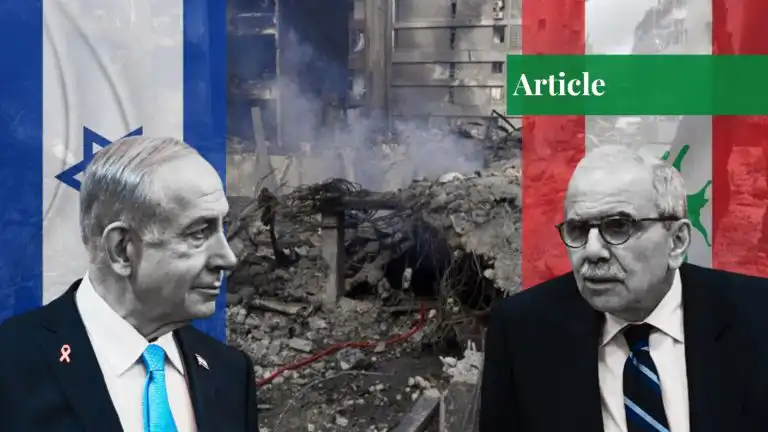
Israel and Lebanon share a history of decades-long war. The series of attacks on October 7, 2023, by Hezbollah, a Shia militant group in southern Lebanon, to deter Israel from its war on Gaza, is a continuation of this history. However, recent cross-border clashes between Hezbollah and Israel ramped up when Iran’s Supreme Leader Ayatollah Ali Khamenei was assassinated by a USA-Israel airstrike campaign against Iran on February 28, 2026. This event revived the decades-long confrontation between Hezbollah leadership and Israel’s Defense Forces (IDF). Israel has taken the ground that Hezbollah is a terrorist organization operating from the soil of Lebanon. Taking this into consideration, Israel has once again invaded southern Lebanon while displacing thousands of Lebanese and killing civilians, committing war crimes to defend its right to self-defense.
Israel’s Justification for the Lebanon Invasion
“If I’m strong, why should I negotiate? If I’m weak, how can I negotiate?”
Thomas Friedman
This reflects the Israeli geopolitical psyche, the core justification of Israel’s aggressive foreign policy and disproportionate military campaigns across the Middle East, of which Lebanon is once again at the center. Israel characterizes its territorial seizure of Lebanon’s sovereign land as neutralizing Hezbollah’s military capacity, creating a depopulated southern buffer zone, and annexing the territory up to the Litani River to achieve the ultimate goal of Greater Israel. The manifestation of all these objectives has resulted in the 1948, 1982, and 2006 invasions and the ongoing cataclysmic invasion of Lebanon.
Israel and Hezbollah share a history of being adversaries, each posing a threat to the other’s existence. Although it is not wrong to say that Hezbollah is a result of what Israel caused in Lebanon during its 1982 invasion. After 7,000 cross-border strikes between Hezbollah and Israel between October 2023 and June 2024 from the Lebanon border to support the Palestinians in Gaza, Israel has positioned Hezbollah as a major security threat. So, one of Israel’s core security concerns is to degrade Hezbollah’s massive missile arsenal, a 150,000-plus rocket capability that could paralyze Israeli infrastructure.
Lebanon represents one of the nodes in the supply chain of these military weapons and capabilities. Moreover, the land of Lebanon serves as a host for Hezbollah to operate and grow. Using this as leverage, Israel documents Hezbollah as a security threat to its existence and invades Lebanon with bombs and airstrikes as a preemptive security measure.
Israel has explicitly stated that the situation in Lebanon is a part of its Rafah and Beit Hanoun model plan, referring to the destroyed, displaced, and depopulated towns of Gaza by Israeli forces. The ongoing attacks on southern Lebanon are a continuation of this plan, as Israel officially ordered the Lebanese of the south to leave the area near the Litani River on March 4, 2026. Following the Dahiya Doctrine, Netanyahu has briefed the IDF to expand the annexation of the 8% Lebanese territory that lies south of the Litani River to create a deep security zone. Israel is narrating the total destruction and attacks on civil infrastructure as preemptive strikes on the hideouts of Hezbollah. The planning of completely leveling the Sohmor and Maashghara bridges over the Litani River by labeling them as operating areas of Hezbollah demonstrates this approach. Israel is destined to systematically level suburban infrastructure to cease any kind of Lebanese people’s existence there.
Israel’s resistance to negotiations, creation of a yellow zone in Gaza, total destruction in southern Lebanon, demilitarization of Hezbollah, and policing through the Dahiya Doctrine all lead to the Greater Israel road. This is not a matter of interpretation but rather an explicit intent voiced by Israeli Prime Minister Benjamin Netanyahu in an interview. As cited by i24 News in August 2025, Benjamin Netanyahu told the interviewer that Greater Israel is a spiritual vision that encompasses the territories of occupied Palestine, along with parts of Jordan, Lebanon, Syria, and Egypt.
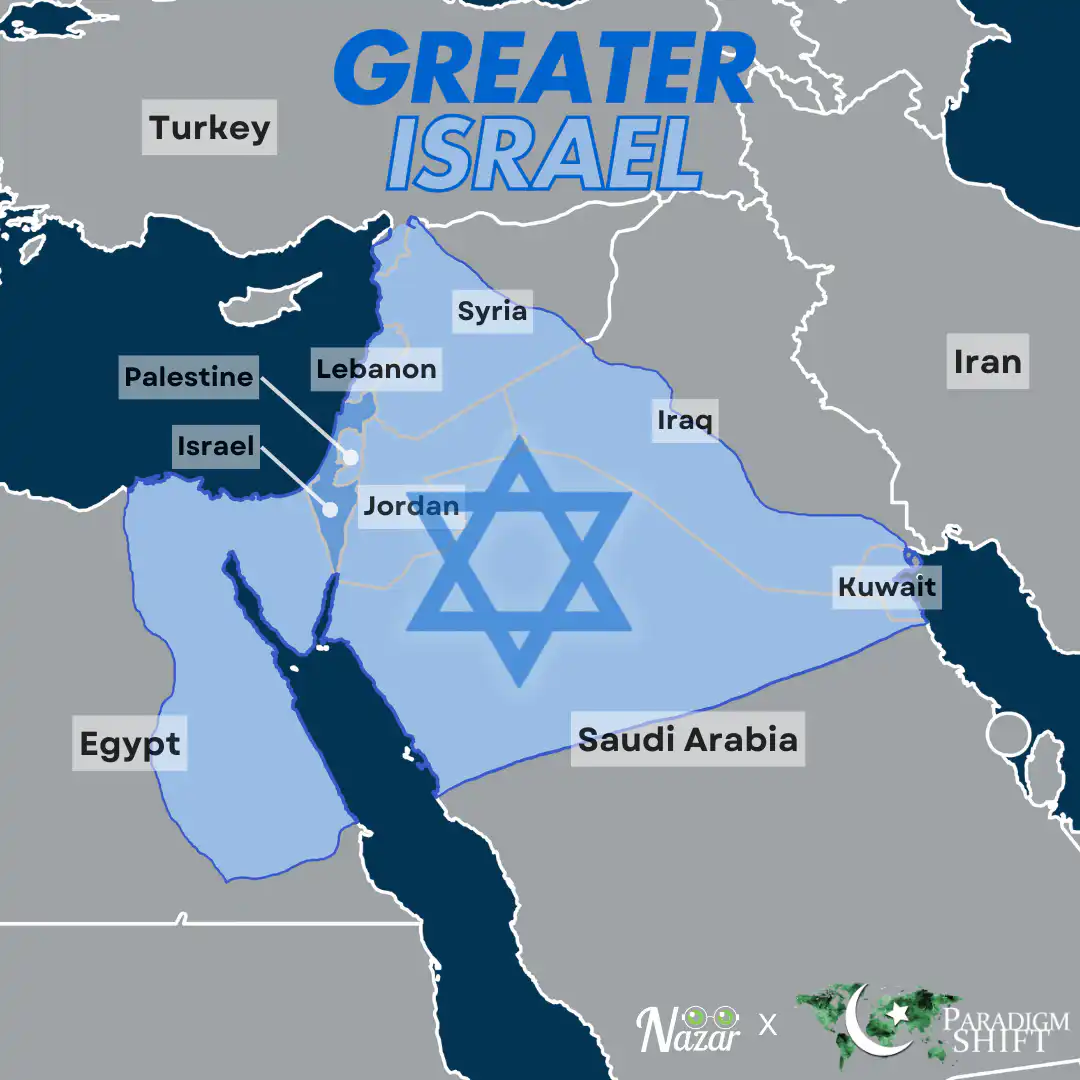
With the Greater Israel vision, the IDF has been justifying the criminal act of invading Lebanon’s sovereignty and wars in the Middle East, including the current conflict with Iran. The resumption of attacks on Lebanon in 2026, along with the assassination of military leadership in Hezbollah as well as Iran, is part of a broader plan by Israel. It constitutes the weakening and total demolition of the Ring of Fire in the Middle East so that Israel can manifest its Greater Israel vision on the criminally occupied territories. Dismantling Hezbollah by carrying out an invasion in Lebanon serves Israel’s ultimate goal.
The Scale of Israel’s Ground Occupation
To achieve this ultimate vision, Israel is actively working through its security doctrine to occupy Lebanese territory. On March 16, 2026, Israeli forces targeted the Litani River and damaged civilian infrastructure with the destruction of five bridges over the river. The operation in 2026 exceeds the destruction caused by Israel in Lebanon in 2006. With the demolition of more than 36,000 homes in southern Lebanon, Israel is following the Gaza plan here as well.
According to the map provided by Al Jazeera, approximately 1,000 sq km of area is documented under Israeli military control. The incursions expand into southern Lebanon, the Gaza Strip, and Syria from October 7, 2023, onward.
The occupied area in Gaza and southern Lebanon is declared by the Israeli army as part of its officially renewed regional map. The figure of 1,000 sq km is not based on a single source; in Gaza and southern Lebanon, it was calculated based on the borders declared by the Israeli army itself, whereas in southern Syria, it relied on an independent geographic estimate of areas of de facto military influence, given the absence of similar declared Israeli maps.
Israel, following the Rafah model, has officially termed the illegal occupation of Lebanon’s territory a forward defense area, which includes the expansion of Israeli forces up to 10 km within Lebanon. Israeli officials have outlined plans for a long-term “security zone” inside the border, though the preferred terminology now is a “forward defense line area,” with Israeli Prime Minister Benjamin Netanyahu saying his forces will expand their positions 10 kilometers (6 miles) deep inside Lebanon.
The Human Cost that Israel Doesn’t Count
After the announcement of the displacement of people on the southern Lebanon border, Israel’s defense minister, Israel Katz, further issued an official statement that explicitly intended the killing of civilians in case they refused to leave their homes. This threat was followed by the killing of 1,029 Lebanese, including children and medical workers, on March 2, 2026. Israel has not hesitated to kill journalists, civilians, children, doctors, women, and elders in clear violation of the laws of war since October 7, 2023.
Not only Lebanese civilians, but rescue teams from the Red Cross reaching to aid affected civilians also faced live fire targeting by Israeli forces. The war crimes of Israel see no red line, as its forces have opened fire on UNIFIL patrols in Lebanese territory. International human rights bodies have declared Israel’s actions in southern Lebanon and Gaza serious war crimes against humanity. Here too, Israel has called this self-defense.
Lebanon’s Future Under the US-Iran Deal
Finally, after June 17, 2026, the world is anticipating a path toward the long-awaited peace agreement between Iran and the United States. However, the question remains whether this Memorandum of Understanding (MoU) also addresses Lebanon’s future. Iran has stated that no deal can be signed unless Israel withdraws from Lebanon. According to this preliminary framework, Israel is not a party to the agreement and has stressed that it will keep its forces along the southern Lebanese border for as long as necessary. This stark contrast between the positions of two regional powers, amid efforts to sign the agreement, leaves the question of Lebanon’s ceasefire shrouded in ambiguity.
On one hand, this diplomatic breakthrough promises the reopening of the Strait of Hormuz, a development later confirmed by the Iranian Foreign Ministry. On the other hand, Israel’s continued bombing of southern Lebanon threatens both the peace process and the 60-day ceasefire period agreed upon by Iran and the United States before the signing of a formal peace treaty. Hence, the world is looking toward this fragile thread of hope, which could be shattered at any moment by renewed military escalation. Meanwhile, Iranian and US negotiators have reportedly canceled their trips to Switzerland, where the peace talks were scheduled to begin. Does this signal that no agreement can be finalized until a complete ceasefire is achieved in Lebanon?
Conclusion
The memorandum of understanding (MoU) stands at a crossroads as Israel persists in bombing southern Lebanon even after the peace deal. This de-escalation is a way forward for regional security and the reconstruction of Iran, but Israel’s continued airstrikes push any peace deal to be implemented. Washington and Tehran cannot sit at the negotiation table until Israel confirms that Lebanon’s territory is not subordinate to Israel’s colonial strategy. Although the MOU has signaled the permanent peace between the two sovereign states, the practice is still in question.
If you want to submit your articles and/or research papers, please visit the Submissions page.
To stay updated with the latest jobs, CSS news, internships, scholarships, and current affairs articles, join our Community Forum!
The views and opinions expressed in this article/paper are the author’s own and do not necessarily reflect the editorial position of Paradigm Shift.