Introduction
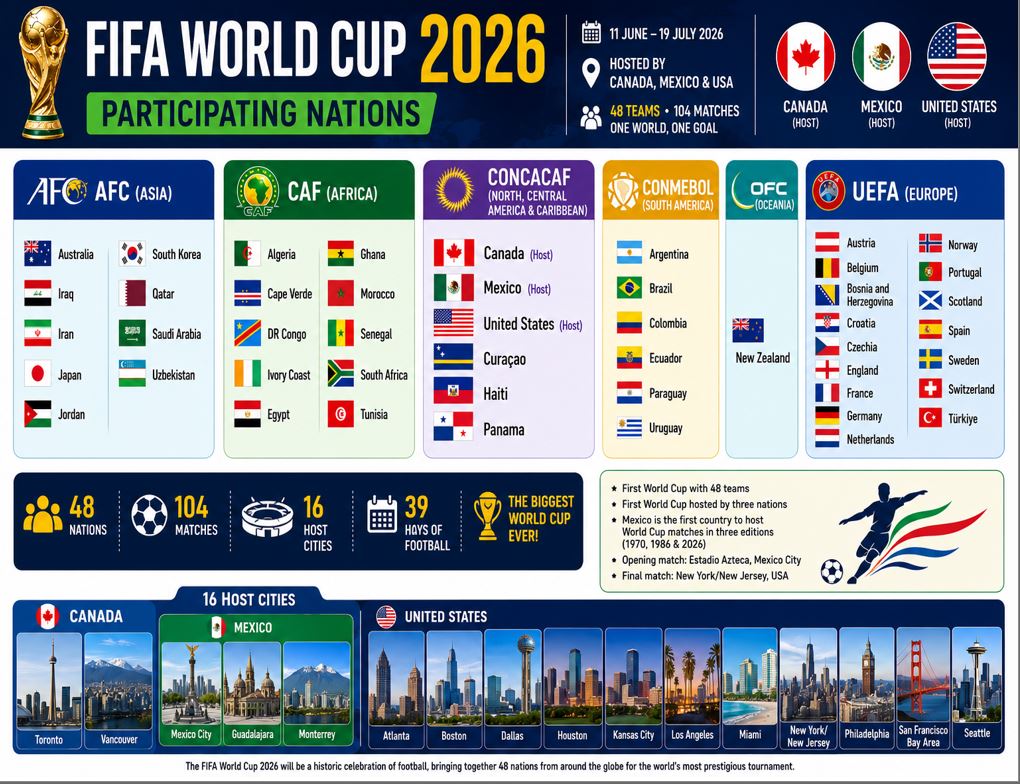
The FIFA World Cup 2026 will turn out to be the largest and most ambitious football competition ever organized. It is organized by the United States, Canada, and Mexico, and the competition will bring about many historical achievements. It is the first World Cup that is co-hosted by three nations.
It is the first FIFA World Cup where 48 teams will compete instead of the regular 32 teams. More teams mean more games and more participation from more spectators around the world. As the most popular event in the world of sports, the 2026 World Cup is anticipated with great enthusiasm.

Change in FIFA Format
One of the key differences between the 2026 FIFA World Cup and the previous ones is the increase in the number of teams from 32 to 48. The expansion was made by FIFA with the aim of having more teams participate and allowing many nations to enjoy the biggest event in their lives. The World Cup will have 12 groups, each of which will have 4 teams.
The first- and second-place teams of each group, alongside eight teams that place third in their respective groups, will qualify to play the newly created Round of 32. In the end, there will be a total of 104 games played in this World Cup, as opposed to 64 matches in the earlier versions.
The Host Nations
The FIFA World Cup 2026 is taking place in three North American nations—the United States, Canada, and Mexico. The United States will play host to most of the games, including the final. Canada will play host to some group matches and knockout rounds. Mexico again has the chance to welcome the football-loving world to another highly prestigious competition.
This is especially significant for Mexico since it makes Mexico the first nation ever to stage World Cup games in three different editions, having hosted the event in 1970 and 1986. This World Cup will showcase the increasing importance of North America to the world of football with all its advanced stadiums and infrastructure.
Participating Teams
The larger scale of the competition has greatly increased the level of involvement from all the continental confederations. The competing continents are going to be more represented compared to past World Cups.
Among the many teams competing in this year’s tournament are some of the most traditional football powerhouses. Some of the countries are Argentina, Brazil, France, Germany, England, Spain, Portugal, and the Netherlands, which have strong football traditions and can field some of the best players in the world.
However, the scale of the competition has made it possible for some of the smaller nations to join this competition. This is because, in the past, such nations had not been able to make their presence felt in the competition.
Key Dates
| Opening Match | 11 June 2026 |
| Group Stage | 11-27 June 2026 |
| Round of 32 | Late June to Early July |
| Quarter-finals | July 2026 |
| Semi-finals | July 2026 |
| Final | 19 July 2026 |
Dark Horses and Rising Countries
Among the most captivating elements of every edition of the FIFA World Cup is the rise of dark horses. This year’s edition will definitely feature many surprise performances due to the new format.
One such example is Morocco, which made it to the semis of the last World Cup and proved that African countries could rival footballing giants. Japan, South Korea, the United States, and Senegal have strong sides that are also able to reach an advanced stage of the tournament.
With more participants joining the event, there will be more opportunities for countries of Asia, Africa, and Oceania to prove themselves. They may not be viewed as favorites of the tournament, but they will make sure to affect the performance of other teams by beating them.
Challenges with the New Format
The extended format will pose new challenges for both the players and the coaches. The sheer number of games played will mean that team depth and player fitness will become very important aspects for success. Team injury management, fatigue levels, and the logistics associated with traveling such a large geographic distance will be key considerations.
With such a long period of time until the end of the tournament, consistency will matter as much as star quality. Those countries which will have great bench strength and tactical versatility will probably be better equipped for their last few games in the tournament.
Interesting Facts
- The FIFA World Cup 2026 is the first World Cup with 48 teams taking part.
- It is the first World Cup organized by three countries.
- There will be a record-high number of 104 games played.
- Over 1,200 footballers have taken part in the World Cup.
- This is the first time that Mexico has hosted World Cup matches in three different editions.
- Teams that qualify for the final can play eight games in the World Cup rather than seven as before.
Conclusion
Considering that there will be a total of 48 teams competing, three hosts, and many never-before-seen matches, the FIFA World Cup 2026 promises to outdo all other past tournaments. The tournament not only offers the established giants of this sport a chance to reassert their dominance but also offers new nations a chance at making history.
Besides being a sporting event, the FIFA World Cup is the essence of international brotherhood, diversity, and athleticism. Whether there is victory for one side or defeat for another, the 2026 FIFA World Cup promises to be one of the best tournaments that will be remembered in the future.
If you want to submit your articles and/or research papers, please visit the Submissions page.
To stay updated with the latest jobs, CSS news, internships, scholarships, and current affairs articles, join our Community Forum!
The views and opinions expressed in this article/paper are the author’s own and do not necessarily reflect the editorial position of Paradigm Shift.

Syed Hammad Ali is pursuing a BS in International Relations programme from the International Islamic University, Islamabad, and has a keen interest in research works, policy analysis, defence and strategic studies, and conflict resolution.