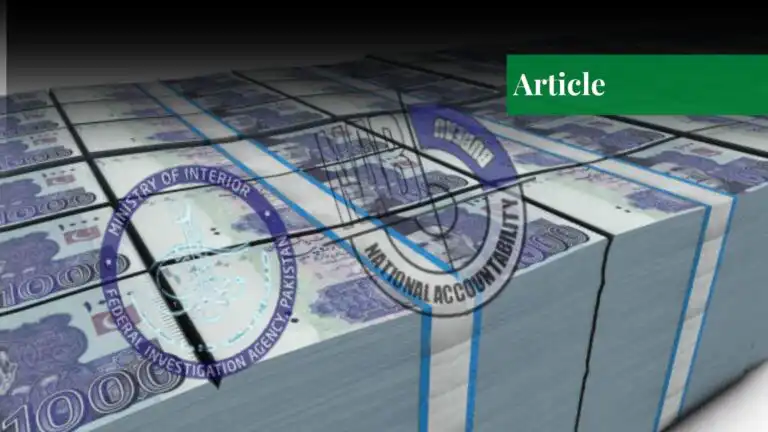
Introduction
Money laundering is popularly termed as “invisible crime.” It is a financial crime that involves illegally concealing money obtained from illicit activities. In simple terms, laundering refers to cleaning, so money laundering means cleaning dirty money. In Pakistan, money laundering tem is firmly rooted in our institutions, affecting the governance and national security. Pakistan is facing a deficiency in its anti-money laundering (AML) and counter-terrorism financing (CTF) frameworks, which is the main reason for its listing on the FATF Grey List from 2018 to 2022.
The State Bank of Pakistan (SBP), in its AML policies, says real estate, hawala, and trade transactions are the main drivers of money laundering. Due to limited investigation units and inter-agency coordination, Pakistan continues to face extreme vulnerabilities in money laundering and terrorism financing. These flaws in our institutions create loopholes for criminal networks to exploit, harming national security.
Globally, the United Nations Office on Drugs and Crime (UNODC) emphasizes that money laundering erodes national sovereignty by strengthening terrorist and extremist networks. It directly corrodes state institutions, breeds corruption, and reduces foreign investments due to a lack of trust and transparency. Money laundering in Pakistan must not be seen only as a financial crime but as a threat to national security that empowers illicit networks and weakens governance. Thus, tackling this issue is not just about financial regulations, but it is a matter of national survival.
Money Laundering in Pakistan
There are various forms of money laundering in Pakistan, such as benami accounts, shell companies, and real estate agencies. According to a report by the Federal Board of Revenue (FBR), people register their assets, like vehicles or real estate, in the names of their relatives or employees to dodge the tax system. Offshore or shell companies are used to hold and transmit the illicit funds across borders. For instance, the Panama Papers exposed various influential families in Pakistan hiding a huge amount of wealth and transferring it internationally.
Terrorist networks take advantage of underground remittance systems like hawala or hundi. In Pakistan, the hawala network is extensively used to transfer money from one location to another. The 2002 US Treasury report claims Pakistan to be a part of the “hawala triangle,” enabling the laundering of illicit capital. Some of the hawala operators were arrested in Karachi and Peshawar during FIA raids from 2023 to 2025.
Role of NAB and FIA
The National Accountability Bureau (NAB) functions as a flagship anti-corruption and financial crime agency under the National Accountability Ordinance (NAO) 1999 and the Anti-Money Laundering Act 2010. NAB has relied on plea bargains and voluntary returns to recover funds without lengthy trials, which has sparked judicial concerns. Due to this, the Supreme Court has warned and argued that these activities foster corruption, leading to a rupture of national security and the global image of the state.
Analysts argue that NAB selectively prosecutes the elite class, leaving them less scrutinized. Amendments were proposed in 2024 to mitigate this influence and emphasize the shift in the burden of proof once NAB presents a prima facie case. These reforms will prove beneficial if implemented, as they will strengthen NAB’s effectiveness.
Meanwhile, the Federal Investigation Agency (FIA) has established a special squad to combat money laundering. FIA works against corruption and terrorism with specialized wings/departments. But due to the coordination gap between NAB, FIA, and other agencies, the gap remains significant. FATF reports highlight that the weak interconnection between financial regulators and law enforcement agencies hinders implementation.
The FATF Grey List and International Repercussions
From June 2018 to October 2022, Pakistan’s grey-listing by FATF served as a critical external lever leading to major overhauls in its AML/CFT framework. The APG/FATF Mutual Evaluation Report of October 2019 rated Pakistan’s AML/CFT regime as underperforming, with merely 3% effectiveness and 39% technical compliance compared to FATF requirements. Due to this, the government launched the Anti-Money Laundering Act 2021, which was amended through bills like the Anti-Terrorism Bill 2020 and the UNSC Bill to comply with FATF obligations.
This grey listing affected the international image of Pakistan, as per reports provided by IMF analysts, countries under the observation of FATF suffered average capital inflow declines of approximately 7.6% of GDP. Pakistan’s exit from the grey list in October 2022 was followed by the completion of all 34 APG/FATF action points, which was verified by an on-site technical assessment mission in mid-2022. Reforms in oversight, coordination, ownership transparency, and sanctions played a key role in facilitating the successful exit. This outcome was credited to a comprehensive, whole-of-government strategy, with institutions such as the SBP, FIA, and ICAP as central to strengthening compliance systems.
Legal and Procedural Gaps
Limited financial investigators and prosecutors are the major reason for Pakistan’s subpar judicial outcomes. The Mutual Evaluation Report by FATF/APG, 2019, says that Pakistan’s Financial Monitoring Unit (FMU) forwards selective Suspicious Transaction Reports (STRs) to the FIA, which itself lacks forensic tools and training to effectively carry out investigations. The International Crisis Group (ICG) terms it as a ‘systematic bottleneck.’
Another flaw in Pakistan’s law enforcement system is the ineffective framework for Mutual Legal Assistance, which is used for asset recovery from international accounts. The Pakistan government passed the MLA Criminal Act in 2020 with the Ministry of Interior as the central authority, but its implementation still lags.
Meanwhile, delays in trials and political interference undermine conviction prospects. These legal and procedural gaps deplete international cooperation and operational efficiencies, which weakens deterrence and implementation of reforms in the system.
Institutional Reforms and Global Partnerships
To counter money laundering effectively, Pakistan must implement institutional reforms and expand international cooperation:
- Pakistan must establish an autonomous financial intelligence unit. There is an FIU in Pakistan, but it is not independent; it operates under the SBP.
- There should be institutional coordination among NAB, FIA, SBP, SECP, and the judiciary for joint investigations.
- Pakistan must invest in digital forensics, AI-based audits, and blockchain tracking for real-time monitoring.
- Citizens must report on money laundering cases. Pakistan needs laws protecting whistleblowers and promoting civic participation.
- Pakistan must sign treaties like the MLA for international cooperation.
Conclusion
Money laundering in Pakistan is now not only a financial crime but also a threat to national security. It enables terrorist networks to exploit our institutions. Until and unless Pakistan develops autonomous units, institutional coordination, digital forensics, and effective acts, efforts against corruption and terrorism will remain ineffective.
“You cannot fight crime with dirty hands; trace the money, and you control the crime.”
Global Financial Integrity, 2023
If you want to submit your articles and/or research papers, please visit the Submissions page.
To stay updated with the latest jobs, CSS news, internships, scholarships, and current affairs articles, join our Community Forum!
The views and opinions expressed in this article/paper are the author’s own and do not necessarily reflect the editorial position of Paradigm Shift.

Syeda Farani Fatima is an undergraduate student of International Relations at the International Islamic University of Islamabad, with a strong interest in anti-corruption, counter-terrorism and geopolitics. Strongly committed to fighting corruption, terrorism, and supporting national reform through research and public service.