

Introduction
NATO has taken a step that represents a significant change in its outlook for the future in a world that is becoming more unstable by the day, and where power politics frequently trump diplomacy. The alliance declared at its 2025 summit in The Hague that it would increase its defense spending goal to 5% of GDP by 2035, more than doubling its previous benchmark of 2%.
On paper, this might appear to be a number, but the implications are far from that. This decision represents a change in the balance of power in the world as well as in European military strategy. The message is clear that now NATO is getting ready for bigger threats that it believes lie ahead, in particular from China and Russia. However, this kind of preparation is not done in a vacuum. It causes reactions and sometimes even retaliation.
This article investigates how world politics may be influenced by NATO’s new defense posture. What does it signify for Russia and its already strained Western relations? How might this change be interpreted and responded to in China? What are the wider ramifications for a world already trending toward more intense rivalries and profound divisions, perhaps most importantly?
Reasons behind NATO’s Increase in Defense Spending
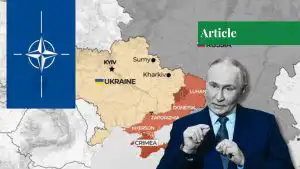
To understand this, we must go back a few years in order to understand this change. Many European states’ perspectives on security were altered by Russia’s full-scale invasion of Ukraine in 2022. Assuming that the hard war in Europe was over, the majority of NATO nations had underfunded their armies for decades. Policymakers were duped by the post-Cold War era into thinking that international institutions, trade, and diplomacy would suffice to keep the peace.
However, that illusion was destroyed by the conflict in Ukraine. NATO abruptly recognized that its military mobility was restricted, its ammunition supplies were inadequate, and its arsenals were exhausted. In Europe, there was a dramatic shift in public sentiment toward security readiness. The United States, which has long been the cornerstone of NATO, was becoming impatient at the same time. American presidents had been urging European allies to shoulder more of the burden for years. In particular, Donald Trump accused allies of freeloading and turned NATO funding into a political issue. This worry persisted even under various administrations. In part, the new 5% goal is a reaction to that pressure.
Moreover, there are other ways in which the world has changed. With advances in cyber warfare and a determined foreign policy in Asia, China has not only grown economically but also militarily. Despite its lack of direct involvement in the Pacific, NATO cannot overlook this development. With a war in Europe and a growing superpower in Asia, the alliance feels compelled to be proactive rather than reactive.
Russia’s Probable Reaction
Moscow sees NATO’s budget increase as a threat rather than a precaution. Russia has long represented NATO as a hostile alliance that isolates and encircles it. This story has been used to mobilize support at home and defend its own military actions. Russia now has more political and strategic ammunition thanks to the new spending target. It can be asserted that since NATO is preparing for war, Russia should follow suit. This will probably support additional increases to Russia’s defense budget. Additionally, it promotes more aggressive conduct via cyberspace, diplomacy, and the military.
What’s most dangerous now is escalation. NATO sees its spending as defense, but Russia may view it as a threat. That could lead to more drills near NATO borders, new missile placements, or hybrid moves in fragile areas like Georgia, Moldova, or the Baltic. Instead of calming things down, this might only raise the heat.
China’s Response: Competitive Growth or Strategic Caution?
China probably isn’t surprised by NATO’s move, but that doesn’t mean it won’t take it seriously. Even if NATO says it’s focused on Europe, Beijing will likely see this budget increase as just another piece of a bigger picture—a Western strategy to keep China in check. And that kind of thinking leads to action.
It wouldn’t be surprising if China starts speeding up its military plans, not out of panic but calculation. Not to start a war, but to make sure it’s ready for whatever comes, more investment in long-range missiles, stronger naval power, maybe even defense systems in space could happen quicker than before. But it’s not just about weapons; China could also turn to diplomacy. It already has platforms like BRICS and the SCO, and now it might start using them more actively—not just to talk, but to build a world where the West doesn’t call all the shots.
And here’s the part that matters most: if both China and Russia start feeling cornered, they’re likely to move closer, not just as partners in name, but in real, strategic ways. That could change the whole shape of global power. Quietly at first, maybe, but steadily that might make the gap between the Western alliance system and its enemies bigger, which is exactly what NATO might wish to avoid.
How Does It Change the Global Balance of Power?
For a long time after the Cold War, the United States—backed by NATO—pretty much shaped how global security worked. Their military edge, combined with influence through diplomacy and institutions, gave them a kind of default leadership. But that grip has been slipping. China has grown stronger, not just economically but strategically. Russia has become bolder, and many global institutions don’t carry the same weight they once did.
Now, with NATO raising its budget in a big way, it looks like the West is trying to hold the line—to show it still leads and to pull its members together with more force than before. But here’s the catch: this could end up deepening the divide rather than bridging it. Instead of calming tensions, it might reinforce the idea that we’re heading into a world of “us vs. them”—with the West on one side and China and Russia on the other. And for countries that aren’t part of either camp? They might get stuck in the middle, having to pick sides or stay uncomfortably neutral, even when they’d rather focus on their own challenges.
This change is hard for countries in the Global South. Many countries don’t want to get caught in a superpower standoff. They’re more focused on things like climate change, food, energy, and debt than on missiles or military drills. If NATO’s military expansion is met with similar steps in the East, it could gravely hurt global cooperation on shared problems.
Another problem is the arms race in some areas. If Europe spends more money, countries in the Middle East, Africa, or South Asia may feel like they have to do the same. This shift of financing away from infrastructure, healthcare, and education could hurt global development even more.
Is More Security a Sure Sign That People Will Spend More?
Is there a link between spending more and feeling safer? This is probably the most important question. The answer is not simple. On the one hand, NATO’s 5% aim will help make the alliance more ready, more intimidating, and a strong display of unity. By showing potential opponents that NATO is strong and united, it can help keep things from getting out of hand.
But if the military spends money without also spending money on communication and diplomacy, the globe could become much more dangerous. Security is more than just possessing firearms; it also means being able to talk to people, trust them, and keep tensions from getting out of hand.
In addition, a lot of NATO countries will have to make tough choices at home to attain the 5% goal. Will this hurt social welfare? Will governments cut funds for education or public health in order to attain military goals? And what will the public think of those compromises? Also, the alliance could get too focused on preparing for war and forget that the fundamental goal should always be to stop war.
Conclusion
The decision by NATO to raise its defense spending to 5% says a lot about the times we live in. It shows fear, uncertainty, and a shift in mindset—from cooperation to confrontation. On the surface, it might make sense – be stronger, be ready – but behind that is a bigger question: at what cost? You can’t buy peace just by building bigger armies. Real security isn’t just tanks and strategies; it’s about trust. It’s about whether countries talk to each other or just prepare to fight.
The more the world pours into weapons, the more it risks drifting into a place where dialogue dies out—and that’s where the real danger begins.Maybe the smartest way forward isn’t just more spending, but better choices. Choices that keep us safe and sane. That reminds us that borders matter, yes—but so do people and so does peace. And if we forget that, we might win a few battles, but lose something much bigger.
If you want to submit your articles and/or research papers, please visit the Submissions page.
To stay updated with the latest jobs, CSS news, internships, scholarships, and current affairs articles, join our Community Forum!
The views and opinions expressed in this article/paper are the author’s own and do not necessarily reflect the editorial position of Paradigm Shift.

Ahmad Chaudhry is a practicing lawyer with a strong academic background and a deep interest in politics, war, and defense studies. He regularly writes on legal, strategic, and geopolitical issues, combining legal insight with analytical depth. With a passion for current affairs and constitutional law.