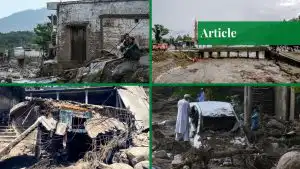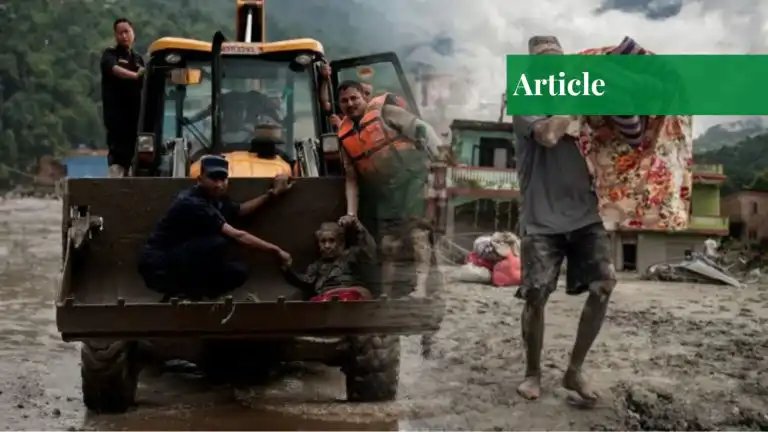
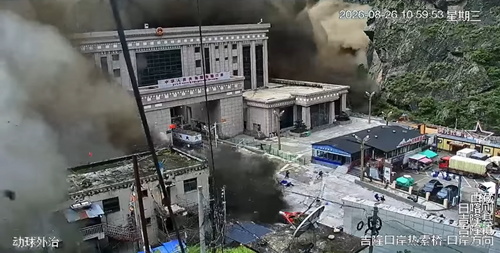
On August 26, 2026, a wall of ice, rock, mud, and water swept through the Himalayan borderlands of Nepal, taking over communities on the Lende Khola, Bhote Koshi, and Trishuli river systems. The U.S. Geological Survey (USGS) rated the event as a catastrophic debris flow and flood, likely triggered by a rapid slope failure that involved a glacier in Langtang National Park. The debris flow continued for almost 100 kilometres downstream and impacted populated areas on both sides of the Nepal-China border, damaging a major highway and the Rasuwagadhi border crossing.
This was not just another flood in the Himalayas. It was a domino effect that quickly turned the physical danger into a humanitarian, infrastructure, and cross-border crisis. By August 30, there were 734 deaths and 2,498 persons missing in Nepal, while in China, 16 people were reported dead and 546 missing in Tibet.
What Nepal is warning the rest of South Asia about is the more important question. The mountains of the Himalayas have become not just a wonder of geography but a battleground for water, energy, infrastructure and geopolitics. None of this is to say that this is just a consequence of climate change; the actual mechanisms behind the glacial collapse are still under investigation. However, shifts in climate can affect the physical conditions of mountain hazards, and increasing populations, infrastructure, and economic integration can increase the risk of mountain hazards when they do occur. Nepal is not only confronting a disaster, but also a warning.
From Flood to Security Crisis
When disasters strike in the Himalayas, the first instinctive reaction is to act in a humanistic manner, to count the dead, to retrieve the trapped and injured, to rebuild the destroyed. Those are key priorities, but stopping there misunderstands the nature of the disaster.
The debris flow damaged settlements and critical infrastructure such as roads between Nepal and China. The disruption of trade, energy, state capacity, and the destruction of roads, bridges, power lines, and border facilities resulted in a mountain hazard. In the logic of Environmental Security, a change in the physical environment can jeopardize the conditions for political and economic stability. When a flood cuts a strategic road, hacks an energy project, and interferes with an economic corridor across the border, it’s not a flood anymore.
Climate change is becoming a “security multiplier,” compounding vulnerabilities in infrastructure, water dependence and geopolitical competition. Similarly, the multi-jurisdictional nature of the threats faced in the Himalayas indicates the inadequacy of regional institutions, as environmental changes are impacting economic systems, inter-state relations, and political stability. Today, the Himalayas are perceived not just as a natural border between two States, but also as water reservoirs, energy corridors, transport infrastructure, as well as a fragile ecosystem that can destabilise along the borderlands across the rivers, through movement, and by compromising infrastructure. A border separates states; a security frontier connects their vulnerabilities. The Nepal disaster makes that distinction clear.
South Asia’s Lifeline, and Its Uncertainty
Water is the first and most important strategic value of the Himalayas. Hundreds of millions rely on the Indus, Ganges, and Brahmaputra, which are fed by the mountains. According to research in Nature Reviews Earth & Environment, the freshwater flows of the Himalaya-Karakoram region are influenced by glaciers and glacial processes, impacting the livelihoods of nearly 869 million people in these basins.
That glaciers are melting is not just a problem; it’s a hydrological uncertainty. When conditions and amounts of snow and ice change, so do the timing and quantity of flows downstream. The “future” is “no water”, but a more dynamic combination of devastating floods and water shortages in some years, with direct implications for agricultural production, hydropower and urban water supply. Water has long been linked to strategic rivalry in Asia, and a changing Himalayan environment has provided fresh impetus to this argument.
Infrastructure, Development and Strategic Risk
Strategic competition between China and India and smaller states such as Nepal and Bhutan is growing in an unstable environment. This is all about infrastructure: roads, hydropower plants and border crossings are being constructed on land that is both economically important and environmentally sensitive. The Himalayas are also valuable, but at the same time vulnerable, because of their connections with the outside world, as seen with the destruction of the Rasuwagadhi crossing.
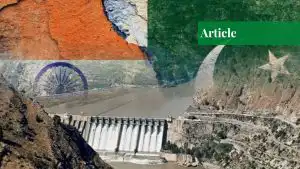
This is the same tension that is seen in Nepal’s hydropower ambitions. Despite climate projections of changing river flows, increased sediment loads, and glacier retreat in these river basins, basin-specific climate-adaptive planning and enhanced transboundary water governance are needed to ensure Nepal’s hydropower potential. The issue is not development; it’s development without proper climate-security risk assessment. Climate change has not taken the place of geopolitics in the Himalayas, but it has introduced a new variable.
Water Security, the Next Fault Line
The Hindu Kush Himalaya region is often referred to as the “water tower” of Asia, but it is facing threats from climate change, including warming and changing precipitation patterns, and glacier melt. Glacier melt, water stress, and climate-related hazards are listed as key risks to the region by the IPCC, and the need to incorporate climate risk into governance is emphasized.
This is not to say that there will be “water wars” in South Asia — it’s not that straightforward. The more pressing threat is the lack of predictability: when there is no certainty as to when and how much water will flow in shared rivers, pressure grows on agriculture, energy planning and diplomacy. Neither is the hazard of the Himalayas new: Research on GLOFs warns that in the absence of clear evidence of increasing frequency, it is not wise to assume that all hazards will increase in frequency as the glaciers change. Whereas what has changed is exposure: more infrastructure, cross-border economic activity, and more people are now sitting on the same unstable terrain. A landslide, which previously cut off a remote village, can now cut off a road that connects two nations.
Why Should Pakistan Be Watching Closely?
The Indus system is vital for the economy of Pakistan, agriculture, and food security, and is nourished by the same cryosphere of the Himalaya-Karakoram region. The strategic interests of Pakistan are not just exposed here, but if the country does not suffer Nepal’s fate, it is well exposed. The issue is not only the reduction of water flow in the Indus, but also the timing of the water flow and its volume. There may be too much water during floods and too little when it is needed for agriculture and hydropower. This aligns with the IPCC’s larger message regarding the interconnections between water, energy, and food risks in Asia. The mountains may be geographically distant from Islamabad, but the rivers that begin there are not.
Recommendations: Disaster Response to Climate Security
South Asia must move beyond disaster management to climate-security planning. There are three key steps to take into account:
- Regional early-warning systems designed for the specific hazard. The Nepal disaster highlighted how traditional systems, which rely primarily on monitoring rainfall and river levels, are not fast enough for floods resulting from rapid glacial melt. Early-warning architecture must get up to speed with the hazards it should be detecting.
- Climate-security risk assessments for key mountain infrastructure. The economic feasibility should be assessed in addition to the vulnerability to future climate and geologic hazards for hydropower plants, roads, bridges and border corridors. An economically viable road is not necessarily a resilient road.
- Institutionalised transboundary data-sharing. Cooperation between Nepal and China during this crisis on rescue operations and upstream conditions demonstrates what can be achieved. The cooperation should not be restricted to the time of emergencies, but should be a regular flow of data exchange for satellite imagery, hydrological data, and glacier monitoring between Nepal, India, China, Bhutan and Pakistan.
All of this does not need to be accomplished through militarisation of climate governance. Regional militaries already possess logistical and high-altitude capacities that would be useful in emergencies, but the framework should not be military-driven, but civilian-led and build on existing disaster-management institutions.
Conclusion
The tragedy in Nepal should not be put on the back burner as another such incident in South Asia’s long history of floods and landslides. It’s a cautionary tale on the consequences of a destabilising mountain context meeting infrastructure, population growth, and geopolitical competition. The Himalayas have always been regarded as the natural barrier of South Asia. However, when the system under the shield begins to fail, the shield becomes an impediment. The danger is not that all such glacier collapses would result in a disaster on the scale of this one, but that water, energy, infrastructure, and displacement increasingly are all happening within the same unstable area.
South Asia has spent decades preparing for threats that cross its borders. It now needs to prepare for threats that move through its mountains.
If you want to submit your articles and/or research papers, please visit the Submissions page.
To stay updated with the latest jobs, CSS news, internships, scholarships, and current affairs articles, join our Community Forum!
The views and opinions expressed in this article/paper are the author’s own and do not necessarily reflect the editorial position of Paradigm Shift.

Eman Alam is an International Relations student with a keen interest in global politics, public diplomacy, and international security. Her work focuses on analyzing contemporary geopolitical challenges and their implications for global power dynamic