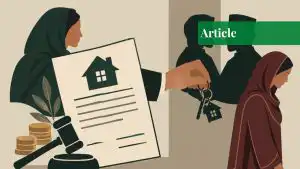
What is Honour Killing?
While speaking of issues being faced by contemporary Pakistan, one cannot be oblivious to the case of honor killing being as widespread as deeply entrenched. That has been the reason for countless deaths and unimaginable suffering due to this social problem steeped in traditional patriarchal ethos. Honour killing refers to the murder of a family member by other members of the family who believe that the victim has brought dishonour to them; because of this, most women fall prey to it.
One of the major causes of this dishonour may be due to reasons such as refusing an arranged marriage, applying for a divorce, or even allegations of immoral conduct. They justify the act while defending the family’s honour most of the time. This issue of honour killing in Pakistan is deeply rooted within the cultural, societal, and religious ethos of the country.
The latent pluralistic structure of Pakistani society, which essentially forms the internal fabric of Pakistani society, most commonly identifies women as custodians of family honor, thereby assigning them a tight code of behavior. Any act deviating from this code is perceived as immorality, refusal of an arranged marriage, or even seeking a divorce is perceived as a crime that soils the family’s good name. This is punished severely, often fatally, to restore the reputation of the family within society.
The Prevalence of Honour Killing in Pakistan
Such is the alarming frequency of such cases. According to statistics by the Human Rights Commission of Pakistan, in the two years starting from February 2014 to 2016, there have been 1,276 honour killings, out of which only 400 are officially registered by the police as crimes. However, human rights campaigners say the real figure is much higher, with estimates suggesting over 1,500 killings took place in 2016-2018 alone, most of which went unreported.
With the overwhelming majority of perpetrators remaining unpunished, this has fostered an air of impunity around honour killings in Pakistan. In the year 2024, 10 cases of honour killing have been reported exclusively from the area of Khyber Pakhtunkhwa district swat. There has been a rise in such cases, mainly from the region of KPK and Chitral, many of which go unreported.
This view is further supported by strict cultural norms governing a woman’s behavior. These norms, ranging from dressing to marriage, are usually considered shameful to have been broken, and the person committing this crime is stigmatized. This blame-shifting attitude is therefore fueled by the mistaken belief that the victim was responsible for this dishonour, hence shifting the responsibility from the criminal to the victim.
Societal attitudes often promote victim-blaming and stigmatization for certain people—especially women—who are perceived to have brought dishonour upon their respective families. Basically, in situations where a woman’s actions or decisions floute traditional norms, society tends to blame the victim and not the perpetrators. Such victim-blaming culture intimidated an enabling environment for the pursuit of justice and further fostered a culture of violence and silence.
Almost all the victims of honour killings are stigmatized and looked upon with suspicion, and their actions or behavior are made synonymous with justification for the violence against them. This attitude in society not only hinders the pursuit of justice but also gets slowly built up for the normalization of honor-based violence or, in general, violence against women.
Religious misinterpretations are another cause of the problem. Although no religion, even Islam, allows anyone to kill or murder another human being for any reason, such crimes against women of the family are perpetrated in the name of restoring family honor by misinterpreting the religious doctrines with emphasis on the modesty and purity of a woman.
The loopholes in the law and lack of any powerful enforcement make the situation even worse. Laws like qisas and diyat, which allow “blood money” as compensation for murder, are also twisted in favor of the murderer, particularly when murderers and their victims are of the same family.
Case Studies
A dreadful example is that of Saba Qaiser. According to the Oscar-winning documentary “A Girl in the River: The Price of Forgiveness,” Saba eloped at 19 years old with a man with whom she had fallen in love—an act that had grossly challenged the authority of her family, especially on marriage matters. In a horrific turn of events, Saba’s father and uncle attempted to execute her in the name of “honour.”
Although she was badly injured in the attack, Saba survived the attempt and mustered the courage to seek justice. It was then that socio-legal pressure took the better of her, and finally, she pardoned the attackers, showing how powerful the influence of social norms can be on the pursuit of justice. The resilience of Saba, despite such adversities, underlines, quite forcibly, why legal and social reforms are required to protect individuals like her from the horrors of honour-based violence.
The second case that shook the entire nation was that of Qandeel Baloch, a social media personality known to make bold statements about the independence of women. This incident in Qandeel’s life has been highlighted through the famous Pakistani series known as “Baaghi.” In 2016, Qandeel was strangled to death by her brother, who, quite proudly, confessed to murdering her, citing the conduct of his sister as a stain on their family’s reputation.
The murder of Qandeel was such that it even stirred a legal amendment to stop dishonor killers from evading punishment. Her murder caused an uproar throughout society and turned the spotlight on the dangerous risks that women take when they dare challenge societal norms. There was such public uproar over her death that calls for legal reforms and protection of lives facing such threats have started surfacing.
Conclusion
Despite horrifying cases and the international fury they raised, honour killings remain widespread in Pakistan. According to Amnesty International, most honour killing victims are women and girls. But it is also a fact that men are also killed in these incidents, though their number is very small. Often the problem is solved through jirga and personal reconciliation, in which others and women are the victims. Face-on, such statistics underscore a critical need for comprehensive legal reforms and raising awareness in society to protect individuals, especially women, from such killings.
These are rather deep-seated cultural norms and social attitudes, that are very hard to alter. Still, Pakistan must go forward in terms of legislation, social awareness, and education to rid itself of this evil practice. The media and civil society therefore play the gigantic role of informing about such outrages, coupled with pressing for legislation, bringing tales of Saba Qaiser, Qandeel Baloch, and others like them to the front, and raising a call to action.
This is, therefore, the harsh reality of the challenge to honour killings in Pakistan. This horrifying practice can still end through legislative reform, raising social awareness, and constant advocacy that works toward a future where women are valued and protected. But even in desperation, hope comes—the resilience and courage of all striving for change. Their voices implore us to unite in our feelings, celebrate the spirit of justice, and create a world where every life is precious and worthy of respect.
If you want to submit your articles and/or research papers, please check the Submissions page.
The views and opinions expressed in this article/paper are the author’s own and do not necessarily reflect the editorial position of Paradigm Shift.

Tayyaba Rehan is a student at the National Defence University. She is currently pursuing her degree in defense and strategic studies. She has worked with multiple governmental and non-governmental organizations. Her articles have been published in national as well as international publications.