The Horrific Reality of Honor Killing in Pakistan
Honor killing in Pakistan is known locally as “ghairt ke naam par qatal.” Honor killing is the murder of a member of a family in the name of self-respect and protection of the family name in society. It is always the killing of a woman and a girl in our community. This act of violence is often rooted in cultural, political, social, or religious beliefs that place high standards of family reputation, which is always linked to controlling women’s behavior, including their choices regarding relationships, living patterns, clothing, choosing their jobs, education, moving in society, or lifestyle.
According to the non-governmental Human Rights Commission of Pakistan (HRCP), 888 women were reported deliberately killed in 1998 in Punjab alone. Of these, 595 killings were carried out by relatives; of these, 286 were reportedly killed for reasons of honor. For many centuries, women have faced many strict restrictions from their families, even though they did not marry outside their family, tribe, or their own choice. If they do, their male householder kills them in the name of ghairat (traditional concepts of familial shame).
There is a long history. When we look at Pakistan, there are many laws present regarding honor killings, but there are unsuccessful attempts to control them. Murder committed in the name of honor is punishable by death or imprisonment for life. In the Farzana Parveen murder case, many conservative families in Pakistan considered it shameful for a woman to fall in love and choose her husband. Refusal to accept arranged marriages frequently results in honor killings. On the other hand, followers of the Maliki school of thought believe that the consent of the wali is only required for the first marriage and not for a second time. According to this, Farzana married for a second time at this time, and the consent of wali was not needed.
In July 2016, Qandeel Baloch, a well-known Pakistani social media personality, was strangled to death by her brother in Multan, Punjab, in what was described as an honor killing. Qandeel had gained attention for sharing bold photos on social media, including one with a Muslim cleric, which sparked controversy. Her brothers had reportedly asked her to stop, but she continued. The state took on the role of the complainant in her murder case, which meant her family could not forgive the killer to avoid punishment. Her brother, Waseem, was arrested and admitted to killing her, saying, “She was damaging our family’s honor, and I couldn’t bear it any longer. I killed her late on Friday night when everyone else was asleep.” According to this case, everyone has the right to life as per their law. Why are women killed in the name of honor?
The Jirga System in Pakistan
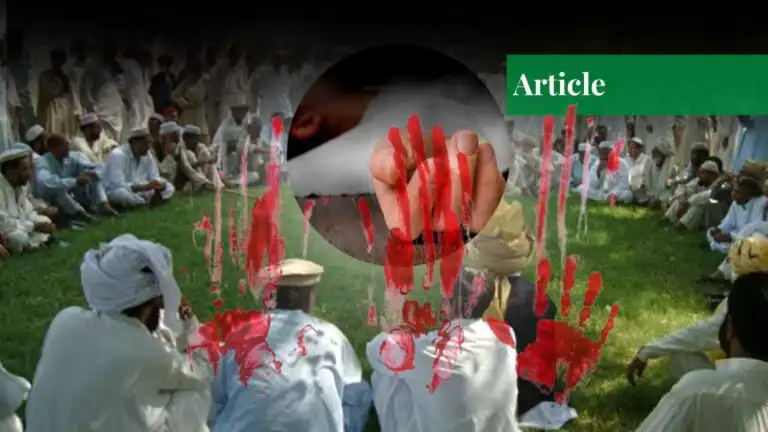
The jirga system in Pakistan holds great significance as it provides support to the grieving and punishes wrongdoers. However, it violates constitutional laws and disregards fundamental human rights when settling conflicts. It was revealed that the jirga is unjust and violates every human right. Meanwhile, ADR programs focus on transparent and equitable conflict settlement while operating lawfully. The honor of men is a critical component of jirga customs. A single testimony from a male relative is sufficient to condemn a woman in a case of adultery.
Even if a woman marries of her own free will, she is still punishable by death under jirga customs, as she has violated the honor of her male relatives. Most men can get away with murder or rape through reconciliation agreements, which offer cash or a girl from their family for marriage as compensation. In one case, a jirga decided that two teenage lovers should be electrocuted because they believed the couple had brought shame to the community. In 2015, a jirga in Diamir banned women from voting, which stopped about 12,000 women in that area from taking part in elections.
In another shocking case, an 11-year-old girl was forced to marry a much older man as punishment for a crime her uncle had committed. These examples show how some village councils or jirgas make deeply unfair and harmful decisions, especially against women, often promoting violence and discrimination. The Supreme Court of Pakistan, in PLD 2019 SC 218 (NCSW v Government of Pakistan), categorically held that the jirga system is illegal and unconstitutional. The recent brutal murder of Sheetal Baloch and her husband, Zarak, allegedly on the orders of a jirga, is a flagrant violation of the law and fundamental human rights.
Honor killing is a dark stain on our society and must be eradicated through firm legal action and accountability. It was not until 2019 that jirgas and panchayats were declared unlawful by the Supreme Court of Pakistan. The judgment clearly explains the international laws that Pakistan is bound to follow. Pakistan has signed the Universal Declaration of Human Rights (UDHR), which says in Articles 7 and 8 that everyone should be treated equally under the law without discrimination and that people should have the right to go to court if their basic rights are violated.
Pakistan is also part of the International Covenant on Civil and Political Rights (ICCPR), which gives similar protections. It requires countries to make sure people enjoy the rights promised in the covenant and to provide proper legal remedies when those rights are violated. In addition, Pakistan has approved the Convention on the Elimination of All Forms of Discrimination against Women (CEDAW). Article 15 of this treaty says that men and women must be treated equally in court and have the same legal rights and chances to use them.
Enactment of the Honor Killings Act 2004: Strengths and Weaknesses
This type of act defined honor killing as “murder” and treated it as a serious crime, calling it fasad-fil-arz, which means “creating disorder in society.” The Punjab Protection of Women against Violence Act of 2016 was designed to make Pakistani laws stronger in protecting women. Its purpose is to set up a system to protect women from violence, help them recover, and support them in rebuilding their lives. Under the Qisas & Diyat Act of 1991, murder is treated as a crime that can be settled. This means the victim’s family can forgive the accused through a mutual agreement. They can also choose to accept or reject compensation (blood money) from the accused. This makes it harder to enforce the 2004 amendment to the law. In Pakistani law, there are many amendments, but the only missing thing is the implementation.
The long-term impact of these laws is still unclear, but growing awareness and public outrage about violence against women in Pakistan are driving changes in the legal system. For example, the Domestic Violence Bill of 2021 was a major step forward, as it included emotional and psychological abuse as forms of violence against women. While there is still a long way to go in ending crimes against women, the efforts of civil society offer hope for positive change.
Cases of “honor” killings have been coming to courts in Pakistan for years now. Until 2004, there was no specific legislation that had been enacted to curb the rampant crime of “honor” killings in the country. In the Abdul Waheed case, the Supreme Court looked at the plea of sudden and grave provocation in light of the earlier Gul Hassan case. The accused had confessed to shooting a man who intervened when he tried to kill his sister after finding her in a compromising situation. Due to weak witness statements, the only evidence was the accused’s confession. The trial court accepted his version and ruled that the victim was not masoom-ud-dam (innocent of blood). The prosecution appealed, asking for a death sentence under section 302(a) of the PPC. Justice Naseem Hassan Shah explained that when someone wants to use a legal exception, they must prove it. He also said that, like in zina cases, proof would require four adult male Muslim eyewitnesses—none of whom were present in this case.
In Ashiq Hussain v Abdul Hameed, the court enhanced the sentence of the accused, who committed the murders of Abid Hussain and Hafizan Bibi on the account of honor. The court went into detail as to how “some of the pre-Islamic prejudices persist in one form or the other. The murders in the name of honor are one manifestation of this prejudice, which has taken the lives of many innocent souls.” The court went on to state that “no court can, and no civilized human being can, sanctify murders in the name of tradition, family honor, or religion.”
As for the Balochistan High Court, it seems to have given some positive decisions in the cases of honor crimes. In Khadim Hussain v. the State, the court supported the view that nobody had any right, nor could anybody be allowed to take the law into their own hands to take the life of anybody in the name of ghairat. Neither the law nor the religion permitted the so-called honor killing, which amounted to qatl-e-amd simpliciter. Such an iniquitous and vile act was violative of the fundamental rights as enshrined in Article 9 of the Constitution, which provided that no person would be deprived of life or liberty except following law, and any custom or usage in that respect was void under Article 8(1) of the Constitution. Similarly, in another case, it was said that murder based on ghairat did not furnish a valid mitigating circumstance for awarding a lesser sentence, and “killing of innocent people, especially the women, on the pretext of ‘siyahkari’ was un-Islamic, illegal, and unconstitutional.”
Conclusion
Many people were unaware of the law, and it was poorly written. It still allowed families to forgive killers and let them go free. Excuses like “sudden and grave provocation” were often used to get lighter sentences, and judges, influenced by cultural bias, accepted them. The 2016 law also had similar flaws, and honor crimes remain common. Lower courts often ignore good rulings from higher courts and treat killings differently from other murders.
Judges are not always neutral. Their decisions can reflect male-dominated views. Law is shaped by power and can keep unfair systems in place. Feminist legal thinkers want to change this by making laws fairer for women. But legal change alone isn’t enough. Society’s attitudes must also change to truly stop honor crimes.
If you want to submit your articles and/or research papers, please visit the Submissions page.
To stay updated with the latest jobs, CSS news, internships, scholarships, and current affairs articles, join our Community Forum!
The views and opinions expressed in this article/paper are the author’s own and do not necessarily reflect the editorial position of Paradigm Shift.