From Allies to Adversaries: How Pakistan and the Taliban Fell Out
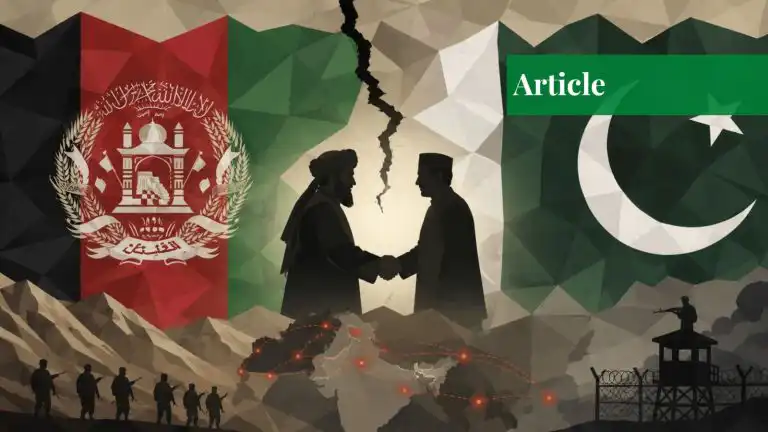
On Wednesday, July 1st, Afghanistan launched a series of drone strikes at targets in Pakistan, a few days after Pakistan had launched its own air strikes on Afghanistan. This is the latest in a long series of skirmishes between the two countries and threatens to upend a fragile semi-ceasefire that was agreed in March.
Let’s start by explaining how Pakistan and the Taliban got into this mess. Until recently, the Taliban and Pakistan were actually pretty good mates. In reality, Pakistan had been supporting the Taliban and the entire group of Mujahideen in their struggle against the Soviets in the ’80s and became one of only three nations that recognized the Taliban as the legitimate government of Afghanistan after their victory and capture of Kabul in 1996, the other two being Saudi Arabia and the UAE. Relations between Pakistan and the Taliban continued despite the US occupation of Afghanistan starting in 2001.
This annoyed the US government, but Pakistan did not want to sever relations with the Taliban as Pakistan believed that one day the TTA could again come into power. This was because Pakistan did not want the TTA to house any terrorist organizations within its territory that would conduct operations against the state of Pakistan, including the TTP. Unfortunately for Pakistan, when the Taliban returned to power in 2021, they made basically no effort to stop terror groups, including not just the TTP, but also other groups like the Baloch Liberation Front, from operating out of Afghanistan. And terror attacks inside Pakistan restarted with increasing frequency. According to the Center for Research and Security Studies, 2024 and 2025 were the two deadliest years for Pakistani security personnel for nearly a decade, with over 1,200 fatalities. In response, Pakistan carried out intermittent strikes on TTP targets inside Afghanistan. There was an escalation in October when Pakistan launched a series of air strikes on targets in Kabul and Kandahar, signaling that they would hold the Taliban directly responsible for attacks by terror groups operating out of Afghanistan.
The Cycle of Escalation: Border Clashes, Airstrikes, and Fragile Ceasefires
It was possible for Qatar to broker a last-minute ceasefire, but everything went down the drain this year with another suicide bombing. In retaliation, Pakistan conducted a number of airstrikes against terrorist training camps in Afghanistan. As for the Taliban, they launched an attack on Pakistan’s border regions. And then Pakistan retaliated again by launching massive airstrikes on Taliban strongholds in both Kabul and Kandahar. Another ceasefire was negotiated in March, this time with help from Turkey, but it always looked fragile, and there’ve been intermittent skirmishes in the months since, culminating in the escalation of violence we saw earlier this week. As it has already been argued that the fundamental problem here is that the Taliban just cannot actually stop the various terror groups operating inside Afghanistan because the Taliban lacks the state capacity, a 2023 UN report for instance estimated that more than 20 terror groups operate in Afghanistan, which puts quite a lot on the Taliban’s proverbial plate, but the Taliban itself has lots of factions within it. So even if the main factions agreed to Pakistan’s demands, other factions would probably continue to cooperate with their favorite terror groups.
The two countries have thus been stuck in a sort of escalatory cycle. A terror attack happens in Pakistan, Pakistan demands that Afghanistan crack down on the relevant terror groups, Afghanistan says no, Pakistan escalates in a futile attempt to get the Taliban to take their concerns more seriously, and the cycle repeats. However, something has changed in recent months that might merit some cautious optimism. Namely, Russia’s re-engagement with the Taliban. After becoming the first and only country to formally recognize the Taliban last year, in May, and this flew slightly under the radar, Russia took things a step further and signed a military cooperation agreement with Afghanistan. Apparently, mostly focused on repairing the Taliban’s Soviet-era weapon systems. There are two reasons to think that this new security pact, and Moscow’s engagement with the Taliban more generally, could help encourage peace between Afghanistan and Pakistan.
The first is that it could deter Pakistan from taking too drastic military action against Afghanistan in the future. The Taliban made this explicit when they signed the agreement, with their acting defense minister claiming that Pakistan would soon no longer dare to attack Afghan territory. The second is that Russia will presumably be able to pressure the Taliban into doing more against the various terror groups operating in its territory. This isn’t just because Russia wants to favor with Pakistan. It’s also because Russia itself is worried about Islamic State Khorasan, or ISKP, which, was responsible for the 2024 Moscow concert hall terror attack, and could use Afghan territory as a sort of operating base. More generally, there is some evidence that Russia wants to restore its prestige and influence in Central Asia, which has waned since the war in Ukraine. In part because other post-Soviet states worry about Putin’s imperial ambitions, but also because the Russian military’s lackluster performance has undermined its appeal as a security partner.
Russia’s Return to Central Asia: A New Hope for Regional Stability?
However, as we say, there has been some evidence in recent months that Russia wants to re-engage with the region by emphasizing the fact that even if the Russian military isn’t all it was once cracked up to be, Russia remains the only viable security guarantor. It is only this week that Russia has announced that they are planning to bolster its military presence in Tajikistan, since Russia’s military presence in Tajikistan is currently deployed as a CSTO mission to help protect against militant attacks originating from Afghanistan. As a little bit of background for you, CSTO stands for the military organization whose primary purpose is to serve as the mutual defense pact between Russia and five other former Soviet republics, including Belarus, Armenia, Kazakhstan, Kyrgyzstan, and Tajikistan. There used to be much speculation that the CSTO was irrelevant following the annexation of Ukraine by Putin because the former Soviet republics mistrusted Russia, and the latter did not live up to the mutual defense pact when Armenia fought with Azerbaijan in 2023.
The fact that Russia is taking the CSTO deployment seriously suggests Russia might be interested in reviving its role as a regional security guarantor, and might thus be willing to both pressure and maybe even help the Taliban sort out its domestic security situation, which is really the only way Afghanistan was ever going to have peaceful relations with Pakistan.
If you want to submit your articles and/or research papers, please visit the Submissions page.
To stay updated with the latest jobs, CSS news, internships, scholarships, and current affairs articles, join our Community Forum!
The views and opinions expressed in this article/paper are the author’s own and do not necessarily reflect the editorial position of Paradigm Shift.

Muhammad Haseeb Sulehria is a student of Defense and Strategic Studies at Quaid-i-Azam University, and a former internee at Pakistan’s Ministry of Defense. With a keen interest in national and international affairs, he actively explores issues of security, strategy, and global politics, aspiring to contribute to policymaking and peacebuilding.