
Trump’s First-Term China Strategy: Tariffs, Sanctions, and Strategic Confrontation
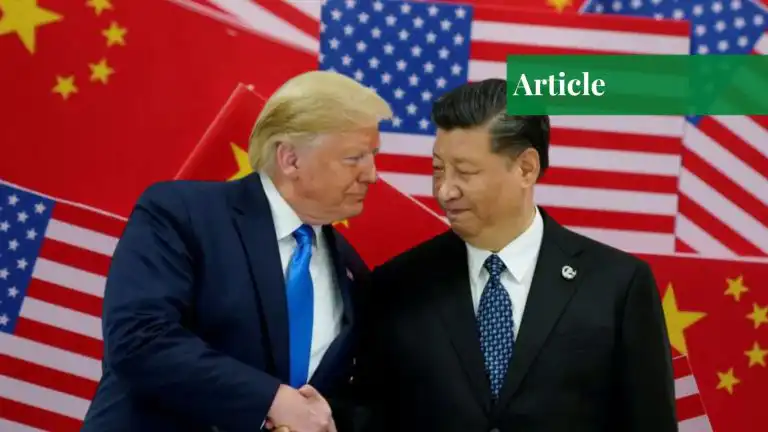
The US President Donald Trump met Xi Jinping in May of this year. The trip has been remarkably chummy. Trump has spent most of it gushing about how beautiful China is and complimenting his host. And he was apparently unable to extract any meaningful concessions, apart from apparently a commitment from Xi that China wouldn’t supply weapons to Iran, something that Trump already claimed Xi agreed to in the last meeting. This is probably a good thing from the perspective of anyone who wants to avoid a superpower complex, but it’s a pretty remarkable turnaround from Trump, who used to be incredibly hawkish towards China. So, to appreciate just how dramatic this reversal has been, it’s worth remembering quite how hawkish Trump used to be on the so-called China issue. When he first came on the political scene in 2015, one of Trump’s big talking points was China.

Find more statistics at Statista
To the extent that the 2016 election was sometimes framed as a choice between the confront-China candidate in Trump versus a confront-Russia candidate in Clinton. Trump’s main bugbear was the fact that the US ran and still runs a large bilateral trade deficit with China. This has been happening since the ’80s, but it really ballooned in the 2000s and was running at about $350 billion when Trump took office in 2016. To remedy this, in January 2016, Trump suggested a flat 45% tariff on all Chinese imports. Obviously, this didn’t actually end up happening, but the tariffs Trump did impose were nonetheless pretty severe, at least by modern standards. Trump began applying tariffs to an ever-expanding list of Chinese goods in July 2018. By the end of his presidency, Trump had imposed tariffs averaging about 20% on most Chinese imports.
Throughout his term, Trump also imposed a number of sanctions on Chinese tech companies like Huawei and ZTE, and on companies suspected of doing business in Xinjiang. Trump also lashed out against Beijing’s claims in the South China Sea, wherein China claims roughly 90% of the region using something called the nine-dash line, after which a map published by a Chinese cartographer in 1936. In his tweet dated December 2016, Trump asked, “Did China ask us to build a massive complex in the middle of the South China Sea? I don’t think so.” And in 2017, Trump’s Secretary of State-to-be, Rex Tillerson, suggested during his confirmation hearing that the US could deploy naval assets to, quote, “bar China from accessing the artificial islands.” Trump was also pretty hawkish on Taiwan. After his election victory in December 2016, Trump held a direct phone call with Taiwan’s then president, the first between the leader of the island and a US president or president-elect since ties began in 1979. Trump also filled his administration with so-called China hawks and signed the Taiwan Travel Act, allowing US officials of all levels to travel to Taiwan.
In August 2020, just a few months before the election, Trump sent Health Secretary Alex Azar to the island, the highest-level visit by a US official in decades. Trump also escalated arms sales, culminating in an $8 billion package, including 66 upgraded F-16 fighter jets in late 2019, which provoked retaliatory sanctions from Beijing against US arms companies. You get the idea. In his very first term, Trump was very hawkish on China. During the 2024 presidential election campaign, Trump essentially promised more of the same. He suggested a 60% flat tariff on all Chinese imports and took a notably confrontational tone on espionage, warning Beijing that the FBI would quote “hunt down any Chinese spies.” Like his first term, Trump’s second term is also full of well-known “China hawks,” and in this case, one can mention Elbridge Colby, the current Under Secretary of War for Policy, who gained prominence in Washington through the assertion that America has to withdraw from Europe and the Middle East to concentrate on China.
The 2025 Policy Reversal: Trade Truces, Diplomatic Outreach, and a Warmer Tone Toward Beijing
In the opening months of his second term, it looked like Colby and Co. might get their way. Trump said that he’d get the US out of Ukraine and, days after taking office, imposed a 10% tariff on all Chinese imports, which, thanks to a rapid tit-for-tat trade war after Trump’s so-called Liberation Day tariffs, ballooned to something like 140% by May. But since then, Trump’s policy and rhetoric towards China have become increasingly dovish. The tariffs were promptly reduced as part of a hastily negotiated trade truce, and Trump has spent most of his time since praising Xi as a great leader. In December, Trump’s 2025 National Security Strategy avoided explicitly labeling China as America’s foremost strategic competitor and instead focused more on Europe. A month later, he upset even congressional Republicans by allowing Nvidia to sell its high-end AI chips in China, so long as the US government got a cut of the profits. Trump also slow-rolled a forced sale of TikTok, something he previously framed as an urgent necessity, and walked back an earlier threat to cancel visas for Chinese students studying at American universities.
During the war in Iran, which some commentators suggested might be a way to indirectly undermine China, Trump then took pains to avoid upsetting Beijing. After CNN reported that China was sending weapons to Iran, Trump reacted by merely sending Xi a letter asking him to stop and said on Truth Social that he was planning to open the Strait of Hormuz for China. Ahead of that summit, as we noted in the intro, Trump took a conspicuously dovish tone. The US also delayed final approval of a $13 billion military aid package for Taiwan. So, why has Trump changed his tone? In other words, what happened to Trump the China hawk? Well, Trump’s chumminess with Xi is sometimes chalked up to his well-documented affinity for strongmen. There might be something to this, but we also see at least two more structural reasons for this pivot.
Why the Shift? Geopolitical Pressures, Economic Realities, and China’s Growing Leverage
The first is that, contrary to what Elbridge Colby might have hoped, the US has proved incapable of extricating itself from Europe and the Middle East. While Trump has withdrawn most support for Ukraine, he’s been unable to end the war and has apparently gotten stuck in another open-ended conflict in the Middle East, this time with Iran. At the same time, Trump has started taking more of an interest in the Western Hemisphere, which has left the US without the strategic bandwidth to mount a meaningful challenge against Chinese influence in Asia.
Second, this is clearly a reaction to last year’s trade war, when Trump’s rhetoric started to change. As you might remember, China reacted to Trump’s Liberation Day tariffs by restricting the export of rare earths, elements which are crucial for most modern technology. Unfortunately for Trump, China utterly dominates in both production and refining, which is why this prospect sparked panic in America’s business community. This proved that China does indeed have leverage over the US, contradicting Trump’s long-held belief that their imbalanced trade relationship had fundamentally given the US the upper hand. Greenland. For decades, it’s been viewed as little more than a giant ice sheet on the edge of the world. A massive ice fortress that most of us only ever saw from 30,000 ft on a flight to somewhere else.
If you want to submit your articles and/or research papers, please visit the Submissions page.
To stay updated with the latest jobs, CSS news, internships, scholarships, and current affairs articles, join our Community Forum!
The views and opinions expressed in this article/paper are the author’s own and do not necessarily reflect the editorial position of Paradigm Shift.

Muhammad Haseeb Sulehria is a student of Defense and Strategic Studies at Quaid-i-Azam University, and a former internee at Pakistan’s Ministry of Defense. With a keen interest in national and international affairs, he actively explores issues of security, strategy, and global politics, aspiring to contribute to policymaking and peacebuilding.