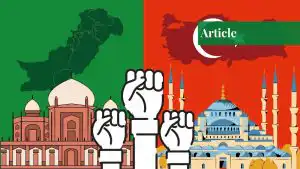
The recent showdown in Bannu and Balochistan cast a glaring spotlight on the daintiness of Pakistani nationalism. Forced abductions and recurring unrest highlight the deep-rooted challenges Pakistan faces in fostering a cohesive nationalistic fervor. As the flames of unrest and violence flare up, Pakistan’s narrative of a singular, primordial national identity seems to be falling apart, calling into question the effectiveness of the state’s policies and actions in instilling a unified sense of nationalism.
History Of Pakistani Nationalism
The challenge of national integration in Pakistan is as old and troublesome as the history of the state itself. Formed on the ideology of Islam, the country faced a plethora of ethnic and linguistic crises from the start. Ethnic nationalism fractured the threads of newly formed civic nationalism among Pakistanis, with linguistic conflict arising in the early years. Quaid could see the contention becoming an inherent problem. Thus, on his visit to Dhaka University, he stated that Urdu and only Urdu would be the national language of Pakistan.

Quaid’s warnings and apprehensions to Pakistanis about the rifts caused by ethnic nationalism and politics of secession were, after all, proved right. From Sindh Khuppay to Jaag Punjabi Jaag, one after another, all the provinces raised slogans of ethnic nationalism, falling into the trap of secessionists.
Mishandling by Pakistan
The state machinery of Pakistan has played a vital role in fracturing Pakistani nationalism. Being a product of the British colonial regime, since its inception, Pakistan had a responsibility to cultivate civic nationalism upon independence. From its inception, the mishandling of ethnic nationalism has been constantly disrupting the ruling regimes.
The 1971 episode of Bangladesh is the most illustrious example of the state’s failure to create a secure environment for all ethnic groups. With time, other ethnic communities like Balochi and Sindhi began to feel marginalized and insecure about their ethnic identity within the state, compelling them to rise for secession. In contrast, India emerged well from ethnic divisions, using constitutional changes such as the National Framework of the 1950s, which recognized the boundaries of states along linguistic lines. Whereas, when the “One Unit Policy” was introduced in 1952, Pakistan assimilated the ethnic communities—merging them as one. The idea backfired as the ethnicities believed it devolved their language, history, and indirectly their existence.
The Balochistan and Pushtoon Episode
A recent prominent example of mishandling by the state is the “Balochistan and Pushtoon” crisis. Since its dramatic secession to Pakistan, Balochistan has been a bone of contention. The region has seen multiple military insurgencies and counter-operations by the state, staining the streets of Balochistan in blood. Military operations included tactics such as human rights abuses and extrajudicial killings. Forced abductions fueled resentment against civic nationalism amongst the Baloch; from the military operations of Zulfiqar Ali Bhutto to the murder of Nawab Nourouz. The relationship between Baloch sardars and the ruling elite of Pakistan is fraught with mistrust. The clash between Nawab Akbar Bugatti and President Musharraf proved to be a crushing blow, with the president publicly condemning influential tribes and their leaders in 2006.
Similarly, the Pakistani military operations against the Taliban and TTP left northern Khyber Pakhtunkhwa in a devastating situation, with many Pushtoons suffering due to the unexploded landmines left behind after the war in South Waziristan. The Pushtoon population of these areas has expressed its concern and disenfranchisement both politically and militarily. The Bannu cantonment attacks show that a big faction disagrees with the government’s approach to these issues.
India’s Nationalist Approach
South Asia is not a stranger to conflicting nationalist narratives. To say that India hasn’t met with this kind of political crisis is not entirely true. Being one of the top two most densely populated states in the world, India faces significant challenges in maintaining political unity. It has faced such challenges in states like Jammu and Kashmir, Nagaland, Assam, and Manipur.
The states and people of Northern India expressed their dissatisfaction and political disenfranchisement with their government from the start, like Naxalites were with Maoists. It was harder to sustain and maintain government control. The rebel ideas did not stay confined to their geographical area as states like Chhattisgarh, Odhisa, and Jharkhand soon caught the affliction. India’s approach to handling political crises has been multidimensional and has involved both military and diplomatic efforts. Military operations were used to combat rebels but civil discussions led to agreements like the Shillong Accord in 1975 and the 2015 Framework Agreement with NSCN.
Unlike Pakistan, which failed to bring most of its insurgent groups to the table due to ever-uncertain policies, India saw some modicum of success. Today, the precarious situation between TTP and the state of Pakistan can be attributed to the government’s inconsistent policy directions over the years. Constant back and forth of state relations with militant organizations (as was seen during the Zarb-e-Azb Operation—APS 2016 episode) has not only made them more inimical but increased restlessness in people up north who are tired of the government constantly toying with their lives.
Governing Structure
A key distinction between Pakistan and India’s path—to keep their states intact—has been the governing structure. Pakistan has faced controversies over the “One Unit” scheme and the 18th Amendment which could have avoided the 1971 incident by simply decentralizing the power to the provinces. In contrast, India came up with a combination of federal and unitary elements. It masterfully yielded a dynamic with a clear division of power between the central government, constituent states, semi-tribal territories, and the union territories.
India also has provisions for autonomous regions, especially in North East India and West Bengal, and has multiple (22) national languages. The contrasting world that India and Pakistan created for themselves nurtured the spirit of nationalism in both countries. Where India’s hybrid model successfully maintained unity, Pakistan kept on falling into the same trenches—even after losing Bangladesh in 1971.
Conclusion
The issue of national integration is not unsolvable. For this, the leadership of Pakistan needs to sit and implement the lessons learned from the past. As much as the state is right in its claim that no Sardar—from any province—owns the land under his name, it is necessary to realize that national integration can only be achieved by bringing them under one flag and political identity rather than ousting them. To promote “Pakistaniyat’” both bottom-up and top-down approaches should be introduced. Otherwise, the efforts to promote Pakistani nationalism would keep falling short, as they have before. In a nutshell, to forge unity, the state needs to insert seeds of security and respect in ethnic communities, only then it will become the country Jinnah manifested.
If you want to submit your articles and/or research papers, please visit the Submissions page.
To stay updated with the latest jobs, CSS news, internships, scholarships, and current affairs articles, join our Community Forum!
The views and opinions expressed in this article/paper are the author’s own and do not necessarily reflect the editorial position of Paradigm Shift.

She is doing her Bachelor in International Relations from Kinnaird College for Women's University, Lahore. She has done multiple internships with prestigious institutes and has a keen interest in foreign policy and diplomacy.