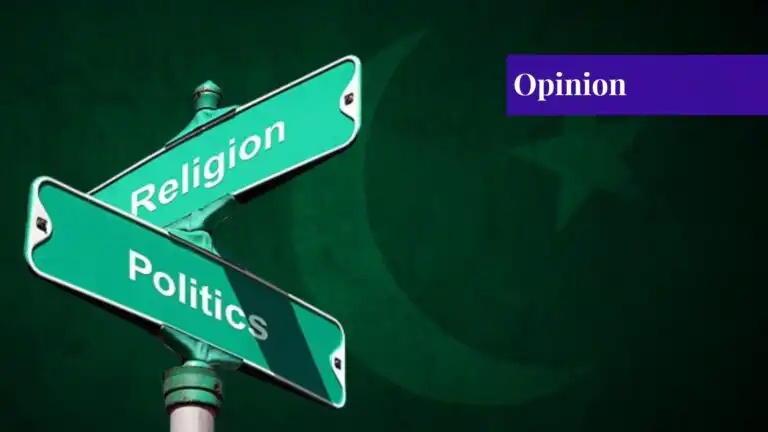
This article examines a twin phenomenon—the politicization of religion and the religionization of politics in Pakistan, with a focus on their historical trajectory and implications for the state and society.
The invocation of religion in political discourse leads to the politicization of religion, while the influence of religion on political life results in the religionization of politics. Jocelyne Cesari, a renowned scholar in the field of political science and religion, defines the politicization of religion as the process in which religious symbols, beliefs, and values become intertwined with political agendas and processes. This ultimately results in the utilization of religion for political gains, blurring the boundaries between political and religious spheres. Thus, the instrumentalization of religion serves as a tool to advance specific political goals and ideologies.
She argues that this transmutation of religion is a complex and nuanced process influenced by socio-political dynamics, historical contexts, and power struggles within societies. Religion and politics present a complex interplay in many areas.
It is a well-known fact that politicians and military rulers in Pakistan have been using religion as a political tool—for legitimization and mobilization—since the inception of the state in 1947. However, the roots of politicization can be traced back to the historical context of Pakistan’s formation and its independence from British rule, which was based on religious ideology. The need for an ideology arises from people’s struggle to provide structure and meaning to their aspirations and endeavors. Since its inception, Pakistan has faced a leadership vacuum, a weak political process, a lack of strong institutions, and a limited progressive interpretation of Islam among the people. This situation has allowed the ruling elites to manipulate Islam for political ends and impose a repressive state, with the orthodox ulama providing ideological cover.
Both in pre-partition and post-partition periods, people’s emotional attachment to Islam made them easily susceptible to rhetoric such as “Pakistan ka matlab kya—La Ilaha Illallah” (What does Pakistan mean—there is no God but Allah). This process of building an emotional ideological smokescreen in the name of Islam played a crucial role for feudal elements in the Muslim League leadership and paved the way for the use of religion for personal benefit. As Lawrence Ziring noted, the emergence of Pakistan was “…a premature, feeble offspring at birth, and although it survived a critical infancy, it never gained the strength necessary to combat its inborn ailments.”
Furthermore, no evidence indicates the existence of a blueprint for the new state, contributing to confusion regarding the state structure and the role of Islam. This confusion led to clashes between traditional ulema and other progressive leaders of the time, as there was no clear vision regarding whether Pakistan would be a secular or theocratic state. The epistemological underpinnings and fundamental differences between a modern nation-state aligned with democratic institutions and an ideological state based on religious ideology are evident in Pakistan.
The process of Islamization began with the passing of the Objectives Resolution by the Constituent Assembly of Pakistan in March 1949. In the 1950s, Maulana Maududi, the founder of Jamaat-e-Islami (The Islamic Party), a conservative and traditionalist scholar, opposed the formation of Pakistan and advocated for the establishment of a Sharia-based system in the new state. Maududi’s theory of the Islamic state presents a monolithic concept of the Muslim community and justifies an authoritarian state. If the sovereign is accepted as the vicegerent of God, entitled to intervene in all spheres of human activity, including thought and conscience, it would justify coercion in the name of religion.
Ayesha Jalal, in her book “The Struggle for Pakistan: A Muslim Homeland and Global Politics,” offers a comprehensive analysis of Pakistan’s political evolution, including the role of religion in shaping its identity and governance structures. She provides valuable insights into the complexities of Pakistan’s political landscape, tracing the historical trajectories of religious nationalism and its impact on state formation and societal dynamics. Ayesha Jalal highlights the instrumentalization of religion by political and religious leaders to gain power, which has derailed Pakistan from the path envisioned by its founder, Quaid-e-Azam.
The Politicization of Religion by State Rulers
Several leaders and political parties have partaken in utilizing religion and partisan politics for their gain in Pakistan’s history.
1. Zulfiqar Ali Bhutto
The Government of Zulfiqar Ali Bhutto was no different with respect to the use of religion for political ends and in acquiescing to the religious lobby in Pakistan. One of Zulfiqar Ali Bhutto’s key manifesto points was “Roti, Kapra, Makan” (Bread, Clothing, Shelter), and he raised the slogan of Islamic socialism to appeal to both the socialist-leaning masses and the religious sentiments of the Pakistani people. He also implemented policies such as declaring Friday a holiday, banning alcohol and gambling, and betting on horse racing.
2. General Zia-ul-Haq
Moreover, during the military regime of General Zia ul Haq, the people of Pakistan were subjected to Islamization policies. In the name of Islam and with the support of various ulama, the regime attempted to establish something very close to a theocratic state. It did so not only to perpetuate itself in power but also to pave the way for vested interests to exploit the masses in the name of religion. General Zia justified his continuation in power by claiming a divine mission to Islamize Pakistan and impose Islamic law under the banner of Nizam-e-Mustafa. Zia made Islamization the raison d’etre of his regime, marking the first time in the history of Pakistan that a leader with religious cleric-like attributes governed both the state and the military. He sought legitimacy from religion to steer Pakistan towards a path of Islamization encompassing both the state and society.
3. Imran Khan
However, the pattern of Islamization policies continued in different forms after Zia’s death in Pakistan. During his tenure, Imran Khan portrayed and raised the slogan of recreating the state of Madina. Imran Khan used religion during his term to mobilize the masses and appeal to their religious sentiments through religious rhetoric and populist tactics. In several speeches, he called for the formation of a “Riyasat-Madina.” The establishment of the National Rahmatull-lil-Alameen (NRA) authority has become the center of critical debate in intellectual circles in Pakistan. Imran Khan took the initiative to materialize his religio-political narrative. He mainstreamed madrassas and reprioritized Islamic education through the single national curriculum.
The political use of religion has been detrimental to the social fabric, weakened state-society relations, and become an enemy of democracy in Pakistan. The use of religion for political gains has fostered religious extremism, intolerance, sectarian polarization, radicalism, violent extremism, and terrorism throughout the country. In the 1980s, Pakistan allied with Afghanistan and prepared mujahideen to fight against the Soviet Union in Afghanistan, funded by the USA and Saudi Arabia. This alliance sowed the seeds of religious extremism. Zia’s conservative Sunni laws exacerbated the Shia-Sunni conflict, and later, during the war on terror, Pakistan became enmeshed in radicalism, local militancy, and extremist violence, severely damaging the country’s global image.
In a nutshell, the implications of the politicization of religion in Pakistan have negatively impacted economic growth, the political situation, and the status of minorities, fostering peril, insecurity, and a negative global image.
If you want to submit your articles and/or research papers, please check the Submissions page.
The views and opinions expressed in this article/paper are the author’s own and do not necessarily reflect the editorial position of Paradigm Shift.

The writer is a researcher and columnist based in Islamabad.