When the Soviet Union collapsed in 1991, many people in the West felt that a great force beyond a country had vanished. For fifty years, two rival ideas had faced each other, each insisting that it was the best way to arrange politics and society. Then suddenly one of those ideas disappeared. Francis Fukuyama called this event the “End of History.” That phrase has likely been misinterpreted more often than it has been studied carefully. He was not suggesting that history, in the ordinary sense, would simply stop and that nothing important would happen again.
That would have been a rather strange claim for a political scientist to make. His argument was more specific: liberal democracy appeared to have outlived its serious ideological competitors. Conflicts would continue, certainly, but they would increasingly take place within the broad framework of liberal democracy rather than between fundamentally different systems.
Seen from the perspective of 1991, this was not an entirely unreasonable conclusion. The problem is that history did not turn out in the way that Fukuyama and many other thinkers had predicted. Thirty years later, the growing power of right‑wing, nationalist, and populist movements in democracies that were once thought to be safe forces us to rethink that confidence. What became of the expectation that liberal democracy had become the political horizon?
Competing Explanations
There is a temptation to answer that question quickly. One common explanation is economic: liberalism failed to spread the benefits of globalization and market expansion, leaving large portions of society insecure and resentful. Another explanation gives weight to culture, arguing that intolerance and exclusionary attitudes either remained hidden beneath the surface or were successfully mobilized by political actors. Both explanations capture part of the story. Neither, however, is sufficient on its own.
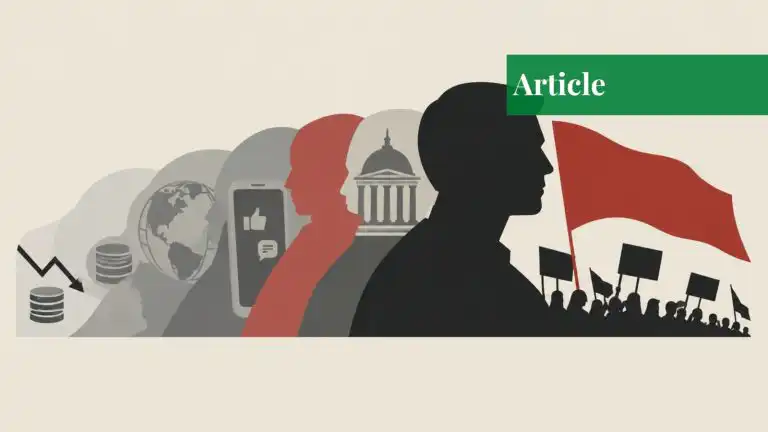
Both of these answers contain a kernel of something true, but neither one, taken alone, is patient enough with what actually happened. What seems closer to the truth is that liberalism’s expansion after the Cold War, tied as it was to globalization, to market integration, and to an increasing emphasis on the individual as the basic unit of social life, set off a chain of disruptions that unfolded over years rather than months.
These disruptions produced insecurity, of more than one kind, and this insecurity did not translate itself into politics automatically. It had to be translated. The right proved remarkably effective at doing so, turning a diffuse and often unnamed unease into a story about authority, about belonging, about a nation that had lost something and might still reclaim it. To understand how this translation took place, it helps to examine each layer of the process on its terms before considering how they ultimately fit together.
Tensions Within Globalization
Begin with the layer since it is the one most people reach for first and, for evenness and reason, the one most often flattened into a slogan. Globalization, whatever else can be said about it, did produce benefits. Trade expanded, supply chains grew more efficient, and globalization helped millions of people across parts of Asia move out of poverty within a single generation. That much is difficult to dispute. What is also difficult to dispute, though it received less attention at the time, is that these benefits were not distributed evenly and that certain regions, especially those built around manufacturing in wealthier countries, experienced a long and quiet decline while political leadership continued to speak about globalization’s advantages as though they were self-evident to everyone.
Then came 2007 and 2008, and whatever patience remained for this asymmetry began to run out. The financial crisis was not simply an economic event. It was also, and perhaps more importantly, a credibility event. People had been told that markets, left to manage themselves with a light regulatory touch, would produce stability and shared prosperity. What they saw instead was that the institutions responsible for managing risk had, in many cases, been the ones generating it. This is not a small thing to lose faith in. Once that faith cracks, it does not simply repair itself because a recovery eventually arrives on paper.
But the economic story, on its own, cannot carry the whole explanation, and it is worth pausing here rather than rushing past the point. Many of the people most drawn to right-wing populist movements are not among the economically worst off, and many communities that have suffered real economic decline have not turned toward the right at all. Something else is clearly operating alongside the economic disruption, and this is where questions of culture and identity enter the picture, not as a separate story running in parallel, but as another expression of the same underlying disturbance.
Migration, demographic change, and the gradual loosening of inherited social and religious norms have unsettled people’s sense of belonging in ways that resist easy measurement but are not, for that reason, any less real. What one person experiences as openness, as the world becomes more connected and more available, another person experiences as a loss of control over the place they call home. The right has been unusually skilled at taking this second kind of experience and giving it a narrative shape, one in which decline has an author, whether that author is an immigrant, a distant elite, or an international institution, and in which restoration becomes possible if only sovereignty can be reclaimed from whoever is said to have taken it.
A Psychoanalytical Explanation
Even so, something is still missing from this account, and it is the kind of gap that economics and cultural anxiety, on their own, tend to talk around rather than through. Why should insecurity express itself as a longing for authority in particular, rather than as a demand for reform, or for a different kind of redistribution, or simply as apathy? This is roughly where Erich Fromm becomes useful, not as an ornament borrowed from psychology to make the argument sound deeper than it is, but because his book Escape from Freedom is actually asking a version of the same question, only at the level of the individual rather than the nation.
Fromm’s basic observation is that modern liberal society, in releasing the individual from the older hierarchies that used to tell people who they were and where they belonged, does not automatically hand that individual a felt sense of security in return. Formal freedom and psychological freedom, in other words, are not the same thing, and the space between them can be wider than people expect. To be free, in this sense, is also to be alone in a particular way, since one is no longer embedded in a community whose meaning came pre-assembled. That aloneness can feel like liberation on a good day. On a harder day, it can feel like being exposed, standing in a world that no longer supplies automatic answers about who you are.
Fromm describes a few different ways people try to escape this exposure, and two of them matter here. One is authoritarianism, where the individual hands over judgment to a leader or a movement in exchange for a feeling of certainty and strength that the individual could not generate alone. The other is conformity, a quieter version of the same retreat, where a person simply dissolves into whatever the group expects rather than carrying the weight of deciding things independently.
It would be unfair and also inaccurate to conclude from this that everyone who votes for a right-wing party is secretly authoritarian, or psychologically unwell, or incapable of independent thought. Fromm is not offering a diagnosis of individuals. He is offering an explanation of a tendency, a reason why movements promising order, hierarchy, and belonging become more attractive at moments when the burden of individual autonomy starts to feel heavier than it once did, without claiming that this happens to everyone in the same way or to the same degree.
Freud enters the picture more briefly and more carefully, mainly through his thinking on identification and projection. Dissatisfaction that has no single clear cause tends, almost as a matter of psychological economy, to go looking for one. A political movement that can offer a believable enemy, an outsider group, a distant institution, an undefined elite, is doing something useful for people who are carrying anxiety they cannot otherwise locate. It gives the anxiety a shape and a direction.
This is not the same as saying that political behavior is simply the acting out of unconscious impulses, which is more than psychoanalysis was ever equipped to demonstrate. It is only to notice that identifying with a leader and displacing one’s frustrations onto a constructed opponent are old and well-documented patterns and that they help explain why certain political stories land emotionally in a way that a policy paper never quite manages to.
The “Reactionary International”
Donald Trump and Narendra Modi are useful examples here, though they need to be handled carefully, since it is tempting to collapse them into a single global phenomenon and that temptation should be resisted. Trump’s appeal rested heavily on a story of national decline, of a country that had been betrayed by its own elites and could be made great again if it simply reasserted itself. That story maps fairly closely onto the authoritarian and identificatory patterns described above.
Modi’s political project shares some surface features with this: its appeal to national restoration and its way of building a cultural other. It comes from a very different history. It’s shaped by Hindu organizing that began decades before Modi came along. Also, the connection between religion and the state in India is nothing like what exists in the case. What links the two is not a shared ideology. It’s more about a shared role. Each one, in its context, has found a way to turn deep structural and psychological insecurity into a coalition. That coalition is built around authority and a sense of belonging.
This brings us back to where we started. Is wing politics weakening liberalism? The honest answer sits somewhere between two extremes. Both of which are, in their own way, comforting. Liberalism hasn’t fallen apart. Its institutions, even if stretched thin, still shape life in much of the world.
Summation
What’s been revealed, though, is an assumption that always sat underneath the End of History idea. That assumption was that liberalism’s win wasn’t really something that had to be fought for and protected. Instead, it was seen as something inevitable. That assumption left liberal institutions unprepared for a set of demands their own success would eventually produce. Liberalism was never particularly well designed to supply belonging or collective meaning, having been built instead around individual rights and procedural fairness, and for a long stretch after the Cold War this limitation did not seem to matter very much. It matters now. What liberal democracies are facing is not really a rival ideology waiting in the wings to replace them, but something closer to an unmet need, arising from within their own societies, for the kind of security and recognition that liberal institutions have always found difficult to offer on their own terms.
If you want to submit your articles and/or research papers, please visit the Submissions page.
To stay updated with the latest jobs, CSS news, internships, scholarships, and current affairs articles, join our Community Forum!
Find our FREE quizzes and MCQs here!
The views and opinions expressed in this article/paper are the author’s own and do not necessarily reflect the editorial position of Paradigm Shift.