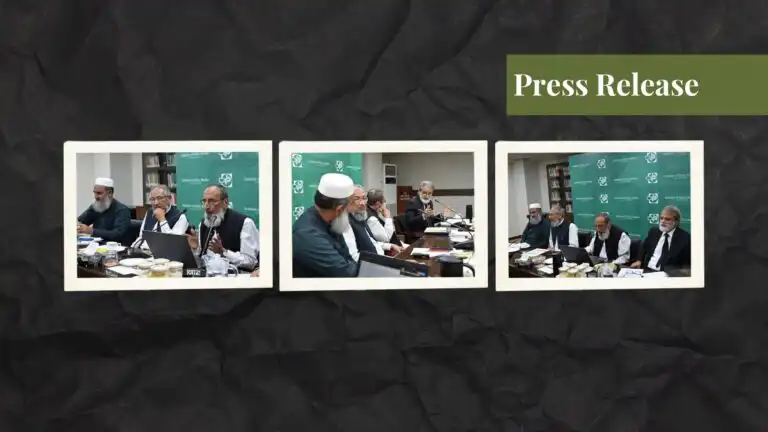
Islamabad, April 28: Urgent dedicated primary legislation, swift adoption of AAOIFI (Accounting and Auditing Organization for Islamic Financial Institutions) standards tailored to local financial context, and the establishment of a stronger Shariah-based governance framework are critical steps needed to ensure the sustainable and credible growth of Islamic banks and non-bank financial institutions in Pakistan. This requires coordinated efforts across the regulatory, legal, and institutional fronts, as no financial framework operates in isolation.
Leading financial and legal experts highlighted this at a session, “Towards a Shariah-based Islamic Finance Ecosystem in Pakistan,” held to discuss the legal framework for Islamic banks and non-bank financial institutions at the Institute of Policy Studies (IPS), Islamabad.

The discussion witnessed broad participation from the Securities and Exchange Commission of Pakistan (SECP), Islamic banks, academia, and legal professionals. The main speakers included Justice Dr. Syed Muhammad Anwer, aalim judge of the Federal Shariat Court; Tariq Naseem, head of the Islamic Finance Department at SECP; Tauseef ur Rahman, managing executive, SECP; and Dr. Muhammad Ayub, former director of Research and Training at Riphah Center of Islamic Business. The discussion was moderated by Dr. Atiquzzafar Khan, board member of IPS.
In a key presentation, Tariq Naseem elaborated on a proposed legal framework for non-bank financial institutions, noting that the sector’s growth remains stunted by the absence of a comprehensive and dedicated structure.
Dr. Ayub provided a comparative analysis of the Shariah governance frameworks issued by the State Bank of Pakistan (SBP). He highlighted how legal and regulatory gaps in Shariah-based governance have allowed compromises in Islamic banks’ operations, pointing to the urgent need for a systemic overhaul. Justice Dr. Syed Anwer underscored the need for a well-crafted legal framework that ensures both regulatory clarity and adherence to Shariah principles in the Islamic financial sector.
Building on these presentations, the speakers accentuated the distinction between Shariah-compliant and Shariah-based finance with a suggestion to move beyond surface-level compliance toward a truly ethical, holistic financial system grounded in Islamic principles. They also highlighted Pakistan’s untapped potential as a regional hub for Islamic finance, which is projected to grow to nearly $7 trillion globally by 2027.

The participants pointed out that as AAOIFI’s standards are developed through extensive consultation, these can be adopted by SBP and SECP, with necessary modifications to align with Pakistan’s capital and money markets. They also stressed the need for primary laws to regulate Islamic banks and non-bank financial institutions, as current regulations are largely based on secondary legislation.

The participants emphasized that the SBP and SECP should establish rigorous criteria and a selection mechanism for Shariah scholars with expertise in Islamic law and finance to strengthen the governance and legal framework for both banks and non-bank financial institutions. To ensure impartiality, the scholars should serve only one institution at a time, with appointments managed through a central pool. Besides, each fatwa or Shariah board decision should be clearly referenced to the sources of the Qur’an, Sunnah, or ijma. Additionally, the Federal Shariat Court could act as the adjudicator in cases involving conflicting Shariah opinions between institutions.
The session also paid tribute to the late Prof. Khurshid Ahmad, a distinguished scholar, reformer, and statesman, for his lifelong contributions to Islamic economics and finance, and included his reflections on the Islamic banking experience.
If you want to submit your articles and/or research papers, please visit the Submissions page.
To stay updated with the latest jobs, CSS news, internships, scholarships, and current affairs articles, join our Community Forum!
The views and opinions expressed in this article/paper are the author’s own and do not necessarily reflect the editorial position of Paradigm Shift.

The Institute of Policy Studies (IPS) is an autonomous, not-for-profit civil society organization dedicated to promoting policy-oriented research, dialogue, and human & technological development for better governance. IPS provides a forum for informed discussion and dialogue on national and international issues. The contributions spanning over forty-three years and the overall impact signifies the importance of pragmatic research on policy issues. The institute highlights the role of think tanks in modern democratic polities.