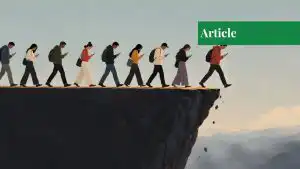
Social media has woven its way very deep into the fabric of our daily lives, transcending through mere entertainment or connection and carving out for itself a force that has long been shaping our thoughts, actions, and values. Scrolling, apparently benign, has become one of the iconic actions of the current digital age. Constantly supplied with endless feeds of curated content that keep us perpetually engaged is not just a symptom of distraction, but it’s doing a quiet job of rewiring our minds. This article will go into detail about the downside of social media and how the design of these platforms shapes our cognitive processes and emotional responses, changing how we learn, think, and remain focused.
Historical Parallel: Information’s Evolution
Johannes Gutenberg invented the printing press in the 15th century and it was an important transition moment in human history when knowledge, previously confined to the elite became accessible to the masses. Until the printing press, books had not been easier to copy; the labor of scribes in monastic or royal courts, therefore rare and expensive, was difficult to find. Very few could learn to read and write, and the wide dissemination of knowledge and ideas hardly left exclusive circles.
With the invention of the printing press, information began to spread like wildfire into the public domain. It could now, with great speed and cheapness, be put onto writing, and for all sorts of great cultural and social development, the Eastern and Western minds began to open up one to another. It set forth the Protestant Reformation, the Renaissance, and the Scientific Revolution because ideas could then be intellectualized and shared with a broader audience. This democratization of knowledge set the stage for Enlightenment thought, where John Locke, Voltaire, and other philosophers would critique traditional authority and promote reasoning in terms of individual rights and knowledge pursuit.
Although it granted development, the printing press also had its disadvantages. It allowed for disinformation and propaganda to spread quickly, as well as doctrines that were dangerous enough to incite trouble and swell credulity. The pamphlets and books that circulated during the Reformation incited religious wars as printed media were used by political movements to incite passions. While the printing press opened the door to information to a wide section of the audience, the ambivalent consequences were confusion, misinformation, and polarization.
This parallel is key to understanding the effects of social media in contemporary times. More than ever, the freedom to share and consume information on the internet is unparalleled, but there is an undermining catch. The newer printing press now affords a license to anyone with access to a smartphone or computer to announce their ideas to a global audience. The question we must ask is this: are we headed for enlightenment or chaos?
The same technologies making knowledge possible are also busy delivering misinformation. Are we, like the thinkers of the Enlightenment, sharpening our view of the world, or are we drowning in triviality and unable to focus on today’s complex, nuanced issues? As the printing press offered access to both knowledge and chaos, almost distinguishably paving the way for sharpened minds since then, so has social media played a double-edged sword over our minds that people have to practice navigational skills to survive.
Neuroscience of Scrolling: The Dopamine Trap
To fully understand social media addiction, we must first delve into how the brain’s reward system operates across the spectrum, with a huge focus on dopamine. Dopamine is the chemical that fits into the neurotransmitter family and plays a huge role in motivation, pleasure, learning, and decision-making. It is also called the “feel-good” chemical because whenever something pleasurable or rewarding is experienced, it sends a dopamine signal through the central nervous system. Examples include eating a favorite food or getting all the praise for a job well done.
Dopamine then reinforces the behavior and thus helps to imprint it in memory and learn to repeat in the future. Dopamine is part of a broader circuitry within the human brain that comprises the mesolimbic dopamine pathway with the ventral tegmental area (VTA) and nucleus accumbens. These two areas usually respond whenever a rewarding stimulus is encountered.
Now, let’s take a look at social media. Unlike other forms of reward, the dopamine hit that social media gives is sporadic and rapid. Every time we like something, comment, share, or a new post shows up while scrolling down our feeds, the brain releases dopamine. This gives you a small, delightful burst of pleasure. This release is, in essence, similar to other rewarding situations, say eating a chocolate bar or realizing that you’ve achieved a goal quietly set in your mind. The defining difference is their frequency and randomness of delivering dopamine hits.
Social media fosters a “variable reward,” where neuroscientists connect a high and unguaranteed amount of pleasure to each notification or reward that we see. This variability heightens the truism that social media is, by its very nature, addictive. It is like gambling; though we do not know when the next reward will drop in, betting on it becomes a repetitive affectation. Each post, like, or notification suggests the prospect of a bigger reward, which makes it increasingly hard to stop scrolling. Such anticipatory reward-and-expectation loops favor addiction. As we scroll and as we interact with content, dopamine hits trigger our brain, conditioning the behavior and thus allowing the thrill of anticipation to go on.

But the addictive power of social media goes beyond just liking and commenting on pictures; it also greatly affects cognition. As we are bombarded with feedback in the form of constant notifications and micro-rewards, we start exhausting our executive-level abilities. Loss of the prefrontal cortex causes processes such as prudent planning, impulse control, and sustained attention to fail. The brain then becomes inept at conducting complex functions that govern cognition, something it could once do with great ease and it finds difficulty in engaging in deeper planning.
Instead, the mind absorbs inputs by competing for immediate responses that foster efficiency and time alongside superficial engagement. This urge forces long-term planning, problem-solving, and deep reflection out of the making. Therefore, it begins to feel increasingly difficult to perform tasks like reading long articles or working on a project setup, while scrolling through tweets or video feeds seems effortless and keeps one’s attention.
This cycle of addiction and cognitive decline is what some neuroscientists refer to as “brain rot.” The more the brain comes to depend on the instant gratification provided by social media, the less able it is to engage in activities that require deep and sustained cognitive attention. This reworking of brain function could carry on into the future, especially as our society of technologies increasingly focuses attention and engagement around the principles of short-term engagement over deep and focused thought.
It is pertinent to focus on how the neuroscience of dopamine and how social media manipulates this entire system and gives depth to our understanding of the supposed adverse effects of these platforms on our minds.
Micro-concentration vs. Macro-focus: A Creative Crisis
Social media has created micro-concentration among users; they can now concentrate on small, bite-sized content and multi-field information with constant distraction. This is easily acknowledged from the immense viewership of short-form content on TikTok or Instagram; videos take mere seconds, and stories last only fragmented moments and disappear in 24 hours. Whether this format of content consumption has enabled us to process information faster and absorb it only on the surface level, it has somewhat compromised our ability to get involved in deeper, complex, and sustained ideas.

In the past, literature and art demanded macro-focus, the capacity to concentrate for lengthy periods on a single piece of work. Writers such as Dostoevsky and Tolstoy wove dense, richly developed novels demanding great patience on the part of their readers, with each page offering an unending series of penetrating insights and rich inner life for characters. Artists like Van Gogh and Picasso poured in hours into each piece, revealing not merely through their work their creative vision but their journey with the process.
Rather than sleek, superficial instant gratifications, their works call for long meditation, reflection, and emotional engagement. The other side of the issue is that social media presents content in small, attenuated doses: ambling video vignettes, headline news, and memes without a second for pause and reflection. Attaining sustained attention on complex ideas or in lengthy works feels much more challenging now.
All this change is not simply about preference or lifestyle; it’s a razor into the deeper erosion of our human capacity to engage information fully. As the micro-concentration sets in, our brains have now become accustomed to skipping quickly from one point of focus to another and this intense focus has little room for that which would allow us to understand and appreciate the “big picture.” Creativity cannot bloom without macro-focus. Hence, writing, art, and thinking do have a great difficulty with the sustainment of deep focus on producing meaningful long stories in almost every line of learning.
Instead of working on novels or forming large theories, we are constantly ingesting small bits and fragments of content and insight, often erasing the trail of more concentrated meaning in the process. This also has larger cultural implications, as the thought process of complex narratives dissipates, leading up to the practices of our critical capacity to process extended arguments we are used to making. The macro picture, be it in painting, philosophical discourse, or political conversation, melts away amidst bombardments of novelty signals excusing us from critical focus on complex subjects.
Attention as Currency: The Ethics of Exploiting Focus
In this digital age, attention has turned into the most valuable currency. Our attention is no longer a personal resource within this transactional world, but rather a commodity traded for profit. There is a paradox; the more we consume, the less we actually own. The longer our focus stays on these platforms, the more our capacity for sustained, meaningful attention is reduced. Rather than participating in thoughtful reflection or spending time on work requiring deep focus, we tend to fragment our attention into brief bursts while chasing the next notification or piece of content.

This raises difficult ethical questions. Is it ethical for companies to make profits from having us lose focus, plucking their economic resources from our natural cognitive instincts, thus making us easier to manipulate? Social media platforms are intentionally schemed to target the neurological processes that give rise to our continued engagement and gratification, often at the cost of our mental welfare. If attention is the most valued resource we have, what happens when that’s packaged and sold to the highest bidder, hijacking our own concentration for profit? These questions invite consideration of the ethics of attention in the digital age and how that weighs against the cost of convenience and our most essential mental resources.
Conclusion
In a world where attention has become an increasingly prized commodity, social media is shaping how we consume information and transforming our thinking, our very feelings, and our connections with one another. The dopamine-driven cycles of instant gratification encourage shallow engagement, which suppresses deep and sustained focus.
For this reason, the similarities that we can draw between the advent of the printing press and social media chronicle both auspicious pathways toward enlightenment and dismal outcomes propagating misinformation. Just like the chaos unleashed by the printing press over the revolution brought about through access to knowledge, social media also allows for a more democratized flow of information, dubious at heart to induce emotional stimuli rather than intellectual propensities from its users. The paradox begs the question as to whether we really become any more informed or just more distractive.
The ethics of commodifying attention is a dilemma we must deal with. In the world of modernity, we should confront the status quo by questioning the ethics of platforms profiting from our devoured attention; also, poised to reclaim our agency in how we engage with the world ourselves.
Indeed, the digital revolution offers a potential never before known for our connection and creative growth if we indeed are intentional about the way we direct our mental energies. Understanding how social media hijacks our mindsets returns us to wellness, switching gears toward the deeper and away from the fleeting and quick. Reclaiming our attention is not only an individualized endeavor, but a collective obligation should we indeed wish to safeguard mental clarity, creativity, and critical thinking that allow the minds today to prosper.
If you want to submit your articles, research papers, and book reviews, please check the Submissions page.
The views and opinions expressed in this article/paper are the author’s own and do not necessarily reflect the editorial position of Paradigm Shift.

Momina Areej is currently pursuing an MPhil in Clinical Pharmacy Practice. With a passion for writing, she covers diverse topics including world issues, literature reviews, and poetry, bringing insightful perspectives to each subject. Her writing blends critical analysis with creative expression, reflecting her broad interests and academic background.