

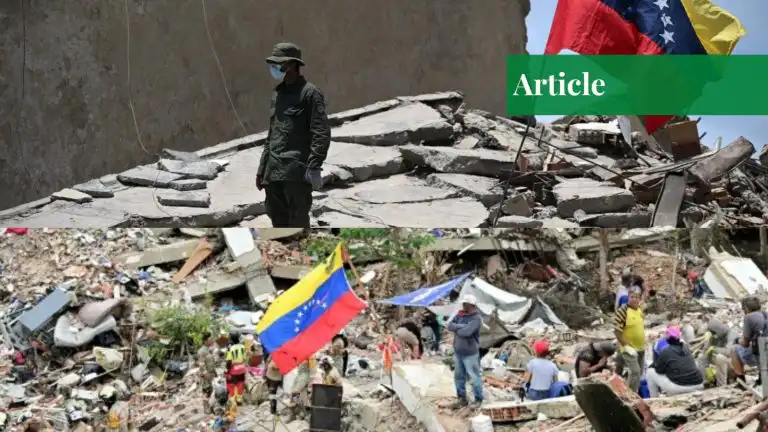
Caracas, the capital of Venezuela, was badly affected by recent earthquakes that caused widespread damage to its poor infrastructure. The two powerful earthquakes struck one after another, measuring magnitudes 7.2 and 7.5, leading to major destruction of homes, hospitals, and infrastructure. The seriousness of the disasters soon became visible. According to Al Jazeera, the death toll rose from 164 to 235 within 72 hours after the disaster, and more than 4,300 people were injured. The Venezuelan information ministry has reported more than 3,300 casualties and 16,470 injured so far. The twin earthquakes have not only destroyed lives but also left more than 17,000 people homeless.
The US Geological Survey estimates the death toll could increase drastically, and the worst possible outcome could exceed 10,000. However, the scale of a disaster cannot be measured by magnitude alone; other parameters contribute to its damage. The city of Caracas lies in a deep sedimentary basin. Its soft soil increases the intensity of earthquake shaking.
Geological Vulnerability and Seismic Risk
Caracas’s geology is one of the major factors that increase its earthquake risk. Weak soil weakens the infrastructure because it does not absorb the seismic energy completely. Unlike hard soil, it strengthens the waves and increases the duration of an earthquake’s vibration. As a result, it puts densely populated areas and high-rise buildings at high risk. Another reason for the high destruction is the shallow depth of the earthquake.
The earthquakes that originate closer to the surface generate more energy on the surface than other quakes. In the case of Venezuela, the nature of these earthquakes caused greater destruction of infrastructure, roads, and public facilities. The occurrence of two immediate high-intensity earthquakes worsened the situation, making the vulnerability more severe. This led to the collapse of many buildings that had survived less intense earthquakes.
Fragile Infrastructure and Poor Urban Housing
Weak and inadequate infrastructure is one of the primary causes of the intense damage to the city. Venezuela experiences major building-safety issues. A large number of structures were built before modern seismic standards were introduced, and many have never been properly retrofitted. Moreover, informal settlements in certain areas have houses made with weak and low-cost materials that cannot withstand earthquakes. This informal infrastructure is at greater risk because it is located on hillsides or weak ground. The infrastructure of these neighborhoods also makes rescue operations difficult. The collapse of infrastructure and landslides block the roads, which then block the emergency routes. This condition makes recovery harder. As a result, residents can be trapped, and emergency rescue may be delayed.
A clear evidence of the weak infrastructure was the collapse of a 22-story building in Altamira. The area was reported as one of the hardest-hit districts of Venezuela. Rescue operators and emergency crews are continuing their search for trapped people, pulling survivors from the rubble while relatives search for missing family members. More than 50,000 people have been reported missing, particularly in the city of La Guaira on the Caribbean coast, where Caracas’s international airport is located.
Lack of Funding and Infrastructure Gaps
The lack of funding is the main contributing factor to the weak infrastructure and poor disaster preparedness in Venezuela. Long-term underdevelopment has weakened the infrastructure and made Venezuela vulnerable to natural disasters like earthquakes. The poor investment in infrastructure and disaster management has increased the risk of damage and casualties, according to Al Jazeera. Hence, the lack of public spending largely impacts hospitals, institutions, schools, and the electricity system, which further reduces the city’s capacity to respond to disasters.
As per the satellite-based Rapid Digital Assessment (RAPIDA) by the United Nations Development Programme (UNDP), the estimated 6.7 billion dollars in physical damage is equal to 6 percent of the GDP of Venezuela. Additionally, good infrastructure is not enough for disaster management; working hospitals, safe roads, reliable communication, and proper planning are necessary to ensure safety, provide effective management of natural disasters, and avoid construction in hazard-prone areas. After the earthquakes, the healthcare system has been severely affected in Venezuela. Reports showed that one of Caracas’s main trauma hospitals has partly collapsed, and in Guaira, two of the three public hospitals are unable to function, while the remaining one is under pressure to handle a large number of injured people.
The Legacy of Seismic Hazards
Caracas has a historical record of seismic damage. According to USGS estimates, the 1812 earthquake caused widespread destruction and claimed nearly 30,000 lives. Another major earthquake struck in 1967, causing significant damage to high-rise buildings and claiming 240 lives. Venezuela is located near the boundaries of the Caribbean and South American tectonic plates, making it highly vulnerable to earthquakes for centuries. The natural hazard threat is well known, but many people have lived in unsafe areas and at high risk for a long time.
Why Some Countries Suffer Less Damage
Japan provides a good example. Like Venezuela, Japan lies near tectonic plates and experiences frequent earthquakes. However, long-term investment in seismic engineering, retrofitting, and public education has saved many lives. Infrastructure, such as modern buildings in Japan, is designed to absorb seismic motion instead of collapsing. Japan shows that preparedness can reduce the impacts of earthquakes. With strong funding, good planning, and public disaster awareness, they suffer less damage. Venezuela reflects the other side of the coin, demonstrating that limited preparation and less effective policies have caused great disasters.
Building a Safer Caracas
The city of Caracas requires real improvement, not just shallow policies. After the disaster, many engineers found that the weak construction methods used in collapsed buildings and public infrastructure lacked earthquake-resistant materials, such as unreinforced masonry and “soft-story” ground floors, exactly the types of structures that tend to pancake in strong shaking, leading to total structural failure. Strengthening this building with steel frames and shear walls can enhance longevity, provide protection, and reduce fatalities in the future from natural disasters. These methods are approved, successful, and used by countries such as Chile and Mexico. Moreover, a strong infrastructure combined with early warning systems and evacuation exercises can greatly reduce future risk and casualties.
If you want to submit your articles and/or research papers, please visit the Submissions page.
To stay updated with the latest jobs, CSS news, internships, scholarships, and current affairs articles, join our Community Forum!
The views and opinions expressed in this article/paper are the author’s own and do not necessarily reflect the editorial position of Paradigm Shift.
Mahnoor Gujjar is a student of English literature and linguistics at the National University of Modern Languages (NUML), Hyderabad Campus.