The Alaska Summit
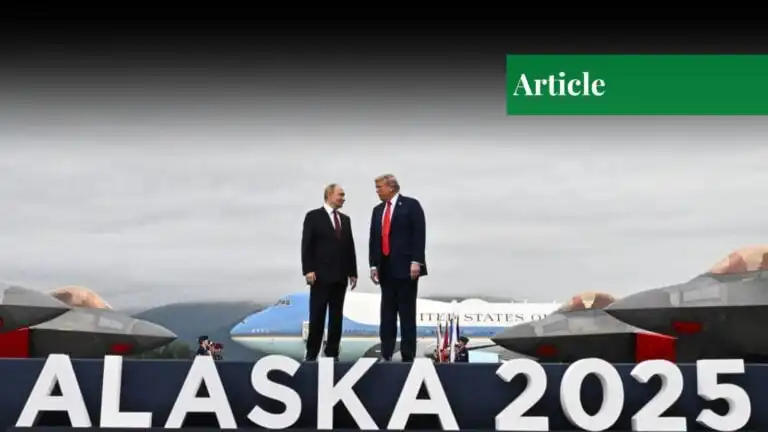
The Alaska Summit between US President Donald Trump and Russian President Vladimir Putin promised a breakthrough in ending the war in Ukraine. What it delivered instead was a spectacle: red carpets, handshakes, photographs, and smiles, but no ceasefire and no concrete agreements.
Putin received a red carpet welcome at Joint Base Elmendorf-Richardson. This marked his first step on Western soil since the 2022 invasion of Ukraine. Trump greeted him warmly and even offered a ride in the presidential limousine. For Russia, this display of cordiality constituted a “diplomatic win,” projecting the image of a normalized relationship despite ongoing conflict.
Yet, behind the display, substance was scarce. The summit, which was expected to last seven hours, was wrapped up in under three hours. The leaders gave brief, scripted statements and refused questions from journalists. Putin spoke first, emphasizing a “constructive atmosphere.” He reiterated that the “root causes” of the conflict must be resolved before peace can be achieved. These causes include Ukrainian neutrality, demilitarization, and recognition of Russian control over contested territories. He said:
“We are close neighbors, and it’s a fact. We expect that Kyiv and European capitals will perceive that constructively and that they won’t throw a wrench in the works…”
In practice, these are maximalist preconditions, amounting to a near-complete capitulation for Kyiv. Reports also suggest that Putin sought Ukraine’s withdrawal from the entire Donetsk region as a condition to end the war.
The Outcome
Trump aligned with Putin in backing a comprehensive peace deal rather than the urgent ceasefire sought by Ukraine. Speaking after the meeting, Trump said President Zelenskyy will meet him in the Oval Office and that, “if it all works out,” he will then schedule talks with Putin. The emphasis was on a direct peace deal rather than a temporary ceasefire.
The optics of Alaska are instructive. Experts argue that the summit may have emboldened Putin by demonstrating US deference and exposing divisions within the Western alliance. Orysia Lutsevych observes that the meeting shifted pressure onto Ukraine and its allies rather than extracting concessions from Moscow.
Trump’s own statements were equally vague. He praised the “very productive meeting,” claiming, “There were many, many points that we agreed on. Most of them, I would say. A couple of big ones that we haven’t quite gotten there on, but we’ve made some headway… So there is no deal until there is a deal.”
His only concrete reference to Ukraine was a note on the staggering human toll, followed by an acknowledgment. He said:
“Gotta make a deal. Yeah. Look, Russia is a very big power, and they’re not. They’re great soldiers… Now, it’s really up to President Zelenskyy to get it done. And if they’d like, I’ll be at that next meeting.”
Meanwhile, these optics were not the only dimension of the summit. Putin highlighted potential US-Russia cooperation in tech, space, and Arctic ventures, which signal Moscow’s broader ambitions. Despite Trump’s insistence that trade discussions would follow progress on a ceasefire, these economic overtures underscored the risk of diplomacy being overshadowed by optics and transactional positioning.
Reactions to the Summit
Equally important were the reactions from Ukraine and Europe. Trump frames Zelenskyy as bearing the responsibility of negotiating a deal. He treated the process as trilateral between the US, Ukraine, and Russia. Zelenskyy confirmed he is “ready for constructive cooperation” and emphasized the importance of European involvement to ensure “reliable security guarantees.” He also warned that Russia may intensify attacks in the coming days to gain leverage.
However, European leaders reaffirmed support for Ukraine. They stress ironclad security guarantees, no Russian veto over EU/NATO membership, and rejection of any changes to borders by force. They also endorsed stronger sanctions on Russia and the potential for a Trump-Zelenskyy-European trilateral summit. Ahead of Zelenskyy’s Washington visit, leaders of the “coalition of the willing,” including Emmanuel Macron, Friedrich Merz, and Keir Starmer, plan a video conference to coordinate strategy.
The Recent Trump-Zelenskyy Meeting
Alaska illustrates a central truth of contemporary geopolitics: optics often matter as much as outcomes. However, now that the long-awaited Washington meeting between Trump and Zalensky took place on 18th August, 2025, it offered a sharper contrast to the stage-managed theater of Alaska.
In Washington, Zelenskyy arrived with a clearer diplomatic posture, flanked by European leaders who underscored their commitment to Ukraine’s defense. Inside the Oval Office, discussions centered on security guarantees and long-term defense cooperation. At a press conference following the meeting, Zelenskyy confirmed “productive and detailed” talks with Trump and stressed that Europe and the United States must act as one in defending Ukraine.
The most striking outcome was the announcement of a planned U.S. weapons package worth nearly $90 billion which included advanced aircraft, air-defense systems, and cooperation on drone technology. This signaled Washington’s readiness to move from symbolic gestures to material commitments. Trump, however, was careful to note that American involvement would remain tied to a broader allied effort rather than unilateral action.
Additionally, security guarantees dominated the conversation. Zelenskyy insisted that Ukraine could not accept vague assurances. Instead, it required enforceable commitments backed by Europe and the US. Trump echoed the need for credible guarantees, even though his phrasing left the details deliberately flexible.
Majorly, the question of a trilateral summit with Putin lingered in the background. Trump expressed openness and framed it as a logical “next step.” But Moscow’s resistance means such a meeting remains hypothetical and Trump’s next step will end up being a vague promise.
Conclusion
On one hand, Alaska demonstrated the emptiness of optics without substance. The Washington talks brought a stronger sense of substance than Alaska. On the positive side, Ukraine secured a commitment to a massive U.S. defense package and demonstrated a unified Western stance on its security. Yet, glaring gaps remain. No ceasefire was achieved. No peace framework was drafted. Security guarantees are also still largely unenforceable commitments on paper rather than binding treaty obligations.
Russia has flatly rejected participation in a trilateral summit, leaving diplomacy stalled at the very point where progress matters most. For Ukraine, the stakes are nothing less than survival. For Trump, the challenge is clear: can Washington’s promises, of weapons, guarantees, and allied unity, be turned into action?
Until then, diplomacy remains suspended between theater and war.
If you want to submit your articles and/or research papers, please visit the Submissions page.
To stay updated with the latest jobs, CSS news, internships, scholarships, and current affairs articles, join our Community Forum!
The views and opinions expressed in this article/paper are the author’s own and do not necessarily reflect the editorial position of Paradigm Shift.

Noor ul Sabah is a researcher focused on intersectional approaches to gender, governance, and technology. Her work explores how power and identity shape experiences of violence, migration, and citizenship.