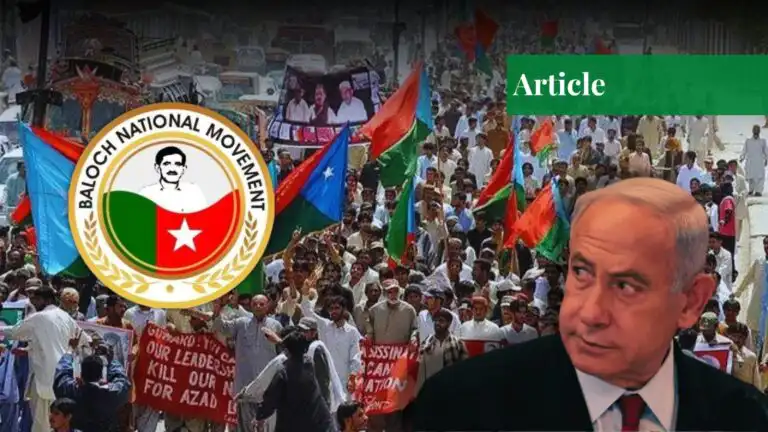
The Baloch National Movement, which is long-rooted in calls for political autonomy, cultural recognition, and equitable development, is re-emerging with renewed visibility on the international stage. But this resurgence is no longer purely internal. External forces, most notably Israel, are beginning to engage with Baloch political narratives in ways that raise important questions.
As Iran’s regional position grows more precarious, actors such as Israel are recalibrating their strategies. In this process, they are seeking influence through historically marginalized groups at Iran’s periphery. Among them are the Baloch people.
This article explores the growing ties between the Baloch struggle and Israel’s regional goals. It raises critical questions about agency, morality, and the risks of foreign alignments for the credibility and direction of the movement.
Resistance and New Alignments
The Baloch population is over 56 million, which is distributed across Pakistan, Iran, and Afghanistan. In both Iran and Pakistan, Baloch territories are rich in natural resources but plagued by poverty, political exclusion, and cultural suppression.
In Iran, most Baloch live in the Sistan and Baluchestan provinces. This region has some of the country’s worst socioeconomic indicators. Although armed resistance in Iran has been sporadic, this region is heavily securitized, and advocacy for local rights has taken various forms. In recent years, Baloch diaspora organizations have become more vocal in seeking international engagement.
Groups like the Free Balochistan Movement (FBM) promote a vision of a democratic, secular, and independent Balochistan. They emphasize human rights and political participation, though their strategies and affiliations remain a topic of debate. One of the most consequential alignments emerging today is with Israel.
Since the 1979 Iranian Revolution, Israel and Iran have maintained an adversarial relationship that is characterized by diplomatic isolation and strategic confrontation. As part of its regional approach, Israel has sought to build ties with Iran’s internal minorities like Kurds, Ahwazi Arabs, and increasingly, the Baloch. This tactic reflects a broader effort to shape regional dynamics..
On June 12, 2025, the Middle East Media Research Institute (MEMRI) launched the Balochistan Studies Project (BSP). MEMRI was founded by former Israeli intelligence officials. The project emphasized the strategic value of Balochistan’s geography and natural resources. It framed the region as a key outpost to check Iranian ambitions and even Pakistani influence.
In the same week, the FBM welcomed Israeli military strikes on Iranian nuclear and military targets, calling them “encouraging” signs for Baloch aspirations. FBM spokespeople described it as a “rare and significant opportunity” for independence and called for unity among Baloch leaders to position themselves politically for statehood.
Ethics and Risks of Strategic Alignment
By asserting that, FBM has framed its alignment in terms of shared interests with states critical of Iran and Pakistan. From a strategy point of view, this engagement with Israel may seem like a smart move. It could bring international attention, possible material or intelligence support, and maybe even a place at the global negotiating table. It might attract attention in Western policy circles that are already critical of Iran’s regional behavior.
But this logic is full of contradictions. This kind of alliance comes with serious risks. Israel claims to support oppressed minorities. Yet, its policies in Palestinian territories, such as settlement expansion and military operations, have drawn widespread international concern. For any movement built on principles of political justice and equality, forming an alliance with Israel carries serious ethical and strategic challenges.
Moreover, there is another danger. If the Baloch struggle becomes too closely tied to Israel or India, it could lose support from other resistance movements in the Global South. So, aligning with highly politicized states may alienate natural allies. Groups fighting for Palestinian freedom, Kurdish autonomy, and Kashmiri rights often see themselves as a part of a shared fight against governance-related marginalization. So, aligning with their opponents in the name of expediency undermines broad-based solidarity networks.
Thus, the FBM’s credibility may be challenged if Israel becomes its most vocal international supporter. While FBM’s Democratic Transition Plan and Liberation Charter show political maturity, their institutional vision could be overshadowed. This is especially true if figures like Mir Yar Baloch are promoted mainly by foreign think tanks like MEMRI, rather than through grassroots networks.
This leads to an important question: Is the Baloch struggle being led by the people of Balochistan, or is it being shaped by outside powers with different strategic interests and agendas?
Toward a Post-geopolitical Solidarity
In response to these challenges, the FBM has proposed a post-geopolitical approach. This means building unity among oppressed peoples and reclaiming control over their own narrative. It also requires rejecting external influence, whether driven by strategic or institutional agendas, and instead aligning with struggles rooted in justice, land, and lived experience.
A powerful example of this grounded vision comes from women-led protests in Gwadar. These protests focus on local issues like resource theft, displacement, and militarization. They reflect the real concerns of the people and are not driven by regional power rivalries. Scholars writing on platforms like Jamhoor have also emphasized the need to take back the moral language of the Baloch struggle from foreign policy actors.
Conclusion
However, the Free Balochistan Movement recently stated, “Such historic moments do not recur frequently in the region.” That may be true. Iran is isolated on the international stage. Pakistan is facing internal instability, and regional alliances are shifting fast. Nevertheless, the real question is not whether this is a strategic opening, but what kind of opening it is.
Aligning with Israel may bring short-term benefits. It could increase visibility, attract international attention, and offer material support. But these gains come with serious long-term costs. The Baloch movement risks losing regional support, becoming reliant on external actors, and weakening its internal consensus.
Israel’s interest in the Baloch cause is not based on solidarity. It is driven by strategy. And mistaking tactical interest for lasting support is a risk many movements have faced. To avoid that fate, Baloch leaders must strengthen internal unity. They must build from the ground up, not from the outside in. They also need to speak clearly about their goals and avoid becoming overly dependent on external agendas.
In the end, the choice is clear. Either the Baloch people shape their own future, or others will shape it for them. Their success depends on political maturity, internal cohesion, and a clear vision grounded in principle rather than power.
If you want to submit your articles and/or research papers, please visit the Submissions page.
To stay updated with the latest jobs, CSS news, internships, scholarships, and current affairs articles, join our Community Forum!
The views and opinions expressed in this article/paper are the author’s own and do not necessarily reflect the editorial position of Paradigm Shift.

Noor ul Sabah is a researcher focused on intersectional approaches to gender, governance, and technology. Her work explores how power and identity shape experiences of violence, migration, and citizenship.